Founding year: the first Thorntown post office (Blevins & Helbock, CC0).The full story ↓
History grade
What drives Thorntown’s History grade
On its age, its old homes and the National Register, Thorntown is more historic than 88% of U.S. towns. All 3 inputs are above most U.S. towns; its share of homes from before 1940 ranks highest and its National Register listings lowest.
A
HistoryA character grade: shown, never part of Thorntown’s overall grade.
Indiana towns list more on the Register than most of the country (a typical Indiana town has 7.9 per 10,000 residents, the U.S. 2.4), so Thorntown’s 8.3 sits near the middle of its state (60% of Indiana towns have fewer) while its 1 listings outnumber those of 51% of U.S. towns.
How sure. Graded on any two of the three inputs instead, the letter would range from B+ to A. The pre-1940 share is a Census survey estimate (±7.3 points). The founding year is the first post office, not a stated founding date.
Founding year: the first post office (other dates in Quick answers). Homes: Census ACS 2020–24. National Register: National Park Service, May 2026 list; each listing counted once (boundary changes and added documentation belong to their listing), and a historic district counts its contributing buildings. How TownRatings grades history →
What stands out about Thorntown’s past
Read from the archive, the National Register and the record. The page puts what stands out first.
The first permanent settlement at Thorntown was made in 1827 when a man named George Harness established a trading post in the area. Thorntown was officially founded by Cornelius Westfall, who platted the town on April 10, 1830. A post office was established at Thorntown the same year. Thorntown is the English translation for the name of a former Native American village located there.
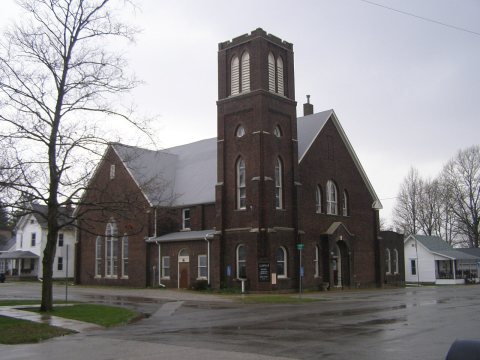
The Thorntown Public Library was listed on the National Register of Historic Places in 1986.
Passages that mention Thorntown, cut from the printed page as they were published.
History of Boone County, Indiana1914 · page 520Read the page →
Read the text
post office was opened at the house of William Kenworthy, east of Thorntown, in 1832. Robert Hamill was the first postmaster proper in Thorntown [certificate of appointment]. The first school teacher in Thorntown was Jefferson Hillis. The first hotel was kept by Isaac Morgan, the next by David Daily. This hotel was a double log house, which stood where the old Brown Academy was afterwards built.
Text read by machine from the scan; it may contain errors.
History of Boone County, Indiana1914 · page 93Read the page →
Read the text
Pike's Crossing is located where the Thorntown and Strawtown road crosses the Lebanon and Frankfort road. 'It has a postoffice, store, blacksmith shop and several fine residences. In the fall of 1831, Enoch Davis laid out a town in the southwest quarter of section 31 where the Indianapolis and Lafayette state road crosses the Thorntown and Strawtown road with a spirit of opposition to the young Thorntown on the banks of Sugar and Prairie creeks.
Text read by machine from the scan; it may contain errors.
Scans and text from the Internet Archive. Books published in 1930 or earlier, which are in the public domain.
The Thorntown post office opened in 1830, the earliest record of the town by name (U.S. post office records).
How does Thorntown rank for history?
Thorntown is more historic than 88% of U.S. towns. The History grade combines the town’s founding era, the share of homes built before 1940 and its National Register listings. It’s a character grade, so it isn’t part of the overall grade. How it works.
What is on the National Register in Thorntown?
One place: the Thorntown Public Library (listed 1986).
How old are the homes in Thorntown?
43% of Thorntown’s homes were built before 1940 (Census estimate, ±7.3 points), against a typical 14% for an Indiana town; the median home was built in 1950.
Founding dates: Wikidata, Wikipedia, the U.S. post office records of Blevins & Helbock (CC0) and the Census. Homes by year built: Census ACS 2020–24. National Register of Historic Places: National Park Service (list of May 22, 2026). Old photos, postcards and papers: Wikimedia Commons, the Library of Congress and other public archives, credited on each item’s page. Maps: U.S. Geological Survey historical topographic maps (via Esri) and Sanborn fire-insurance maps (Library of Congress). History text and census tables: Wikipedia (CC BY-SA 4.0). Places that used to be: USGS Geographic Names Information System (2021).
From Wikimedia Commons (5), the National Register of Historic Places (1), Wikipedia, Wikidata and Wikipedia for famous people, U.S. Geological Survey historical maps, U.S. Census counts (via Wikipedia), the US Post Offices dataset (Blevins & Helbock), the USGS Geographic Names Information System and old county and town histories (Internet Archive). Archive images are copied here with their credits and licenses, shown on each photo’s page. Refreshed monthly.


 2015
 2015
 2015
 2011
 2009


