On its age, its old homes and the National Register, Southport is more historic than 49% of U.S. towns. Its share of homes from before 1940 holds the grade up; its National Register listings pull it down.
B−
HistoryA character grade: shown, never part of Southport’s overall grade.
Indiana towns list more on the Register than most of the country (a typical Indiana town has 7.9 per 10,000 residents, the U.S. 2.4), so Southport’s 0.0 sits below most of its state (22% of Indiana towns have fewer) while its 0 listings outnumber those of 23% of U.S. towns.
How sure. Graded on two of the three inputs, so a change in either one moves the letter more than it would with three. The pre-1940 share is a Census survey estimate (±9.2 points).
Founding year: our sources. Homes: Census ACS 2020–24. National Register: National Park Service, May 2026 list; each listing counted once (boundary changes and added documentation belong to their listing), and a historic district counts its contributing buildings. How TownRatings grades history →
What stands out about Southport’s past
Read from the archive, the National Register and the record. The page puts what stands out first.
The area that is now known as Southport was a wooded area until the first European American settlers arrived in the 1820s. Early settlers included Jacob Smock and Randall Litzey in 1822, Samuel Brewer in 1823, Benjamin McFarland in 1826, and Samuel and Mary Bryan in 1828. Mary Bryan is remembered as one of the first European American women to cross the Cumberland Mountains. By 1828 Southport was a stagecoach stop on the Madison–Indianapolis road. Southport claims it was founded in 1832. The town was platted in 1852.
Passages that mention Southport, cut from the printed page as they were published.
History of Indianapolis and Marion County, Indiana1884 · page 589Read the page →
Read the text
The first settler at what is now the village of Southport was Jacob Smock, who came from Mercer County, Ky., in 1823, and bought land immediately north of the present town. In the same year, Samuel Brewer came, and bought eighty acres of his present farm, then returned to Kentucky, married, and came back to Perry in 1824. The first building erected within the limits of the present village was
Text read by machine from the scan; it may contain errors.
History of Indianapolis and Marion County, Indiana1884 · page 578Read the page →
Read the text
brother Jacob, west of James, on the Shelbyville pike, northeast of Southport ; Thomas Bryant, just west of Jacob Turner, on the south side of the Shelbyville pike, directly north of Southport ; John Brewer, with his family, about half a mile east of Southport ; Andrew Mann, on Buck Creek, south side, next to Franklin township ; Stephen Hankins, with his family, half a mile east of the Madison road, north side of
Text read by machine from the scan; it may contain errors.
History of Boothbay, Southport and Boothbay Harbor, Maine. 1623-1905. With family genealogies1906 · page 199Read the page →
Read the text
ciated themselves together for tlie purpose of " building a meeting house that shall be more convenient and upon more modern plans," at the same time mentioning that "the meetinghouse in the town of Southport is much impaired by time, and the pews uncomfortable to sit upon, and the house quite ancient in its structure." The first meeting was held February 4, 1864. The organization was perfected and a building committee selected. On February 18th by-laws were adopted and a
Text read by machine from the scan; it may contain errors.
Annals of Southport and district. A chronological history of North Meols, A.D. 1086 to 18861888 · page 133Read the page →
Read the text
December 29th. Terrific snowstorm. A train from Southport to Liverpool snowed up quarter of a mile beyond Birkdale Station. The engine was uncoupled, and forced its way about a mile, and then returned for the carriages, but could not get within ten yards of the train it had left only a few minutes earlier. Information was conveyed to the Southport station-master, and he despatched another engine, but that was brought to a
Text read by machine from the scan; it may contain errors.
Scans and text from the Internet Archive. Books published in 1930 or earlier, which are in the public domain.
Timeline
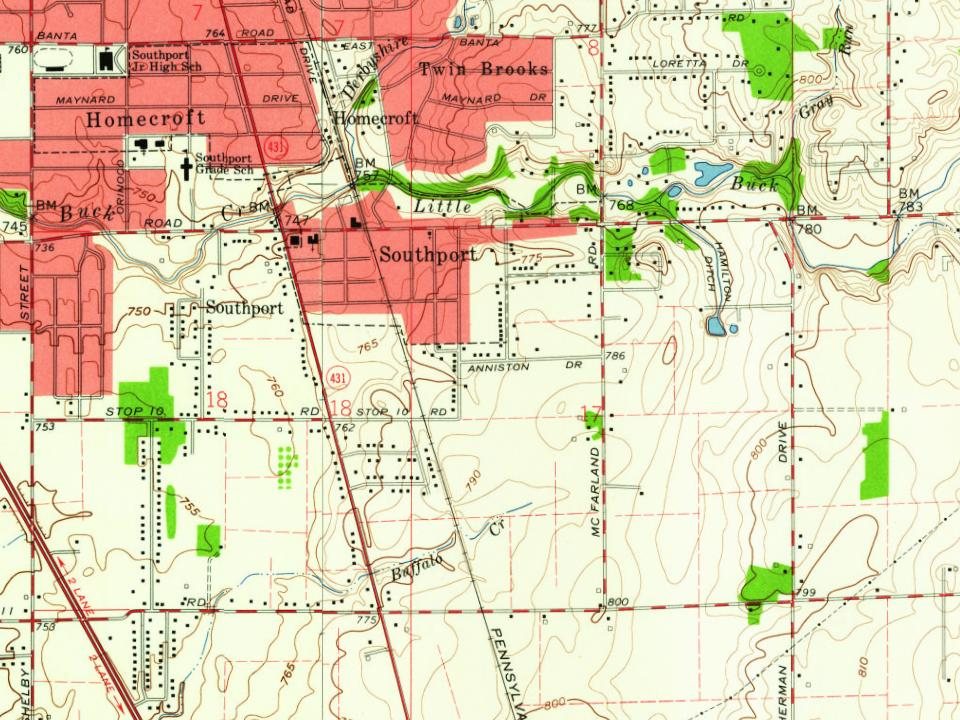
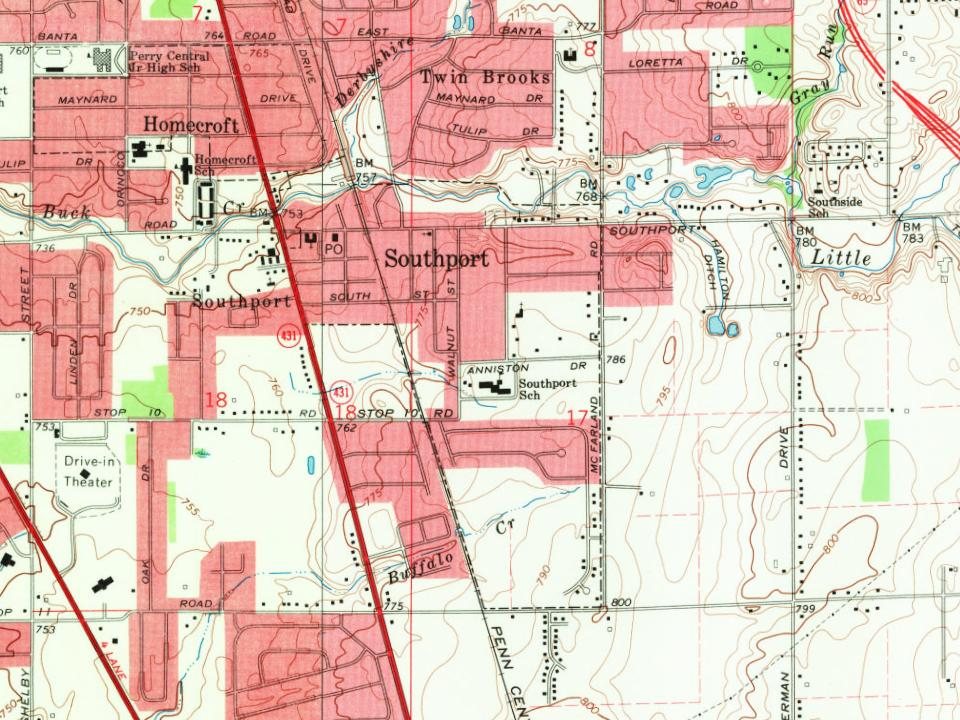
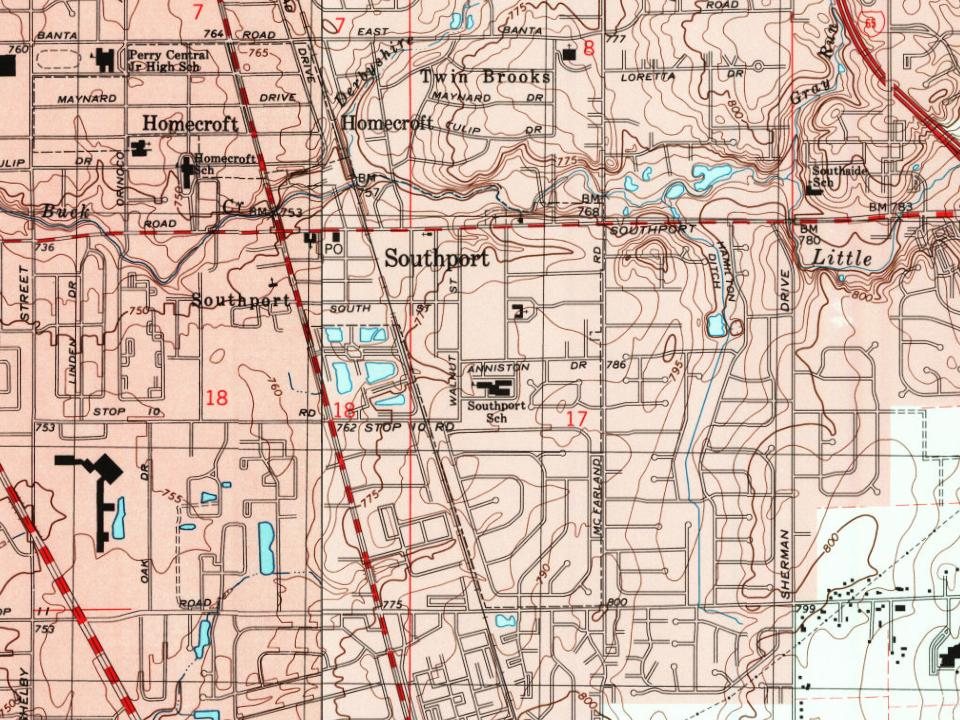
Southport, 1883 to 1948
Woven from the archive, old maps, post office records, the National Register and the people born here.
Southport is more historic than 49% of U.S. towns. The History grade combines the town’s founding era, the share of homes built before 1940 and its National Register listings. It’s a character grade, so it isn’t part of the overall grade. How it works.
How old are the homes in Southport?
23% of Southport’s homes were built before 1940 (Census estimate, ±9.2 points), against a typical 14% for an Indiana town; the median home was built in 1963.
Founding dates: Wikidata, Wikipedia, the U.S. post office records of Blevins & Helbock (CC0) and the Census. Homes by year built: Census ACS 2020–24. National Register of Historic Places: National Park Service (list of May 22, 2026). Old photos, postcards and papers: Wikimedia Commons, the Library of Congress and other public archives, credited on each item’s page. Maps: U.S. Geological Survey historical topographic maps (via Esri) and Sanborn fire-insurance maps (Library of Congress). History text and census tables: Wikipedia (CC BY-SA 4.0). Places that used to be: USGS Geographic Names Information System (2021).
From Wikimedia Commons (4), Wikipedia, Wikidata and Wikipedia for famous people, U.S. Geological Survey historical maps, U.S. Census counts (via Wikipedia), the USGS Geographic Names Information System and old county and town histories (Internet Archive). Archive images are copied here with their credits and licenses, shown on each photo’s page. Refreshed monthly.


 2022
 2020
 2020
 2020