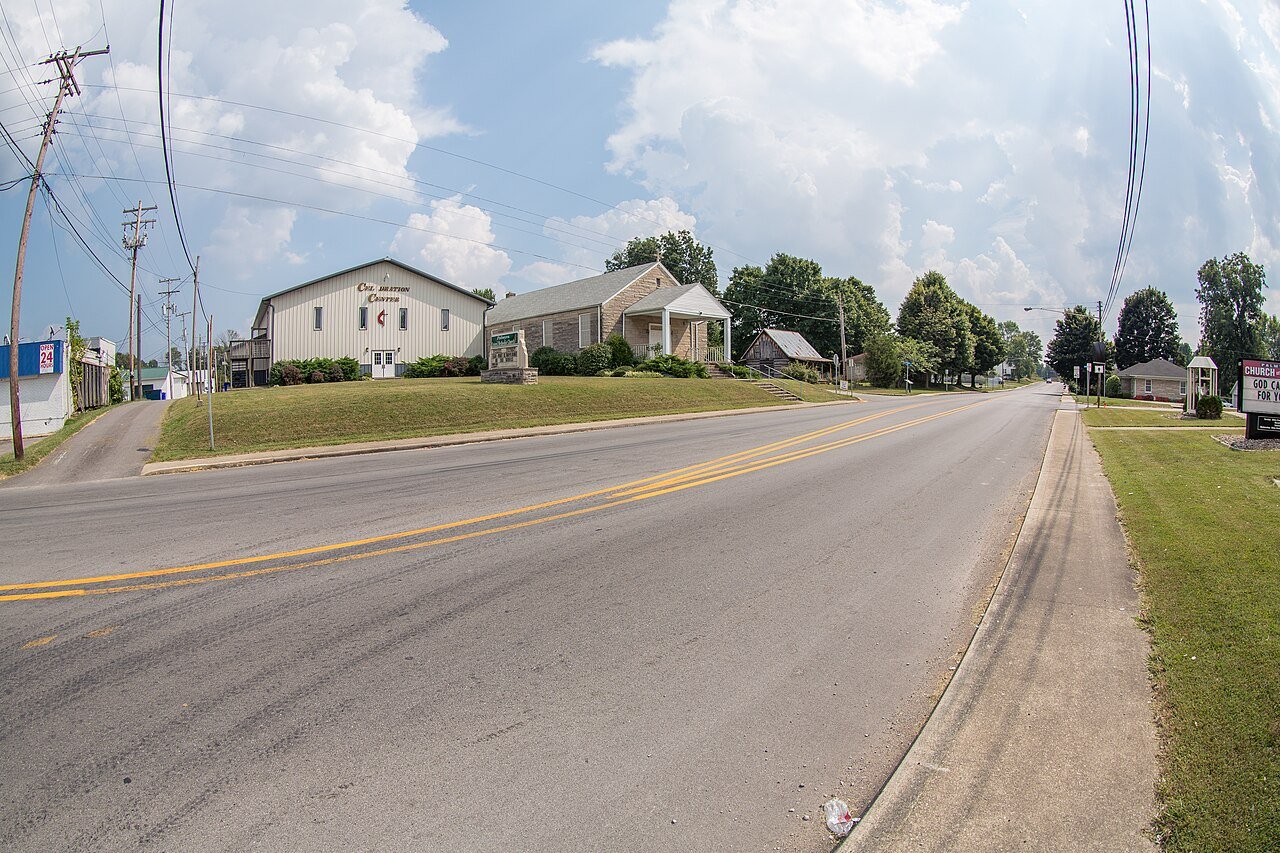
Most of Palmyra was built recently: 7% of its homes predate 1940 and the median home dates from 1983. Below: maps from 1950 on and the census since 1910.
Palmyra was originally called Carthage, and under the latter name was laid out in 1836. Because there was already another Carthage in Indiana, the town was renamed Palmyra in 1839 to avoid repetition. The present name most likely is a transfer from the ancient city of Palmyra.
A Confederate force led by Brigadier General John Hunt Morgan camped in Palmyra on the night of July 9, 1863, after the Battle of Corydon. The army took ransoms from the businesses and commandeered all the town's horses for the Confederate cavalry. The army left the town on the morning of July 10, riding north towards Salem. The town had two previous names: McClellan's Crossroad and Carthage.
Passages that mention Palmyra, cut from the printed page as they were published.
A memorial of the celebration at Palmyra, N.Y. of the centennial Fourth of July, 1876, including the oration by Theodore Bacon, and a sketch of the early history of Palmyra, by Rev. Horace Eaton, D.D1876Read the page →
Read the text
Swift, was then for two reasons in the literary mood. First, he was in lceve with Miss Dosha Boughton, the first school-mistress ; secondly, he was interested in ancient history. Now as ancient Palmyra had a Zenobia, he doubtless thought that his modern Dosha should havea Palmyra. It is not strange that he should urge the name of the ancient City with felicity and success.
Text read by machine from the scan; it may contain errors.
A memorial of the celebration at Palmyra, N.Y. of the centennial Fourth of July, 1876, including the oration by Theodore Bacon, and a sketch of the early history of Palmyra, by Rev. Horace Eaton, D.D1876Read the page →
Read the text
The Presbyterian Church was organized 1793. In regard to the place of its organization, there are conflicting statements ; one, that ‘t was in the house of John Swift,—another, with perhaps more accuracy, in the first school-house in East Palmyra. Their first edifice was built in East Palmyra in 1807. Their first edifice in the village was built in 1811 on the hill in connection with the old cemetery. It is a pleasant fancy that the gathering in of these churches from their dispersions and
Text read by machine from the scan; it may contain errors.
Scans and text from the Internet Archive. Books published in 1930 or earlier, which are in the public domain.
Founding dates: Wikidata, Wikipedia, the U.S. post office records of Blevins & Helbock (CC0) and the Census. Homes by year built: Census ACS 2020–24. National Register of Historic Places: National Park Service (list of May 22, 2026). Old photos, postcards and papers: Wikimedia Commons, the Library of Congress and other public archives, credited on each item’s page. Maps: U.S. Geological Survey historical topographic maps (via Esri) and Sanborn fire-insurance maps (Library of Congress). History text and census tables: Wikipedia (CC BY-SA 4.0). Places that used to be: USGS Geographic Names Information System (2021). How TownRatings grades history →
From Wikimedia Commons (1), Wikipedia, U.S. Geological Survey historical maps, U.S. Census counts (via Wikipedia), the US Post Offices dataset (Blevins & Helbock), the USGS Geographic Names Information System and old county and town histories (Internet Archive). Archive images are copied here with their credits and licenses, shown on each photo’s page. Refreshed monthly.


 2016


