3 places in town are on the National Register, among them two historic districts with 86 buildings between them. Below: 11 old photos and papers, maps from 1942 on, and the census since 1870.
Founding year: the first Nashville post office (Blevins & Helbock, CC0).The full story ↓
History grade
What drives Nashville’s History grade
On its age, its old homes and the National Register, Nashville is more historic than 90% of U.S. towns. All 3 inputs are above most U.S. towns; its National Register listings ranks highest and its share of homes from before 1940 lowest.
A
HistoryA character grade: shown, never part of Nashville’s overall grade.
Indiana towns list more on the Register than most of the country (a typical Indiana town has 7.9 per 10,000 residents, the U.S. 2.4), so Nashville’s 628 sits above most of its state (96% of Indiana towns have fewer) while its 87 historic buildings outnumber those of 89% of U.S. towns.
How sure. Graded on any two of the three inputs instead, the letter would range from A− to A. The pre-1940 share is a Census survey estimate (±7.2 points). The founding year is the first post office, not a stated founding date.
Founding year: the first post office (other dates in Quick answers). Homes: Census ACS 2020–24. National Register: National Park Service, May 2026 list; each listing counted once (boundary changes and added documentation belong to their listing), and a historic district counts its contributing buildings. How TownRatings grades history →
What stands out about Nashville’s past
Read from the archive, the National Register and the record. The page puts what stands out first.
Settlement of land in and around Nashville began with the acquisition of land from native populations under the 1809 Treaty of Fort Wayne. This was expanded with more acquisitions under the 1818 Treaty of St. Mary's. Founded in 1836 by county agent Banner C. Brummett, it was first named Jacksonburg. The population of the entire county was estimated to be 150 in 1830. The first Nashville courthouse was constructed in 1837 and a jail was added in the same year. By 1840, area population had grown to 2,364. The town was officially incorporated in 1872. By the turn of the century, heavy logging in the area had caused significant deforestation which resulted in dramatic erosion problems.
The Nashville and Edgefield Street Railroad Company acquired' the Nashville and North Edgefield street railroad, the Fatherland Street railroad, the Main Street and Gallatin Turnpike street railroad, and the Main Street and Lischey Avenue street railroad in 1889. The McGavock and Mount Vernon Street Railroad Company acquired the Line Street and Watkins Park street railroad, the Church and Spruce Street railroad, the Summer Street and West Nashville street railroad, and the Nashville and Fair Grounds street railroad.
Text read by machine from the scan; it may contain errors.
On July 24 quarantines were established at the following places: On the Nashville and North-western railroad, at Woodward’s Spring, twenty miles from Nashville; on the Nashville and Decatur railroad, at Owen’s Station, twelve miles from Nashville; on the Louisville and Nashville railroad, near Edgefield Junction, ten miles from Nashville. Mayor Kercheval, Dr. Nowlin, and Health Officer Dr. J. B. Lindsley were appointed a committee on quarantine stations. Dr. E. L. Drake was appointed to the position of Medical Officer on the Nashville and North-
Text read by machine from the scan; it may contain errors.
Scans and text from the Internet Archive. Books published in 1930 or earlier, which are in the public domain.
By decade
Nashville, decade by decade
One decade in the archive so far: the 1930s. Scroll each row; tap a photo for its story.
Nothing in the archives for these yearsWeddings on Main Street, storms, parades, school pictures, the old store. If it’s in your family album, it belongs here.
The Nashville post office opened in 1837, the earliest record of the town by name (U.S. post office records).
How does Nashville rank for history?
Nashville is more historic than 90% of U.S. towns. The History grade combines the town’s founding era, the share of homes built before 1940 and its National Register listings. It’s a character grade, so it isn’t part of the overall grade. How it works.
What is on the National Register in Nashville?
Three places: the Brown County Courthouse Historic District (listed 1983), the F.P. Taggart Store (1983) and the Nashville Historic District (2022).
How old are the homes in Nashville?
18% of Nashville’s homes were built before 1940 (Census estimate, ±7.2 points), against a typical 14% for an Indiana town; the median home was built in 1979.
Founding dates: Wikidata, Wikipedia, the U.S. post office records of Blevins & Helbock (CC0) and the Census. Homes by year built: Census ACS 2020–24. National Register of Historic Places: National Park Service (list of May 22, 2026). Old photos, postcards and papers: Wikimedia Commons, the Library of Congress and other public archives, credited on each item’s page. Maps: U.S. Geological Survey historical topographic maps (via Esri) and Sanborn fire-insurance maps (Library of Congress). History text and census tables: Wikipedia (CC BY-SA 4.0). Places that used to be: USGS Geographic Names Information System (2021).
From the Library of Congress (11), Wikidata (1), the National Register of Historic Places (3), Wikipedia, U.S. Geological Survey historical maps, U.S. Census counts (via Wikipedia), the US Post Offices dataset (Blevins & Helbock), the USGS Geographic Names Information System and old county and town histories (Internet Archive). Archive images are copied here with their credits and licenses, shown on each photo’s page. Refreshed monthly.


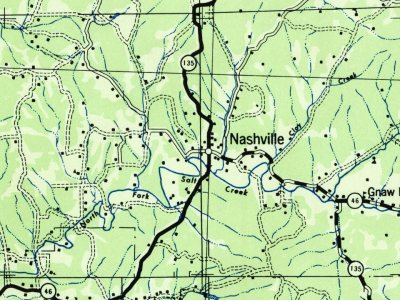


 1935
 1935
 1935
 1935
 1935
 1935
 1935
 1935
 1935
 1935

