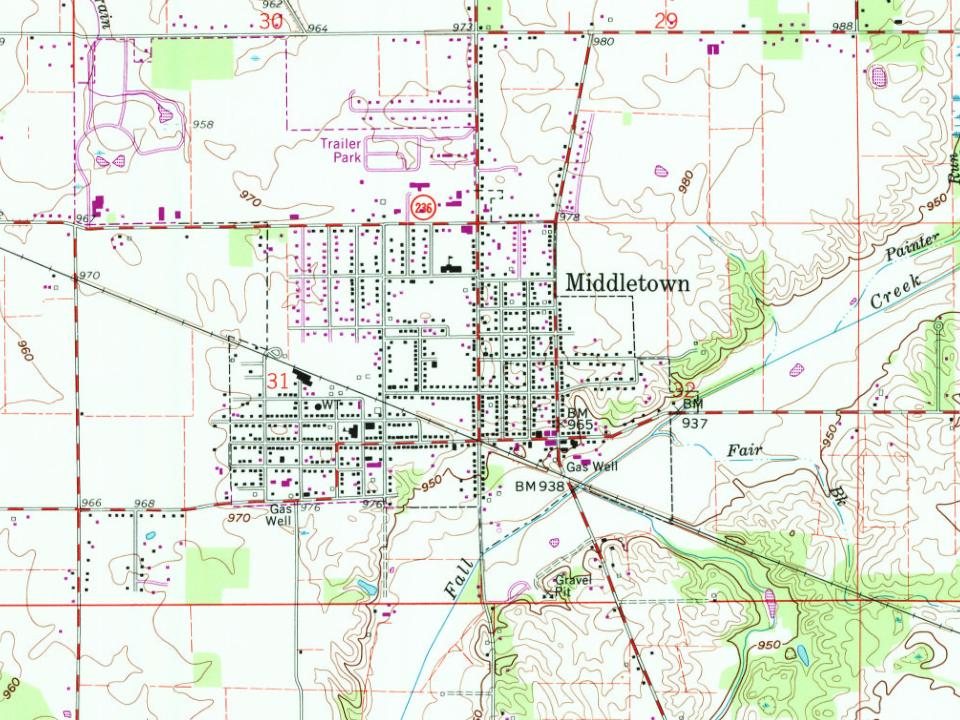
2 places in town are on the National Register, among them a historic district with 17 buildings. Below: 1 old photo or paper, maps from 1896 on, and the census since 1850.
Founding year: Wikipedia. First post office: 1830.The full story ↓
History grade
What drives Middletown’s History grade
On its age, its old homes and the National Register, Middletown is more historic than 93% of U.S. towns. All 3 inputs are above most U.S. towns; its share of homes from before 1940 ranks highest and its age lowest.
A
HistoryA character grade: shown, never part of Middletown’s overall grade.
Indiana towns list more on the Register than most of the country (a typical Indiana town has 7.9 per 10,000 residents, the U.S. 2.4), so Middletown’s 80.5 sits above most of its state (80% of Indiana towns have fewer) while its 18 historic buildings outnumber those of 79% of U.S. towns.
How sure. Graded on any two of the three inputs instead, the letter would range from A− to A. The pre-1940 share is a Census survey estimate (±7.4 points). Two sources give 1829.
Founding year: Wikipedia (other dates in Quick answers). Homes: Census ACS 2020–24. National Register: National Park Service, May 2026 list; each listing counted once (boundary changes and added documentation belong to their listing), and a historic district counts its contributing buildings. How TownRatings grades history →
What stands out about Middletown’s past
Read from the archive, the National Register and the record. The page puts what stands out first.
Fire insurance maps drew every building, what it was made of and what it was used for, so insurers could price the risk of fire. Pick a year, then a sheet.
Middletown was platted in 1829. The town's name is locational, for it lies halfway between New Castle and Anderson. A post office was established at Middletown in 1830. Middletown was incorporated as a town in 1840.
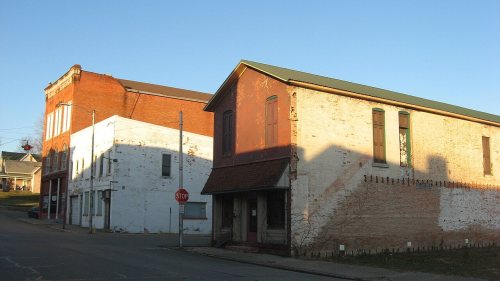
The John W. Hedrick House and Middletown Commercial Historic District are listed on the National Register of Historic Places.
Passages that mention Middletown, cut from the printed page as they were published.
The history of Middletown, Vermont, in three discourses, delivered before the citizens of that town, February 7 and 21, and March 30, 18671867Read the page →
Read the text
In 1835 the society was formed, which will appear from the following record : " We, the subscribers, inhabitants of the town of Middletown, in the county of Rutland, and State of Vermont, do hereby voluntarily associate and agree to form a society by the name of the Methodist Episcopal Society of Middletown, county and state aforesaid, for the purpose of purchasing a situation for, and buiid- ' in £ a meeting house, according to the first section of an act enti-
Text read by machine from the scan; it may contain errors.
land on the Swatara, and the right to a mill race through the Fisher estate; 498J acres purchased from Blair McClenachan; 284J acres purchased from Andrew McClure, Roan McClure and Jonathan McClure; 120 acres “contiguous to the town of Middletown;” four houses in Middletown, to wit: One occupied by himself, one by Charles McDowell, one by Memucan J. Howell, and one by Michael Hemperly; 120 lots in Middletown, 207 acres in Northumberland county; about 300 acres on Penn’s creek, and all his personal property; in trust to John Landis,
Text read by machine from the scan; it may contain errors.
Philadelphia, will naturally accrue, and that is, instead of great quantity of produce of different kind being carried from the counties of York and Cumberland to the town of Baltimore, they will be carried through the channel of the town of Middletown to the city of Philadelphia. “It may not be improper to observe that Middletown is situated at the very lowest end of navigable water of said river Susquehanna, so that the trade of that extensive river will at all events centre in that town and be carried from thence to the city of Philadelphia, and conse-
Text read by machine from the scan; it may contain errors.
and ran a schooner in the West India trade. While in the West Indies he contracted the yellow fever. He recovered, but thereafter abandoned a sea-faring life. In May, 1803, he removed with his family from Middletown to the Berkshire :Mountains, and bought a place situated about a mile and a half west of the village o'f Stockbridge, Mass. This place he afterward sold, and purchased a farm on the west margin of the mountain lake, of clear, deep water, one mile wide and two miles long, at the upper
Text read by machine from the scan; it may contain errors.
Scans and text from the Internet Archive. Books published in 1930 or earlier, which are in the public domain.
In 1829, according to Wikipedia’s history of the town. Middletown’s post office opened in 1830, and the census of 1850 counted 188 people here.
How does Middletown rank for history?
Middletown is more historic than 93% of U.S. towns. The History grade combines the town’s founding era, the share of homes built before 1940 and its National Register listings. It’s a character grade, so it isn’t part of the overall grade. How it works.
What is on the National Register in Middletown?
Two places: the John W. Hedrick House (listed 1984) and the Middletown Commercial Historic District (2010).
How old are the homes in Middletown?
32% of Middletown’s homes were built before 1940 (Census estimate, ±7.4 points), against a typical 14% for an Indiana town; the median home was built in 1955.
Founding dates: Wikidata, Wikipedia, the U.S. post office records of Blevins & Helbock (CC0) and the Census. Homes by year built: Census ACS 2020–24. National Register of Historic Places: National Park Service (list of May 22, 2026). Old photos, postcards and papers: Wikimedia Commons, the Library of Congress and other public archives, credited on each item’s page. Maps: U.S. Geological Survey historical topographic maps (via Esri) and Sanborn fire-insurance maps (Library of Congress). History text and census tables: Wikipedia (CC BY-SA 4.0). Places that used to be: USGS Geographic Names Information System (2021).
From Wikimedia Commons (4), the National Register of Historic Places (2), Wikipedia, Wikidata and Wikipedia for famous people, U.S. Geological Survey historical maps, U.S. Census counts (via Wikipedia), the US Post Offices dataset (Blevins & Helbock), the USGS Geographic Names Information System, Sanborn fire insurance maps (Library of Congress) and old county and town histories (Internet Archive). Archive images are copied here with their credits and licenses, shown on each photo’s page. Refreshed monthly.


 Date?
 2016
 2012
 2012