Founding year: the first Greentown post office (Blevins & Helbock, CC0).The full story ↓
History grade
What drives Greentown’s History grade
On its age, its old homes and the National Register, Greentown is more historic than 92% of U.S. towns. All 3 inputs are above most U.S. towns; its share of homes from before 1940 ranks highest and its age lowest.
A
HistoryA character grade: shown, never part of Greentown’s overall grade.
Indiana towns list more on the Register than most of the country (a typical Indiana town has 7.9 per 10,000 residents, the U.S. 2.4), so Greentown’s 105 sits above most of its state (82% of Indiana towns have fewer) while its 22 historic buildings outnumber those of 80% of U.S. towns.
How sure. Graded on any two of the three inputs instead, the letter would range from A− to A. The pre-1940 share is a Census survey estimate (±7.9 points). The founding year is the first post office, not a stated founding date.
Founding year: the first post office (other dates in Quick answers). Homes: Census ACS 2020–24. National Register: National Park Service, May 2026 list; each listing counted once (boundary changes and added documentation belong to their listing), and a historic district counts its contributing buildings. How TownRatings grades history →
What stands out about Greentown’s past
Read from the archive, the National Register and the record. The page puts what stands out first.
National Park Service, National Register of Historic Places. Photos from Wikimedia Commons, credited on each place’s page.
Every building
Greentown, building by building, 1896–1916
Fire insurance maps drew every building, what it was made of and what it was used for, so insurers could price the risk of fire. Pick a year, then a sheet.
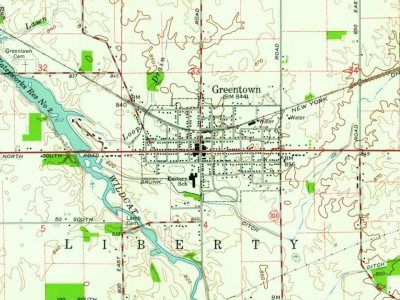
Greentown was laid out in 1848 on the site of a former Native American village. Its inception was largely due to the need for a nearby trading post by people living in the area. First was a merchant, L. W. Bacon, who built a log house on the northeast corner of Main and Merdian. Next was C. O. Fry, who built on the southwest corner of the intersection. Just prior to the establishment of these local stores, around 1840, the Miami tribe of the Algonquin native peoples had a population in Howard County of about two hundred. There was an established village where south Kokomo is now located, as well as villages south of present-day Cassville and Greentown. The frequently traveled paths were from Kokomo to Peru by way of the village of Cassville, and from Kokomo to Meshingomesia by way of a village south of Greentown.
Passages that mention Greentown, cut from the printed page as they were published.
History of Howard County, Indiana1909 · page 243Read the page →
Read the text
The Indiana Tumbler and Goblet Company came to Kokomo from Greentown in 1900 and became known as the Kokomo Glass Manufacturing Company, after having burned out at Greentown. This plant was organized at Greentown in 1894 by D. C. Jenkins, who had many years' experience in the glass manufacturing business, and knows the business from all sides. The Kokomo Glass Manufacturing Company's plant was burned out in June, 1905. The plant was not rebuilt at once, as the company debated the rebuilding
Text read by machine from the scan; it may contain errors.
History of Howard County, Indiana1909 · page 239Read the page →
Read the text
tant points required additional pressure and thus pumping stations along the pipe line was necessary. The main pumping station on the Indiana Natural Gas Company's line (Chicago) was located on the north side of the Kokomo and Greentown gravel road, on the west side of Wild Cat creek, one and one-half miles west of Greentown. A large, well-huilt pumping plant was constructed and a town plat was laid off atljoining, and quite a number of neat homes were built for their employes. Pipe lines from the various
Text read by machine from the scan; it may contain errors.
Scans and text from the Internet Archive. Books published in 1930 or earlier, which are in the public domain.
Timeline
Greentown, 1848 to 1960
Woven from the archive, old maps, post office records, the National Register and the people born here.
The Greentown post office opened in 1848, the earliest record of the town by name (U.S. post office records).
How does Greentown rank for history?
Greentown is more historic than 92% of U.S. towns. The History grade combines the town’s founding era, the share of homes built before 1940 and its National Register listings. It’s a character grade, so it isn’t part of the overall grade. How it works.
What is on the National Register in Greentown?
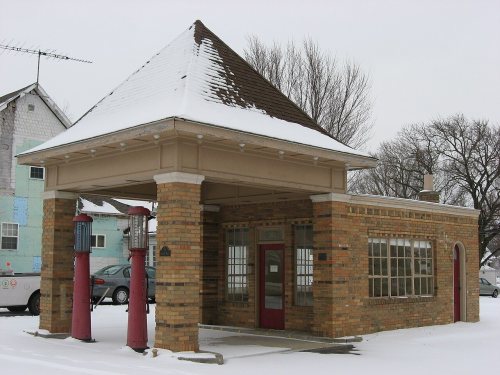
Two places: the Hy-Red Gasoline Station (listed 1983) and the Greentown Commercial Historic District (2018).
How old are the homes in Greentown?
27% of Greentown’s homes were built before 1940 (Census estimate, ±7.9 points), against a typical 14% for an Indiana town; the median home was built in 1970.
Founding dates: Wikidata, Wikipedia, the U.S. post office records of Blevins & Helbock (CC0) and the Census. Homes by year built: Census ACS 2020–24. National Register of Historic Places: National Park Service (list of May 22, 2026). Old photos, postcards and papers: Wikimedia Commons, the Library of Congress and other public archives, credited on each item’s page. Maps: U.S. Geological Survey historical topographic maps (via Esri) and Sanborn fire-insurance maps (Library of Congress). History text and census tables: Wikipedia (CC BY-SA 4.0). Places that used to be: USGS Geographic Names Information System (2021).
From Wikimedia Commons (2), the National Register of Historic Places (2), Wikipedia, Wikidata and Wikipedia for famous people, U.S. Geological Survey historical maps, U.S. Census counts (via Wikipedia), the US Post Offices dataset (Blevins & Helbock), the USGS Geographic Names Information System, Sanborn fire insurance maps (Library of Congress) and old county and town histories (Internet Archive). Archive images are copied here with their credits and licenses, shown on each photo’s page. Refreshed monthly.





 2017
 2013

