Greencastle dates to 1821, and 25% of its homes were built before 1940
More historic than 95% of U.S. towns · #73 of 593 in Indiana. What drives it
11 places in town are on the National Register, among them four historic districts with 527 buildings between them. Below: 4 old photos and papers, maps from 1887 on, and the census since 1850.
Founding year: Wikidata; Wikipedia’s history section gives the same year. First post office: 1824.The full story ↓
History grade
What drives Greencastle’s History grade
On its age, its old homes and the National Register, Greencastle is more historic than 95% of U.S. towns, #73 of 593 in Indiana. All 3 inputs are above most U.S. towns; its National Register listings ranks highest and its age lowest.
A
HistoryA character grade: shown, never part of Greencastle’s overall grade.
Indiana towns list more on the Register than most of the country (a typical Indiana town has 7.9 per 10,000 residents, the U.S. 2.4), so Greencastle’s 544 sits above most of its state (96% of Indiana towns have fewer) while its 537 historic buildings outnumber those of 97% of U.S. towns.
How sure. Graded on any two of the three inputs instead, the letter would range from A− to A+. The pre-1940 share is a Census survey estimate (±6.3 points). Two sources give 1821.
Founding year: Wikidata (other dates in Quick answers). Homes: Census ACS 2020–24. National Register: National Park Service, May 2026 list; each listing counted once (boundary changes and added documentation belong to their listing), and a historic district counts its contributing buildings. How TownRatings grades history →
What stands out about Greencastle’s past
Read from the archive, the National Register and the record. The page puts what stands out first.
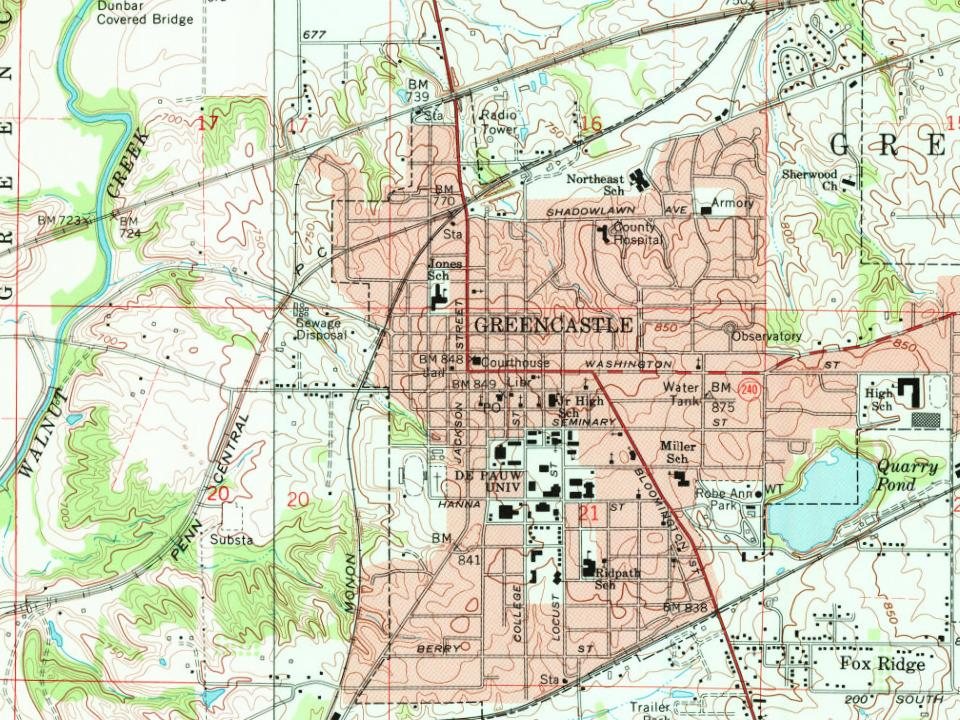
Fire insurance maps drew every building, what it was made of and what it was used for, so insurers could price the risk of fire. Pick a year, then a sheet.
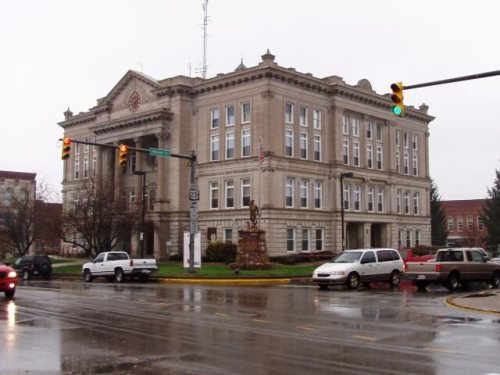
Greencastle was founded in 1821 by Ephraim Dukes on a land grant. He named the settlement for his hometown of Greencastle, Pennsylvania. Greencastle was a village or town operating under authority of the Putnam County commissioners until March 9, 1849, when it became a town by special act of the local legislature. Greencastle, Indiana, officially became a city after an election held on July 8, 1861. The first mayor of Greencastle was E. R. Kercheval, a member of the Freemason Temple Lodge #47. The city became the county seat of Putnam County.
Passages that mention Greencastle, cut from the printed page as they were published.
Weik's history of Putnam County, Indiana1910 · page 583Read the page →
Read the text
with his brothers. Prospering, he later added to the home place until he had one of the most desirable farms in the township, containing two hundred acres, which he still owns, the land lying along the Big Walnut, being nearly all bottom land. In 1883 he came to his present farm in Greencastle township, three miles southwest of the city, this being the old Layton farm, containing one hundred and eighty-three acres, along which runs the \'andalia railroad. .About twenty years ago he erected his present imposing and beautifully located dwelling, standing on an elevation from which an inspiring
Text read by machine from the scan; it may contain errors.
Weik's history of Putnam County, Indiana1910 · page 107Read the page →
Read the text
Elsewhere we learn that the Baptists held meetings at the house of Michael Wilson, a short distance west of Greencastle, early in 1823; that John Leathemian and Richard Denman preached to them and that among their members were Jubal Deweese. Thomas Johnson and John Miller, some of whom lived in the town of Greencastle. the others on land nearby. They also held meetings at the cabin of James Bird, on Walnut creek about seven miles northeast of Greencastle. Eventually they spread throughout the county.
Text read by machine from the scan; it may contain errors.
Scans and text from the Internet Archive. Books published in 1930 or earlier, which are in the public domain.
Timeline
Greencastle, 1821 to 1958
Woven from the archive, old maps, post office records, the National Register and the people born here.
Nothing in the archives for these yearsWeddings on Main Street, storms, parades, school pictures, the old store. If it’s in your family album, it belongs here.
Greencastle’s post office has been open since 1824.
Hamlets and corners on the map
Edgewood LakeFox Ridge
US Post Offices dataset (Blevins & Helbock, CC0). Places and cemeteries from the USGS Geographic Names Information System (2021).
Questions about Greencastle’s history
What year was Greencastle founded?
In 1821, according to Wikidata and Wikipedia’s history of the town. Greencastle’s post office opened in 1824, and the census of 1850 counted 1,382 people here.
How does Greencastle rank for history?
Greencastle is more historic than 95% of U.S. towns, #73 of 593 in Indiana. The History grade combines the town’s founding era, the share of homes built before 1940 and its National Register listings. It’s a character grade, so it isn’t part of the overall grade. How it works.
What is on the National Register in Greencastle?
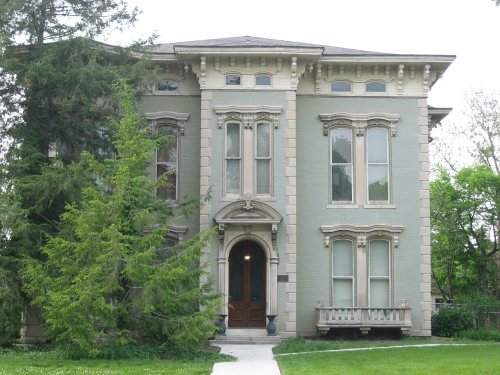
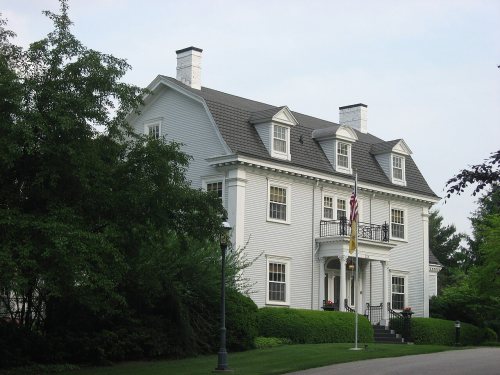
11 listings: 7 buildings, among them the East College of DePauw University (listed 1975, the first), and 4 historic districts with 527 contributing buildings. 537 historic buildings in all.
How old are the homes in Greencastle?
25% of Greencastle’s homes were built before 1940 (Census estimate, ±6.3 points), against a typical 14% for an Indiana town; the median home was built in 1970.
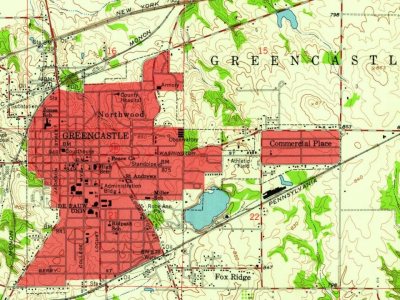
Founding dates: Wikidata, Wikipedia, the U.S. post office records of Blevins & Helbock (CC0) and the Census. Homes by year built: Census ACS 2020–24. National Register of Historic Places: National Park Service (list of May 22, 2026). Old photos, postcards and papers: Wikimedia Commons, the Library of Congress and other public archives, credited on each item’s page. Maps: U.S. Geological Survey historical topographic maps (via Esri) and Sanborn fire-insurance maps (Library of Congress). History text and census tables: Wikipedia (CC BY-SA 4.0). Places that used to be: USGS Geographic Names Information System (2021).
From Wikimedia Commons (6), the National Register of Historic Places (11), Wikipedia, Wikidata and Wikipedia for famous people, U.S. Geological Survey historical maps, U.S. Census counts (via Wikipedia), the US Post Offices dataset (Blevins & Helbock), the USGS Geographic Names Information System, Sanborn fire insurance maps (Library of Congress) and old county and town histories (Internet Archive). Archive images are copied here with their credits and licenses, shown on each photo’s page. Refreshed monthly.




 2006
 2006