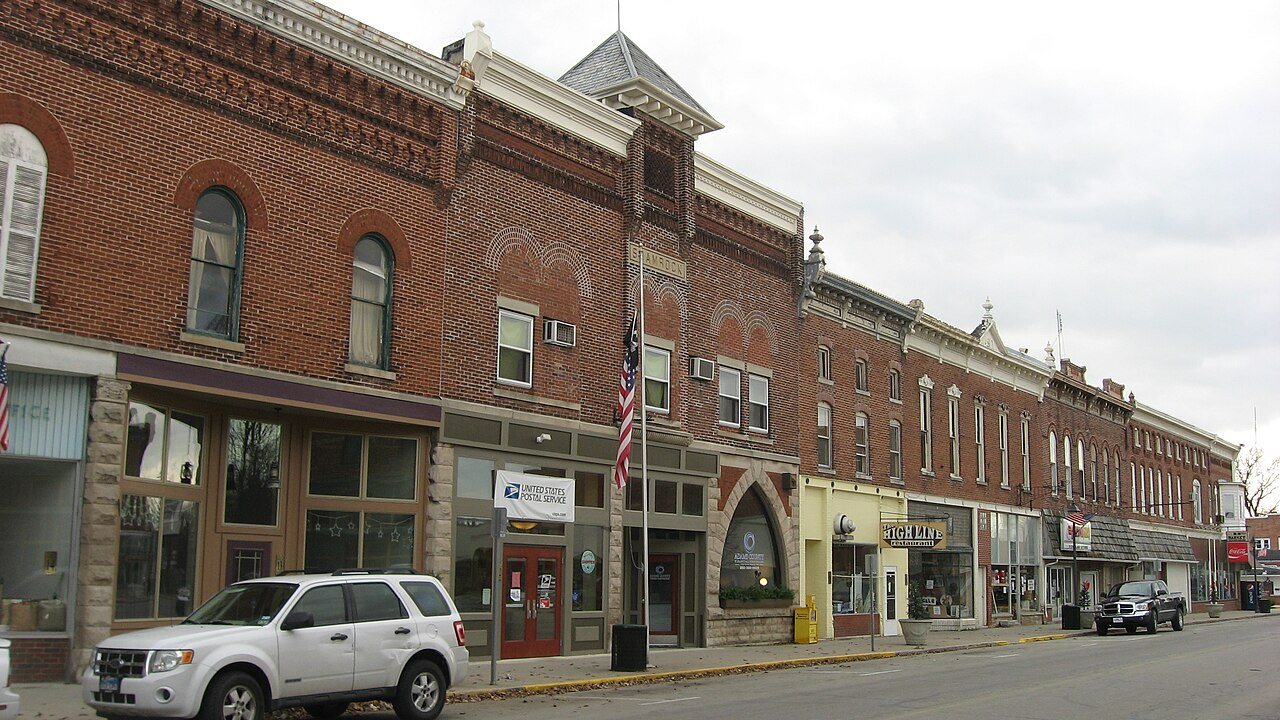
2 places in town are on the National Register, among them a historic district with 22 buildings. Below: 1 old photo or paper, maps from 1896 on, and the census since 1880.
On its age, its old homes and the National Register, Geneva is more historic than 77% of U.S. towns. Its National Register listings hold the grade up; its age pulls it down.
A−
HistoryA character grade: shown, never part of Geneva’s overall grade.
Indiana towns list more on the Register than most of the country (a typical Indiana town has 7.9 per 10,000 residents, the U.S. 2.4), so Geneva’s 186 sits above most of its state (86% of Indiana towns have fewer) while its 25 historic buildings outnumber those of 81% of U.S. towns.
How sure. Graded on any two of the three inputs instead, the letter would range from B to A. The pre-1940 share is a Census survey estimate (±7.8 points). The founding year is the first post office, not a stated founding date.
Founding year: the first post office (other dates in Quick answers). Homes: Census ACS 2020–24. National Register: National Park Service, May 2026 list; each listing counted once (boundary changes and added documentation belong to their listing), and a historic district counts its contributing buildings. How TownRatings grades history →
What stands out about Geneva’s past
Read from the archive, the National Register and the record. The page puts what stands out first.
National Park Service, National Register of Historic Places. Photos from Wikimedia Commons, credited on each place’s page.
Every building
Geneva, building by building, 1896–1914
Fire insurance maps drew every building, what it was made of and what it was used for, so insurers could price the risk of fire. Pick a year, then a sheet.
Geneva had its start in 1871 when the rival towns of Alexander and Buffalo merged. It was named after Geneva, in Switzerland. The first post office in Geneva was established in 1872. Geneva incorporated as a town in early 1874.
to run on the Grand Rapids & Indiana Railroad on Christmas day, 1S71. About that time the railroad station, nearly a half mile north of Buffalo, received its name — Geneva. The station was located at the crossing of the railroad by the east and west public road that is now Line street. As there was not a house or any building for use as a station
Text read by machine from the scan; it may contain errors.
Ancestry of Albert Gallatin, born Geneva, Switzerland, January 29, 17611916Read the page →
Read the text
In 1 5 10 he quitted his seigniories and service in Savoy and enrolled himself as a citizen of Geneva. This step was taken by him immediately preceding the time when Geneva had inaugurated the revolution that led to the separation of Savoy and the church of Rome. In Geneva, he at once established himself as a man of consequence and his superior ability was recognized by the citizens of the new republic. He became devoted to the interests of Geneva and was a member of the council of two hundred during the greater part of his life after this date. In 1535 he
Text read by machine from the scan; it may contain errors.
Indiana Railroad the mails were carried by the railroad and Limberlost and Canoper postoffices were dropped from the list and Geneva and Berne postoffices came into existence. Those who have followed Mr. Sheets are Andrew Cotschalk, William Sheets, Joel Welly, Harvey Harruir, William Waggoner, H. S. Michaud and J. F.
Text read by machine from the scan; it may contain errors.
Ancestry of Albert Gallatin, born Geneva, Switzerland, January 29, 17611916Read the page →
Read the text
He was a burgess of Geneva in 15 10. He was the source of four branches of the family that spread and muUipHed, nearly all of whom became influential in Genevan affairs. From him was descended Albert Gallatin of Geneva and the United States. All male lines from this Pierre Gallatin have become extinct, except those descending from Albert Gallatin, the American immigrant. Another descendant was the distinguished Count Gallatin, who was minister of foreign affairs of the Duke of Brunswick, and in 1819 was minister of Wurtemberg
Text read by machine from the scan; it may contain errors.
Scans and text from the Internet Archive. Books published in 1930 or earlier, which are in the public domain.
Timeline
Geneva, 1872 to 1962
Woven from the archive, old maps, post office records, the National Register and the people born here.
The Geneva post office opened in 1872, the earliest record of the town by name (U.S. post office records).
How does Geneva rank for history?
Geneva is more historic than 77% of U.S. towns. The History grade combines the town’s founding era, the share of homes built before 1940 and its National Register listings. It’s a character grade, so it isn’t part of the overall grade. How it works.
What is on the National Register in Geneva?
Two places: the Gene Stratton Porter Cabin (listed 1974) and the Geneva Downtown Commercial Historic District (2002).
How old are the homes in Geneva?
25% of Geneva’s homes were built before 1940 (Census estimate, ±7.8 points), against a typical 14% for an Indiana town; the median home was built in 1969.
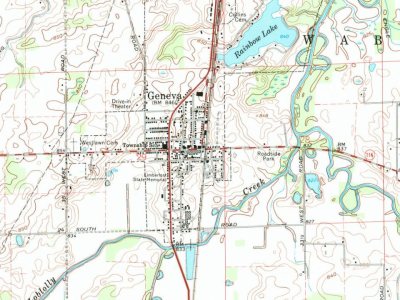
Founding dates: Wikidata, Wikipedia, the U.S. post office records of Blevins & Helbock (CC0) and the Census. Homes by year built: Census ACS 2020–24. National Register of Historic Places: National Park Service (list of May 22, 2026). Old photos, postcards and papers: Wikimedia Commons, the Library of Congress and other public archives, credited on each item’s page. Maps: U.S. Geological Survey historical topographic maps (via Esri) and Sanborn fire-insurance maps (Library of Congress). History text and census tables: Wikipedia (CC BY-SA 4.0). Places that used to be: USGS Geographic Names Information System (2021).
From Wikimedia Commons (2), Wikidata (2), the National Register of Historic Places (2), Wikipedia, Wikidata and Wikipedia for famous people, U.S. Geological Survey historical maps, U.S. Census counts (via Wikipedia), the US Post Offices dataset (Blevins & Helbock), the USGS Geographic Names Information System, Sanborn fire insurance maps (Library of Congress) and old county and town histories (Internet Archive). Archive images are copied here with their credits and licenses, shown on each photo’s page. Refreshed monthly.




 Date?
 2012

