Delphi’s post office opened in 1828, and 32% of its homes were built before 1940
More historic than 97% of U.S. towns · #40 of 593 in Indiana. What drives it
12 places in town are on the National Register, among them three historic districts with 312 buildings between them. Below: 1 old photo or paper, maps from 1886 on, and the census since 1850.
Founding year: the first Delphi post office (Blevins & Helbock, CC0).The full story ↓
History grade
What drives Delphi’s History grade
On its age, its old homes and the National Register, Delphi is more historic than 97% of U.S. towns, #40 of 593 in Indiana. All 3 inputs are above most U.S. towns; its National Register listings ranks highest and its age lowest.
A+
HistoryA character grade: shown, never part of Delphi’s overall grade.
Indiana towns list more on the Register than most of the country (a typical Indiana town has 7.9 per 10,000 residents, the U.S. 2.4), so Delphi’s 1,090 sits above most of its state (99% of Indiana towns have fewer) while its 319 historic buildings outnumber those of 95% of U.S. towns.
How sure. Graded on any two of the three inputs instead, the letter would range from A to A+. The pre-1940 share is a Census survey estimate (±8.5 points). The founding year is the first post office, not a stated founding date.
Founding year: the first post office (other dates in Quick answers). Homes: Census ACS 2020–24. National Register: National Park Service, May 2026 list; each listing counted once (boundary changes and added documentation belong to their listing), and a historic district counts its contributing buildings. How TownRatings grades history →
What stands out about Delphi’s past
Read from the archive, the National Register and the record. The page puts what stands out first.
Fire insurance maps drew every building, what it was made of and what it was used for, so insurers could price the risk of fire. Pick a year, then a sheet.
Delphi was platted in 1828. It took its name from the ancient city of Delphi, in Greece. Several months after Delphi was founded, it was designated as the county seat.
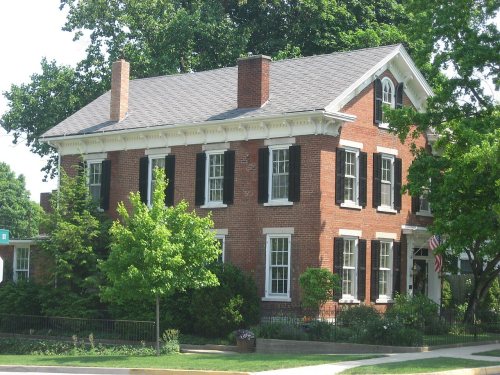
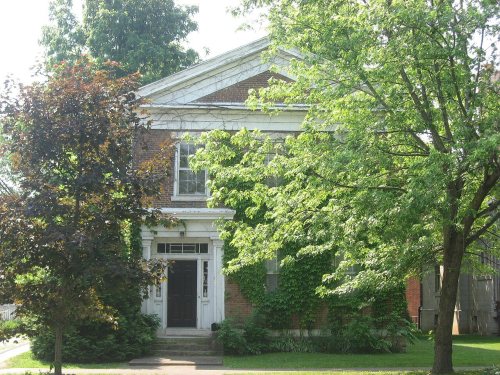
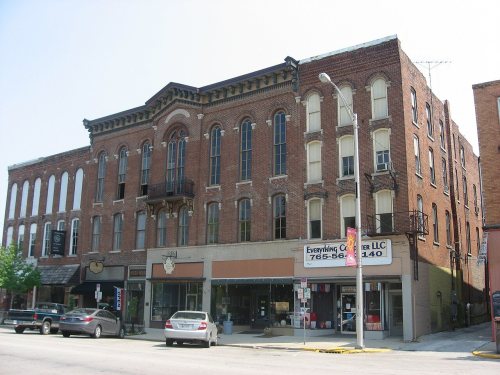
The Barnett-Seawright-Wilson House, Carroll County Courthouse, Delphi City Hall, Delphi Courthouse Square Historic District, Delphi Methodist Episcopal Church, Foreman-Case House, and Niewerth Building are listed on the National Register of Historic Places.
Passages that mention Delphi, cut from the printed page as they were published.
History of Carroll County, Indiana1882 · page 125Read the page →
Read the text
It was also ordered, that, in the future, elections in Deer Creek Township, be held at the schoolhouse, in Delphi. At the same session it was ordered that a fi'ame building be erected in the town of Delphi, on the public square, twenty-two feet wide and twenty-eight feet long, for a Clerk and Recorder's office, " the Clerk to occupy the front room in said building, for a storeroom, by paying a reasonable rent." This, it is believed, was the first public building erected in Delphi, for the use of a county
Text read by machine from the scan; it may contain errors.
History of Carroll County, Indiana1882 · page 155Read the page →
Read the text
sion of the Board of County Commissioners in June, 1880, asked to be empowered to construct a free gravel road along the route prescribed: "Beginning at the corporate limits of the city of Delphi, at a point where the line of said corporation crosses Washington street in said city; thence on and along the road-bed of what is known as the ' Upper or North Road from Delphi to Pittsbui'g,' to the east end of the iron wagon road bridge across the Wabash River; to continue from the west end of said bridge,
Text read by machine from the scan; it may contain errors.
History of Carroll County Indiana1916 · page 227Read the page →
Read the text
The Indianapolis, Delphi & Chicago Railway Company having completed a narrow-gauge road from Delphi to Rensselaer, the event was celebrated at Delphi on September 4, 1879. Banker McCoy, of Rensselaer, donated a fat steer for an old-fashioned barbecue and the animal, adorned as gaily as a bride, with ribbons and flowers, was shipped to Delphi and was assigned a prominent place in the parade which preceded the barbecue. A salute of welcome was fired as the train came in with ‘'the fatted calf” and thous¬ ands of throats made the welkin ring. W. H. Haughey was the marshal of
Text read by machine from the scan; it may contain errors.
History of Carroll County Indiana1916 · page 141Read the page →
Read the text
In 1872 the society held its annual meeting at the grove west of Delphi, then known as “Lenon’s Grove,” and continued to meet at this grove until the year 1902, when the meetings thereafter were held in the public square in the city of Delphi. The annual meeting of the year 1915 was the sixtieth annual reunion of the society.
Text read by machine from the scan; it may contain errors.
Scans and text from the Internet Archive. Books published in 1930 or earlier, which are in the public domain.
Timeline
Delphi, 1828 to 1962
Woven from the archive, old maps, post office records, the National Register and the people born here.
The Delphi post office opened in 1828, the earliest record of the town by name (U.S. post office records).
How does Delphi rank for history?
Delphi is more historic than 97% of U.S. towns, #40 of 593 in Indiana. The History grade combines the town’s founding era, the share of homes built before 1940 and its National Register listings. It’s a character grade, so it isn’t part of the overall grade. How it works.
What is on the National Register in Delphi?
12 listings: 6 buildings, among them the Barnett-Seawright-Wilson House (listed 1980, the first), 3 historic districts, the Delphi Courthouse Square Historic District, the South Delphi Historic District and the Delphi Residential Historic District, with 312 contributing buildings, and 3 structures. 319 historic buildings in all.
How old are the homes in Delphi?
32% of Delphi’s homes were built before 1940 (Census estimate, ±8.5 points), against a typical 14% for an Indiana town; the median home was built in 1972.
Founding dates: Wikidata, Wikipedia, the U.S. post office records of Blevins & Helbock (CC0) and the Census. Homes by year built: Census ACS 2020–24. National Register of Historic Places: National Park Service (list of May 22, 2026). Old photos, postcards and papers: Wikimedia Commons, the Library of Congress and other public archives, credited on each item’s page. Maps: U.S. Geological Survey historical topographic maps (via Esri) and Sanborn fire-insurance maps (Library of Congress). History text and census tables: Wikipedia (CC BY-SA 4.0). Places that used to be: USGS Geographic Names Information System (2021).
From Wikimedia Commons (3), the Library of Congress (10), Wikidata (6), the National Register of Historic Places (12), Wikipedia, Wikidata and Wikipedia for famous people, U.S. Geological Survey historical maps, U.S. Census counts (via Wikipedia), the US Post Offices dataset (Blevins & Helbock), the USGS Geographic Names Information System, Sanborn fire insurance maps (Library of Congress) and old county and town histories (Internet Archive). Archive images are copied here with their credits and licenses, shown on each photo’s page. Refreshed monthly.





 Date?
 2025
 2025
 2025
 2016
 2016
 2016
 2016
 2016
 2016
 2016
 2016
 2016


