Attica dates to 1825, and 41% of its homes were built before 1940
More historic than 98% of U.S. towns · #28 of 593 in Indiana. What drives it
6 places in town are on the National Register, among them four historic districts with 237 buildings between them. Below: 1 old photo or paper, maps from 1886 on, and the census since 1860.
Founding year: Wikipedia. First post office: 1826.The full story ↓
History grade
What drives Attica’s History grade
On its age, its old homes and the National Register, Attica is more historic than 98% of U.S. towns, #28 of 593 in Indiana. All 3 inputs are above most U.S. towns; its National Register listings ranks highest and its age lowest.
A+
HistoryA character grade: shown, never part of Attica’s overall grade.
Indiana towns list more on the Register than most of the country (a typical Indiana town has 7.9 per 10,000 residents, the U.S. 2.4), so Attica’s 741 sits above most of its state (97% of Indiana towns have fewer) while its 240 historic buildings outnumber those of 94% of U.S. towns.
How sure. Graded on any two of the three inputs instead, the letter would range from A to A+. The pre-1940 share is a Census survey estimate (±6.6 points). Two sources give 1825.
Founding year: Wikipedia (other dates in Quick answers). Homes: Census ACS 2020–24. National Register: National Park Service, May 2026 list; each listing counted once (boundary changes and added documentation belong to their listing), and a historic district counts its contributing buildings. How TownRatings grades history →
What stands out about Attica’s past
Read from the archive, the National Register and the record. The page puts what stands out first.
Attica was laid out by George Hollingsworth and platted by David Stump in 1825. The completion of the Wabash and Erie Canal through the town in 1847 brought a considerable amount of growth to the area, and ended (in Attica's favor) a long-standing rivalry with the neighboring communities of Rob Roy, Williamsport and Covington.
Attica is the nearest town to the location where Paul Dresser is believed to have written the state song, "On the Banks of the Wabash, Far Away", in 1897, and the bridge over the Wabash River bears his name.
It has endeavored to educate the people by introducing a temperance column in the Attica " Ledger,'' a temperance text-book in the free schools of Attica, a temperance school on Sabbath afternoons, a bulletin board in the post-office, and by billholders containing temperance literature placed in the depots and hotels. In evangelistic work it has introduced temperance lessons in the Sabbath-schools quarterly, a temperance prayer meeting bi-monthly, and a temperance sermon twice a year from each pulpit. In the work of reform it has assisted the fami-
Text read by machine from the scan; it may contain errors.
Terre Haute, he went to Carlinville, Illinois, and engaged in the hardware business, first in partnership with Harvey Finsley, and next Henry Eldred. He bought out the latter, and in 1867 made an assignment. He returned to La Fayette, and in 1868 came to Attica as a life-insurance agent, and at length was employed as a clerk and bookkeeper, first in a drug and afterward in a hardware store. In 1876 he came to Independence and took charge of the station, and in January, 1877, was appointed agent of the Wabash company. Next June he
Text read by machine from the scan; it may contain errors.
Scans and text from the Internet Archive. Books published in 1930 or earlier, which are in the public domain.
Timeline
Attica, 1825 to 1984
Woven from the archive, old maps, post office records, the National Register and the people born here.
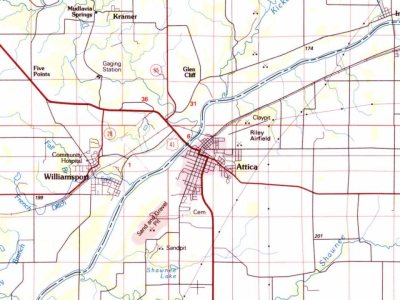
U.S. Geological Survey historical topographic maps (public domain), via Esri’s collection of the scans. The red ring marks the center of Attica.
Every building
Attica, building by building, 1886–1910
Fire insurance maps drew every building, what it was made of and what it was used for, so insurers could price the risk of fire. Pick a year, then a sheet.
US Post Offices dataset (Blevins & Helbock, CC0). Places and cemeteries from the USGS Geographic Names Information System (2021).
Questions about Attica’s history
What year was Attica founded?
In 1825, according to Wikipedia’s history of the town. Attica’s post office opened in 1826, and the census of 1860 counted 1,713 people here.
How does Attica rank for history?
Attica is more historic than 98% of U.S. towns, #28 of 593 in Indiana. The History grade combines the town’s founding era, the share of homes built before 1940 and its National Register listings. It’s a character grade, so it isn’t part of the overall grade. How it works.
What is on the National Register in Attica?
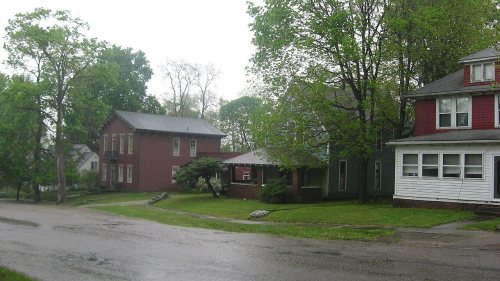
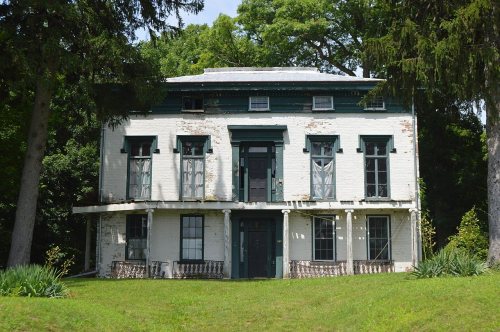
6 listings: 2 buildings, among them the Marshall M. Milford House (listed 1989, the first), and 4 historic districts with 237 contributing buildings. 240 historic buildings in all.
How old are the homes in Attica?
41% of Attica’s homes were built before 1940 (Census estimate, ±6.6 points), against a typical 14% for an Indiana town; the median home was built in 1957.
Founding dates: Wikidata, Wikipedia, the U.S. post office records of Blevins & Helbock (CC0) and the Census. Homes by year built: Census ACS 2020–24. National Register of Historic Places: National Park Service (list of May 22, 2026). Old photos, postcards and papers: Wikimedia Commons, the Library of Congress and other public archives, credited on each item’s page. Maps: U.S. Geological Survey historical topographic maps (via Esri) and Sanborn fire-insurance maps (Library of Congress). History text and census tables: Wikipedia (CC BY-SA 4.0). Places that used to be: USGS Geographic Names Information System (2021).
From Wikimedia Commons (5), Wikidata (3), the National Register of Historic Places (6), Wikipedia, Wikidata and Wikipedia for famous people, U.S. Geological Survey historical maps, U.S. Census counts (via Wikipedia), the US Post Offices dataset (Blevins & Helbock), the USGS Geographic Names Information System, Sanborn fire insurance maps (Library of Congress) and old county and town histories (Internet Archive). Archive images are copied here with their credits and licenses, shown on each photo’s page. Refreshed monthly.




 2013
 2013
 2007
 2006


