Anderson dates to 1838, and 24% of its homes were built before 1940
More historic than 91% of U.S. towns · #141 of 593 in Indiana. What drives it
10 places in town are on the National Register, among them three historic districts with 190 buildings between them. Below: 17 old photos and papers, maps from 1886 on, and the census since 1850.
Founding year: Wikipedia. First post office: 1823.The full story ↓
History grade
What drives Anderson’s History grade
On its age, its old homes and the National Register, Anderson is more historic than 91% of U.S. towns, #141 of 593 in Indiana. All 3 inputs are above most U.S. towns; its National Register listings ranks highest and its age lowest.
A
HistoryA character grade: shown, never part of Anderson’s overall grade.
Indiana towns list more on the Register than most of the country (a typical Indiana town has 7.9 per 10,000 residents, the U.S. 2.4), so Anderson’s 35.6 sits above most of its state (71% of Indiana towns have fewer) while its 197 historic buildings outnumber those of 93% of U.S. towns.
How sure. Graded on any two of the three inputs instead, the letter would range from A− to A. The pre-1940 share (±1.5 points) is firm at this size. Two sources give 1838.
Founding year: Wikipedia (other dates in Quick answers). Homes: Census ACS 2020–24. National Register: National Park Service, May 2026 list; each listing counted once (boundary changes and added documentation belong to their listing), and a historic district counts its contributing buildings. How TownRatings grades history →
What stands out about Anderson’s past
Read from the archive, the National Register and the record. The page puts what stands out first.
Nothing in the archives for these yearsWeddings on Main Street, storms, parades, school pictures, the old store. If it’s in your family album, it belongs here.
Prior to the organization of Madison County, William Conner entered the land upon which Anderson is located. Conner later sold the ground to John and Sarah Berry, who donated 32 acres (13 ha) of their land to Madison County on the condition that the county seat be moved from Pendleton to Anderson. John Berry laid out the first plat of Anderson on November 7, 1827. In 1828 the seat of justice was moved from Pendleton to Anderson.
Passages that mention Anderson, cut from the printed page as they were published.
The history of Anderson County, Kansas, from its first settlement to the Fourth of July, 1876.1877 · page 162Read the page →
Read the text
county commissioners made the following order in relation to votingaid to the railroad : '• Be it ordered. l)y the board of county commissioners of Anderson county. Kansas, that a sjjecial election be licld in said county of Anderson on -the 6th day of April. 1869, and that at said election tlie qualitied voters of said county shall tlien and there vote 'for' or * ajiainst ' the proposition for said county to subscribe one hundred and
Text read by machine from the scan; it may contain errors.
The history of Anderson County, Kansas, from its first settlement to the Fourth of July, 1876.1877 · page 15Read the page →
Read the text
ent time. 1 accepted the appointment, and at once entered upon the work of collecting the incidents connected with the settlement of the territory now embraced within the limits of Anderson county. The settlement of this portion of the Territory followed so closely on the passage by Congress of the Kansas-Nebraska bill, with the repeal of the Missouri compromise, that many incidents of the early struggles of this section have undergone Con-
Text read by machine from the scan; it may contain errors.
A memorial and biographical history of Navarro, Henderson, Anderson, Limestone, Freestone and Leon counties, Texas ... from the earliest period of its occupancy to the present time, together with glimpses of its prospects1893 · page 249Read the page →
Read the text
Anderson’s first county court record begins with the July term of 1846, the first term held in the new county. It reads: “The State of Texas, Anderson county: County court called session, July term, A. D. 1846. At a called session of the county court of Anderson county held at the county seat of said county, on Thursday, the 30th
Text read by machine from the scan; it may contain errors.
A memorial and biographical history of Navarro, Henderson, Anderson, Limestone, Freestone and Leon counties, Texas ... from the earliest period of its occupancy to the present time, together with glimpses of its prospects1893 · page 196Read the page →
Read the text
ground more tlian a home, this feature of early history will be considered more at length in the sketches of the settlement of Navarro, Anderson and Limestone counties, which should be read in connection with this chapter, in order to get a more complete view of the situation, especially that of Anderson county, in which Fort Hous-
Text read by machine from the scan; it may contain errors.
Scans and text from the Internet Archive. Books published in 1930 or earlier, which are in the public domain.
Timeline
Anderson, 1823 to 1968
Woven from the archive, old maps, post office records, the National Register and the people born here.
Every edition of the U.S. Geological Survey’s map of Anderson. Tap a year, or press play to watch the town change.
1952Anderson sheet · 1:24,000
U.S. Geological Survey historical topographic maps (public domain), via Esri’s collection of the scans. The red ring marks the center of Anderson.
Every building
Anderson, building by building, 1886–1900
Fire insurance maps drew every building, what it was made of and what it was used for, so insurers could price the risk of fire. Pick a year, then a sheet.
In 1838, according to Wikipedia’s history of the town. Anderson’s post office opened in 1823, and the census of 1850 counted 383 people here.
How does Anderson rank for history?
Anderson is more historic than 91% of U.S. towns, #141 of 593 in Indiana. The History grade combines the town’s founding era, the share of homes built before 1940 and its National Register listings. It’s a character grade, so it isn’t part of the overall grade. How it works.
What is on the National Register in Anderson?
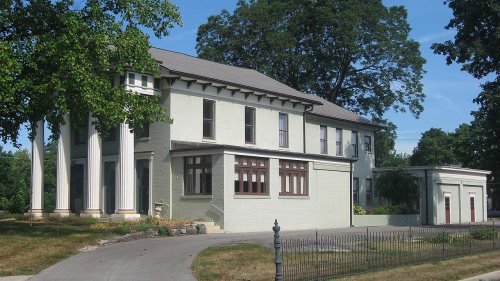
10 listings: 7 buildings and 3 historic districts, the West Eighth Street Historic District, the West Central Historic District and the Anderson Downtown Historic District, with 190 contributing buildings. 197 historic buildings in all.
How old are the homes in Anderson?
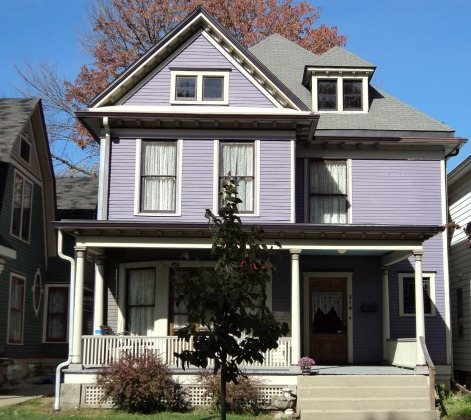
24% of Anderson’s homes were built before 1940 (Census estimate, ±1.5 points), against a typical 14% for an Indiana town; the median home was built in 1961.
Founding dates: Wikidata, Wikipedia, the U.S. post office records of Blevins & Helbock (CC0) and the Census. Homes by year built: Census ACS 2020–24. National Register of Historic Places: National Park Service (list of May 22, 2026). Old photos, postcards and papers: Wikimedia Commons, the Library of Congress and other public archives, credited on each item’s page. Maps: U.S. Geological Survey historical topographic maps (via Esri) and Sanborn fire-insurance maps (Library of Congress). History text and census tables: Wikipedia (CC BY-SA 4.0). Places that used to be: USGS Geographic Names Information System (2021).
From Wikimedia Commons (17), Wikidata (1), the National Register of Historic Places (10), Wikipedia, Wikidata and Wikipedia for famous people, U.S. Geological Survey historical maps, U.S. Census counts (via Wikipedia), the US Post Offices dataset (Blevins & Helbock), the USGS Geographic Names Information System, Sanborn fire insurance maps (Library of Congress) and old county and town histories (Internet Archive). Archive images are copied here with their credits and licenses, shown on each photo’s page. Refreshed monthly.




 1910
 1915
 1915
 1920
 1920
 1922
 1922
 1943
 1968
 1968
 1968
 1968
 1968
 1968
 1968
 1968
 1968