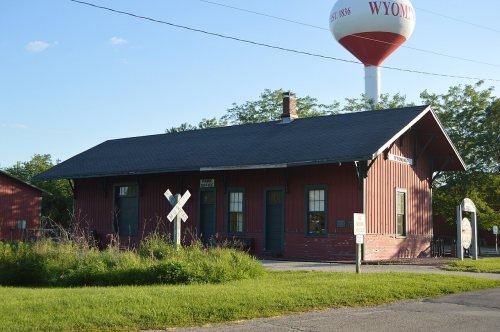
Founding year: the first Wyoming post office (Blevins & Helbock, CC0). Wikidata: 1836.The full story ↓
History grade
What drives Wyoming’s History grade
On its age, its old homes and the National Register, Wyoming is more historic than 86% of U.S. towns. All 3 inputs are above most U.S. towns; its share of homes from before 1940 ranks highest and its National Register listings lowest.
A
HistoryA character grade: shown, never part of Wyoming’s overall grade.
Few Illinois towns list much on the Register (a typical Illinois town has 0.5 per 10,000 residents, the U.S. 2.4), so Wyoming’s 6.3 sits above most of its state (78% of Illinois towns have fewer) while its 1 listings outnumber those of 51% of U.S. towns.
How sure. Graded on any two of the three inputs instead, the letter would range from A− to A. The pre-1940 share is a Census survey estimate (±5.8 points). The founding year is the first post office, not a stated founding date; Wikidata’s 1836 falls in the same era, so the grade doesn’t depend on which one is used.
Founding year: the first post office (other dates in Quick answers). Homes: Census ACS 2020–24. National Register: National Park Service, May 2026 list; each listing counted once (boundary changes and added documentation belong to their listing), and a historic district counts its contributing buildings. How TownRatings grades history →
What stands out about Wyoming’s past
Read from the archive, the National Register and the record. The page puts what stands out first.
Wyoming, the oldest town in Stark County, was laid out in the spring of 1836 for General Samuel Thomas (born 1787), who had served as a captain of artillery in the War of 1812; a post office had been established there in December 1835, and the town was incorporated by the Illinois General Assembly in 1865. Thomas, who had moved to the Wyoming Valley in Pennsylvania at the age of twenty before coming to Illinois in 1834, named the town after his former eastern home. He is buried in the Wyoming City Cemetery, where a plaque below his stone denotes him as the founder and benefactor of the town; the main city park, Thomas Park, and Thomas Street are named in his honor.
Passages that mention Wyoming, cut from the printed page as they were published.
History of Stark County, Illinois, and its people1916 · page 62Read the page →
Read the text
Looking back over a period of four score and six years, to the time when Isaac B. Essex built his lonely cabin on the banks of the Spoon River, about two and a half miles southwest of the present Town of Wyoming, it occurs to the writer that the young people of the present generation may find some interest in learning how the first settlers in Stark County lived. Imagine a vast unbroken tract of country, interspersed with forest and prairie, stretching away toward the JNIississippi River, with but few white settlers between the Shoal
Text read by machine from the scan; it may contain errors.
History of Stark County, Illinois, and its people1916Read the page →
Read the text
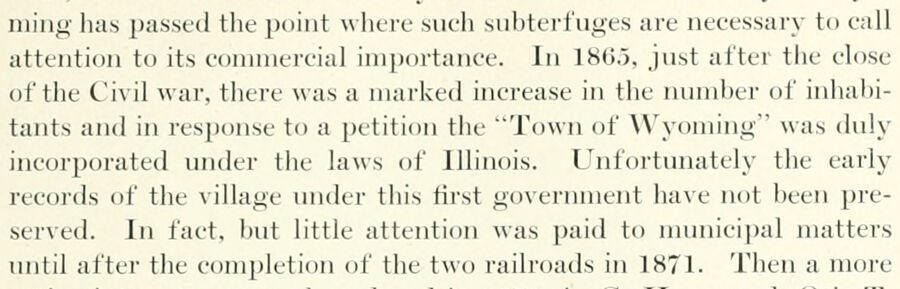
niinohas i)assc(l the point wliere such subterfuges are necessary to call attention to its couunereial importance. In 18G.5, just after tiie close of the Civil war, there was a marked increase in the number of inhabitants and in response to a petition the "Town of Wyoming" was duly incorporated under the laws of Illinois. Unfortunately the early records of the village under this first government have not been preserved. In fact, but little attention was paid to nuinici])al matters until after the completion of the two railroads in 1871. Then a more
Text read by machine from the scan; it may contain errors.
Documents and biography pertaining to the settlement and progress of Stark County, Illinois1887 · page 505Read the page →
Read the text
only two newspapers were taken in the count}^ one by Mr. Essex and the other by Benj. Smith. At this date two weeks were required to get a paper from Springfield, and a pro'portionately longer time to get intelligence from Washington. This office was transferred to Wyoming, where Godley was appointed master. The coming of the railroad brought with it the village of Duncan, and with the village returned the post-office.
Text read by machine from the scan; it may contain errors.
Documents and biography pertaining to the settlement and progress of Stark County, Illinois1887 · page 385Read the page →
Read the text
large manufacturing house. In 1853 he disposed of this interest, and returning to Illinois, settled on lands in Yalle}^ township, which he liad previously purchased. These lands he improved and cultivated until 1857, when he moved to Wyoming, built and opened a large store here, next erected a flouring mill at a cost of $40,000, laid out a park, established tile works, constructed an opera house, and altogether placed about $100,000 in building up his own industries at Wyoming.
Text read by machine from the scan; it may contain errors.
Scans and text from the Internet Archive. Books published in 1930 or earlier, which are in the public domain.
National Park Service, National Register of Historic Places. Photos from Wikimedia Commons, credited on each place’s page.
Questions about Wyoming’s history
What year was Wyoming founded?
The Wyoming post office opened in 1835, the earliest record of the town by name (U.S. post office records). Wikidata gives 1836.
How does Wyoming rank for history?
Wyoming is more historic than 86% of U.S. towns. The History grade combines the town’s founding era, the share of homes built before 1940 and its National Register listings. It’s a character grade, so it isn’t part of the overall grade. How it works.
What is on the National Register in Wyoming?
One place: the Chicago, Burlington & Quincy Railroad Depot (listed 1987).
How old are the homes in Wyoming?
27% of Wyoming’s homes were built before 1940 (Census estimate, ±5.8 points), against a typical 11% for an Illinois town; the median home was built in 1970.
Founding dates: Wikidata, Wikipedia, the U.S. post office records of Blevins & Helbock (CC0) and the Census. Homes by year built: Census ACS 2020–24. National Register of Historic Places: National Park Service (list of May 22, 2026). Old photos, postcards and papers: Wikimedia Commons, the Library of Congress and other public archives, credited on each item’s page. Maps: U.S. Geological Survey historical topographic maps (via Esri) and Sanborn fire-insurance maps (Library of Congress). History text and census tables: Wikipedia (CC BY-SA 4.0). Places that used to be: USGS Geographic Names Information System (2021).
From Wikimedia Commons (1), Wikidata (1), the National Register of Historic Places (1), Wikipedia, the US Post Offices dataset (Blevins & Helbock), the USGS Geographic Names Information System and old county and town histories (Internet Archive). Archive images are copied here with their credits and licenses, shown on each photo’s page. Refreshed monthly.




 2014