The story
Read it all →How Winnebago came to be
From Wikipedia’s history of Winnebago.
James Weber Linn (1876–1939), educator and politician, was born in Winnebago.
Text from Wikipedia, licensed CC BY-SA 4.0.
Each edition grades its towns against each other only.
More historic than 52% of U.S. towns · #382 of 768 in Illinois. What drives it
Below: maps from 1959 on and the census since 1880.
Winnebago dates its founding to 1835 (Wikidata). The census first counted it in 1880.
More historic than 52% of U.S. towns, on its age, its old homes and the National Register.
On its age, its old homes and the National Register, Winnebago is more historic than 52% of U.S. towns, #382 of 768 in Illinois. Its age holds the grade up; its National Register listings pull it down.
Few Illinois towns list much on the Register (a typical Illinois town has 0.5 per 10,000 residents, the U.S. 2.4), so Winnebago’s 0.0 sits below most of its state (28% of Illinois towns have fewer) while its 0 listings outnumber those of 23% of U.S. towns.
Founding year: Wikidata (other dates in Quick answers). Homes: Census ACS 2020–24. National Register: National Park Service, May 2026 list; each listing counted once (boundary changes and added documentation belong to their listing), and a historic district counts its contributing buildings. How TownRatings grades history →
Read from the archive, the National Register and the record. The page puts what stands out first.
The first neighbors to add old photos shape how Winnebago’s history is told.
Woven from the archive, old maps, post office records, the National Register and the people born here.
 Born hereCarol S. Bruch is born here
 On the mapFirst mapped by the U.S. Geological Survey
From Wikipedia’s history of Winnebago.
James Weber Linn (1876–1939), educator and politician, was born in Winnebago.
Text from Wikipedia, licensed CC BY-SA 4.0.
Passages that mention Winnebago, cut from the printed page as they were published.

County," appeared and presented their report, to which reference has already been made, Charles Reed next presented a deed from Nicholas Boilvin & Co., to the County of Winnebago, for thirty acres of land at the town of Winnebago, for the use of the public buildings of the county, as required by the act of the Legislature creating the county, establishing the county seat, etc.
Text read by machine from the scan; it may contain errors.
and it was there that Mr. Harris was emploj'ed in a machine shop for three years. During that time, however, he purchased a tract of wild prairie land in Winnebago Township, and in 1858 located on the place and engaged in farming until 1881, when, as bef<n'e stated, he came to Winnebago village.
Text read by machine from the scan; it may contain errors.
In June, 1856, Mr. Day came to Winnebago County, where he bought one hundred and sixty acres in Winnebago Township and resided until 1865. His next purchase was the farm he now occupies, which joins that portion of Rockford known as the Seminary Tract. Thirty acres of the estate have been laid out in city lots, while the value of the place has been materially increased by its prox-
Text read by machine from the scan; it may contain errors.
a healthy and beneficial influence in religious and political circles. He was a generous and hospitable citizen, and strangers and neighbors always found a warm welcome at his table and at his fireside. David C. Lewis came here from Michigan, in 1845, and commenced life among the Winnebago settlers by working for fifty cents per day. Afterwards he worked at hii> trade, that of carpenter, and subsequently moved into the village of Winnebago, and probably did more in the way of building, to improve the town, than any one man.
Text read by machine from the scan; it may contain errors.Scans and text from the Internet Archive. Books published in 1930 or earlier, which are in the public domain.
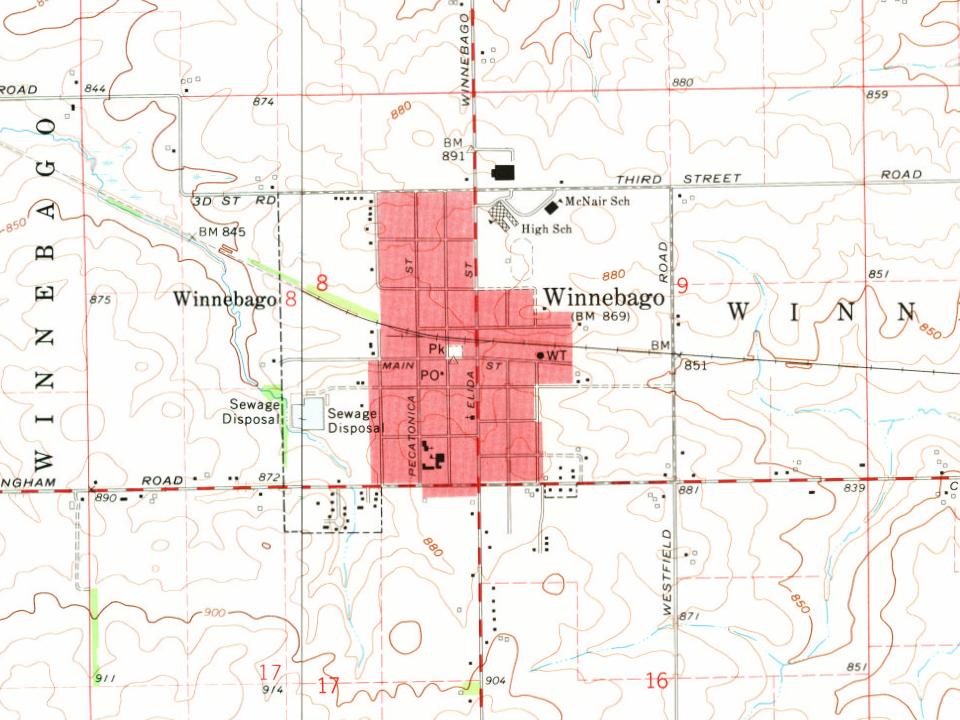
Every edition of the U.S. Geological Survey’s map of Winnebago. Tap a year, or press play to watch the town change.
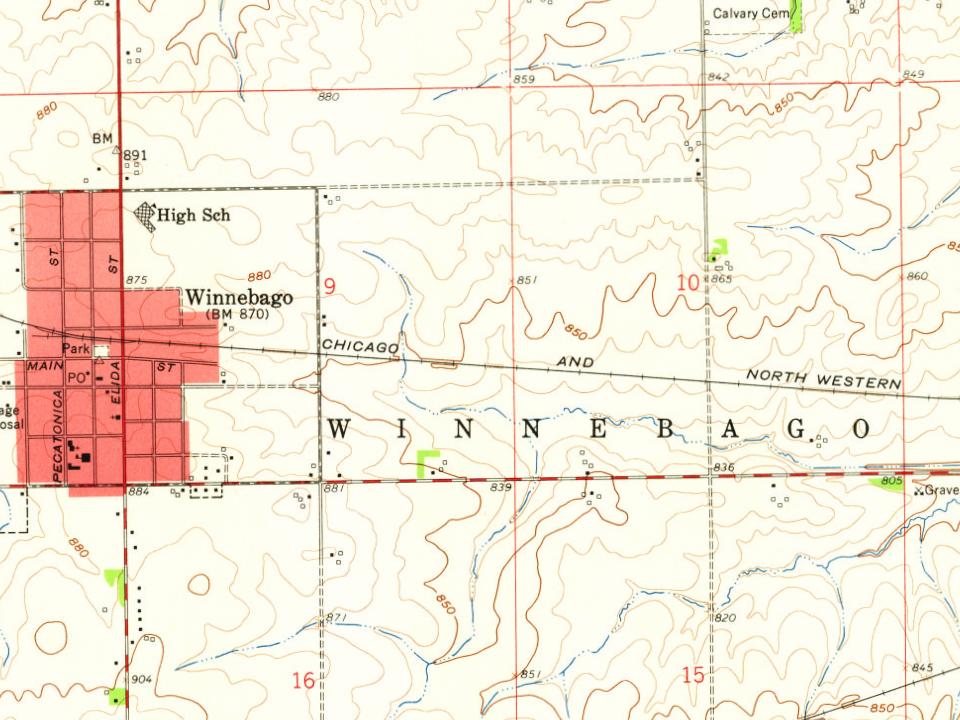
U.S. Geological Survey historical topographic maps (public domain), via Esri’s collection of the scans. The red ring marks the center of Winnebago.
Between 405 and 3,101 people in every census since 1880.
15 censuses, 1880–2020.
U.S. Census Bureau decennial counts, from the census table on Winnebago’s Wikipedia page.
Writers, athletes, leaders and more, ranked by how widely they’re known.
In 1835, according to Wikidata. Winnebago’s post office opened in 1871, and the census of 1880 counted 504 people here.
Winnebago is more historic than 52% of U.S. towns, #382 of 768 in Illinois. The History grade combines the town’s founding era, the share of homes built before 1940 and its National Register listings. It’s a character grade, so it isn’t part of the overall grade. How it works.
12% of Winnebago’s homes were built before 1940 (Census estimate, ±4.5 points), against a typical 11% for an Illinois town; the median home was built in 1985.
What the archives can’t tell you, neighbors can.
Founding dates: Wikidata, Wikipedia, the U.S. post office records of Blevins & Helbock (CC0) and the Census. Homes by year built: Census ACS 2020–24. National Register of Historic Places: National Park Service (list of May 22, 2026). Old photos, postcards and papers: Wikimedia Commons, the Library of Congress and other public archives, credited on each item’s page. Maps: U.S. Geological Survey historical topographic maps (via Esri) and Sanborn fire-insurance maps (Library of Congress). History text and census tables: Wikipedia (CC BY-SA 4.0). Places that used to be: USGS Geographic Names Information System (2021).
From Wikimedia Commons (5), Wikipedia, Wikidata and Wikipedia for famous people, U.S. Geological Survey historical maps, U.S. Census counts (via Wikipedia), the US Post Offices dataset (Blevins & Helbock), the USGS Geographic Names Information System and old county and town histories (Internet Archive). Archive images are copied here with their credits and licenses, shown on each photo’s page. Refreshed monthly.
 2012
 2007
 2007
 2007
 2007