Plainfield dates to 1816, and 4 of its places are on the National Register
More historic than 69% of U.S. towns · #270 of 768 in Illinois. What drives it
Most of Plainfield was built recently: 3% of its homes predate 1940 and the median home dates from 2003. 4 places in town are on the National Register, among them a historic district with 45 buildings. Below: 12 old photos and papers, maps from 1892 on, and the census since 1870.
Founding year: Wikipedia. First post office: 1834.The full story ↓
History grade
What drives Plainfield’s History grade
On its age, its old homes and the National Register, Plainfield is more historic than 69% of U.S. towns, #270 of 768 in Illinois. Its National Register listings hold the grade up; its share of homes from before 1940 pulls it down.
B+
HistoryA character grade: shown, never part of Plainfield’s overall grade.
Few Illinois towns list much on the Register (a typical Illinois town has 0.5 per 10,000 residents, the U.S. 2.4), so Plainfield’s 10.3 sits above most of its state (83% of Illinois towns have fewer) while its 48 historic buildings outnumber those of 85% of U.S. towns.
How sure. Graded on any two of the three inputs instead, the letter would range from C+ to A. The pre-1940 share (±1.3 points) is firm at this size. Two sources give 1816.
Founding year: Wikipedia (other dates in Quick answers). Homes: Census ACS 2020–24. National Register: National Park Service, May 2026 list; each listing counted once (boundary changes and added documentation belong to their listing), and a historic district counts its contributing buildings. How TownRatings grades history →
What stands out about Plainfield’s past
Read from the archive, the National Register and the record. The page puts what stands out first.
The area was called "Walkers' Grove" until it was platted as "Plainfield" in 1841. It was originally settled by a large community of Potawatomi people, and the land was later bequeathed to the United States as part of the Treaty of St. Louis (1816) with the Council of the Three Fires. Indian Boundary Road aligns with the western border of the tract of land originally ceded.
Passages that mention Plainfield, cut from the printed page as they were published.
The history of Will County, Illinois, containing a history of the county ... a directory of its real estate owners1878 · page 477Read the page →
Read the text
Plainfield lays claim to the honor of the first settlement in Will County. The first settlement made in Walker's Grove, a bodyof timber just south of the present village of Plainfield, dates back half a century or more. Look at the figures, 1826 — 1878 ! Fifty-two years are between these milestones.
Text read by machine from the scan; it may contain errors.
The history of Will County, Illinois, containing a history of the county ... a directory of its real estate owners1878 · page 487Read the page →
Read the text
Plainfield is beautifully located on the east bank of the Du Page River, about one mile north of the center of the township of Plainfield, and is nine miles northwest of Joliet. Chester Ingersoll is accredited with laying out the village proper, which is sometimes termed South Plainfield, while the north division was laid out by 'Squire Arnold. He was a New Yorker, and came here in 1834; laid out the village that year, and was one of the first to keep a tavern in the place.
Text read by machine from the scan; it may contain errors.
The history of Will County, Illinois, containing a history of the county ..1878Read the page →
Read the text
enters the Kankakee from the northeast in the township of Wilmington ; Jackson Creek, which enters the Des Planes from the east in the town of Channahon : Spring Creek, which enters Hickory in the town of Joliet ; the *Lillycache, which enters the Du Page in the town of Plainfield; Horse Creek, which enters the Kankakee in the town of Reed, and Rock Run, Avhich enters the Des Planes in the town of Troy. These last mentioned streams and several others for which we have no names, are considerable streams in times of high water, sometimes becoming impassable where not bridged, but in dry sea-
Text read by machine from the scan; it may contain errors.
Souvenir of settlement and progress of Will County, Ill. A review of the lives of our presidents, political, military and commercial history of the United States and of the state of Illinois ... Business directory of Joliet ... Comp. specially for the peo1884 · page 364Read the page →
Read the text
Plainfield Village was laid out in 1834 by Chester Ingersoll, while North Plainfield was platted the same year by 'Squire Arnold. Twenty years later Elihu Corbin platted one hundred acres. At that time the Walker log house was the only building on the plat. Chester Ingersoll added his dwelling in 1834.
Text read by machine from the scan; it may contain errors.
Scans and text from the Internet Archive. Books published in 1930 or earlier, which are in the public domain.
Timeline
Plainfield, 1816 to 2001
Woven from the archive, old maps, post office records, the National Register and the people born here.
Nothing in the archives for these yearsWeddings on Main Street, storms, parades, school pictures, the old store. If it’s in your family album, it belongs here.
Nothing in the archives for these yearsWeddings on Main Street, storms, parades, school pictures, the old store. If it’s in your family album, it belongs here.
Fire insurance maps drew every building, what it was made of and what it was used for, so insurers could price the risk of fire. Pick a year, then a sheet.
In 1816, according to Wikipedia’s history of the town. Plainfield’s post office opened in 1834, and the census of 1870 counted 723 people here.
How does Plainfield rank for history?
Plainfield is more historic than 69% of U.S. towns, #270 of 768 in Illinois. The History grade combines the town’s founding era, the share of homes built before 1940 and its National Register listings. It’s a character grade, so it isn’t part of the overall grade. How it works.
What is on the National Register in Plainfield?
4 listings: 3 buildings, among them the Plainfield Halfway House (listed 1980, the first), and 1 historic district, the Downtown Plainfield Historic District, with 45 contributing buildings. 48 historic buildings in all.
How old are the homes in Plainfield?
3% of Plainfield’s homes were built before 1940 (Census estimate, ±1.3 points), against a typical 11% for an Illinois town; the median home was built in 2003.
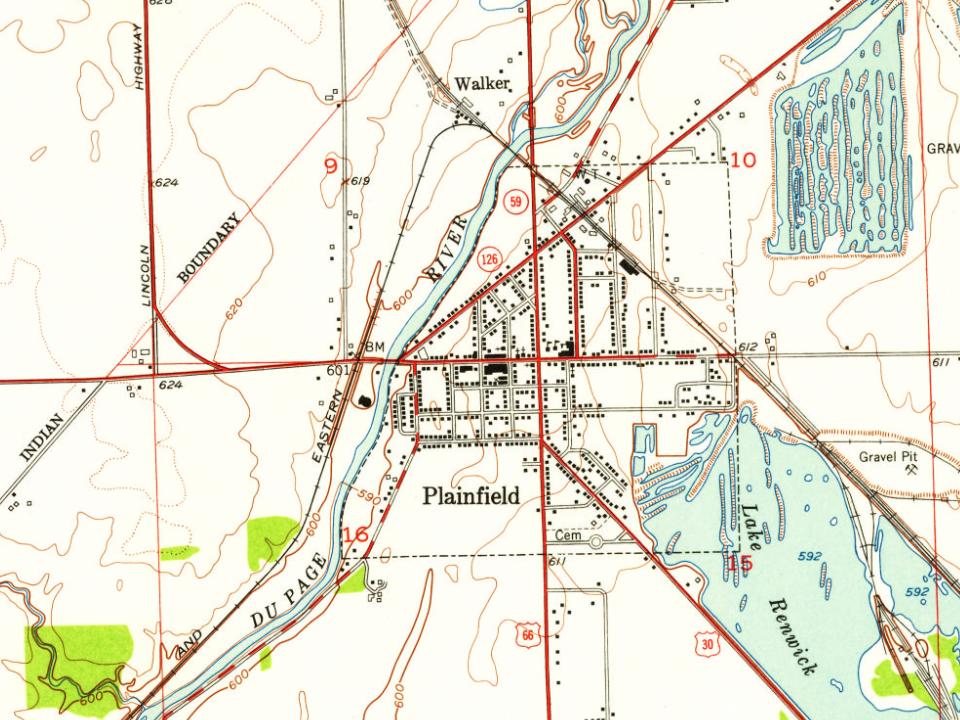
Founding dates: Wikidata, Wikipedia, the U.S. post office records of Blevins & Helbock (CC0) and the Census. Homes by year built: Census ACS 2020–24. National Register of Historic Places: National Park Service (list of May 22, 2026). Old photos, postcards and papers: Wikimedia Commons, the Library of Congress and other public archives, credited on each item’s page. Maps: U.S. Geological Survey historical topographic maps (via Esri) and Sanborn fire-insurance maps (Library of Congress). History text and census tables: Wikipedia (CC BY-SA 4.0). Places that used to be: USGS Geographic Names Information System (2021).
From Wikimedia Commons (11), the Library of Congress (1), the National Register of Historic Places (4), Wikipedia, Wikidata and Wikipedia for famous people, U.S. Geological Survey historical maps, U.S. Census counts (via Wikipedia), the US Post Offices dataset (Blevins & Helbock), the USGS Geographic Names Information System, Sanborn fire insurance maps (Library of Congress) and old county and town histories (Internet Archive). Archive images are copied here with their credits and licenses, shown on each photo’s page. Refreshed monthly.




 1907
 1907
 1933
 1933
 1933
 1933
 1933


