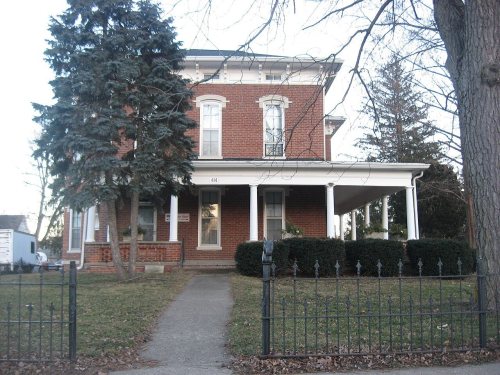
Founding year: the first Paris post office (Blevins & Helbock, CC0). Wikidata: 1826.The full story ↓
History grade
What drives Paris’ History grade
On its age, its old homes and the National Register, Paris is more historic than 92% of U.S. towns, #57 of 768 in Illinois. All 3 inputs are above most U.S. towns; its share of homes from before 1940 ranks highest and its age lowest.
A
HistoryA character grade: shown, never part of Paris’ overall grade.
Few Illinois towns list much on the Register (a typical Illinois town has 0.5 per 10,000 residents, the U.S. 2.4), so Paris’ 8.5 sits above most of its state (82% of Illinois towns have fewer) while its 7 listings outnumber those of 73% of U.S. towns.
How sure. Graded on any two of the three inputs instead, the letter would range from A− to A. The pre-1940 share is a Census survey estimate (±5.4 points). The founding year is the first post office, not a stated founding date; Wikidata’s 1826 falls in the same era, so the grade doesn’t depend on which one is used.
Founding year: the first post office (other dates in Quick answers). Homes: Census ACS 2020–24. National Register: National Park Service, May 2026 list; each listing counted once (boundary changes and added documentation belong to their listing), and a historic district counts its contributing buildings. How TownRatings grades history →
What stands out about Paris’ past
Read from the archive, the National Register and the record. The page puts what stands out first.
Fire insurance maps drew every building, what it was made of and what it was used for, so insurers could price the risk of fire. Pick a year, then a sheet.
Nothing in the archives for these yearsWeddings on Main Street, storms, parades, school pictures, the old store. If it’s in your family album, it belongs here.
Paris was established in 1826 on land donated by Samuel Vance to be the county seat, and was incorporated as a village in 1849. The town most likely received its name from the word "Paris" carved into a jack oak tree in the middle of what became the town and not after France's capital.
Paris's history includes the service of two brothers, Walter Booth and Newton Booth, as its mayors in the mid-1850s. Newton Booth later moved west to California, where he served as governor and a U.S. senator.
Passages that mention Paris, cut from the printed page as they were published.
History of Paris, Maine from its settlement to 1880, with a history of the grants of 1736 [and] 1771, together with personal sketches, a copious genealogical register, and an appendix1884 · page 195Read the page →
Read the text
70 Relation of Dablon, Aug. 1, 1674 (Hist. Mag., v, p. 238). Details sur le Voyage de Louis Jolliet (Margry, i, pp. 259 seq.), in Bibliotheque Nationale, at Paris ; Relation de la Descouverte de plusieurs Pays situes au Midi de la Nouvelle France, faite en 1673 (Margry, i, pp. 262, 263, 268-270), in Depot des Cartes, Plans et Journaux de la Marine, at Paris. These are based upon oral accounts given by Jolliet. See also Jolliet's Letter from Quebec, Oct. 10, 1674 (Harrisse Notes, p. 322), in the Archives of the Seminary of St. Sulpice at Paris,
Text read by machine from the scan; it may contain errors.
High life in France under the republic1887 · page 208Read the page →
Read the text
Madame, with flashes in her eyes : “ The other day when those Bohemians, artists, students, and other bad characters gave a banquet in honour of that fiery-mouthed young advocate who had come from Paris to defend the Anarchist miners, I adjured you to have them arrested, and to make a great fuss about it in order to terrify the population. Nothing could have been nicer than my plan, for the Government papers in Paris would have said that you had quelled dangerous manifestations, and the
Text read by machine from the scan; it may contain errors.
High life in France under the republic1887 · page 311Read the page →
Read the text
more, in Paris, but set off for the St. Lazare station the moment breakfast was over, his good comrade Mistifi accompanying him, of course, and anathematizing in louder terms than himself the vulgar personalities to which the press of France is nowadays addicted.
Text read by machine from the scan; it may contain errors.
History of Paris, Maine from its settlement to 1880, with a history of the grants of 1736 [and] 1771, together with personal sketches, a copious genealogical register, and an appendix1884 · page 30Read the page →
Read the text
This letter was found in the Seminaire de St. Sulpice at Paris, and printed in 1872. 80 The details of Jolliet's voyage and the relation of his discovery, both of which seem to be derived from his oral accounts were disinterred by Margry among the public documents at Paris, and first made known in i879.81 These are much fuller than the letter, giving substantially the same account as Marquette's, and the relation contains an extract from the
Text read by machine from the scan; it may contain errors.
Scans and text from the Internet Archive. Books published in 1930 or earlier, which are in the public domain.
Timeline
Paris, 1825 to 1986
Woven from the archive, old maps, post office records, the National Register and the people born here.
The Paris post office opened in 1825, the earliest record of the town by name (U.S. post office records). Wikidata gives 1826.
How does Paris rank for history?
Paris is more historic than 92% of U.S. towns, #57 of 768 in Illinois. The History grade combines the town’s founding era, the share of homes built before 1940 and its National Register listings. It’s a character grade, so it isn’t part of the overall grade. How it works.
What is on the National Register in Paris?
7 listings: 7 buildings, among them the Edgar County Courthouse (listed 1981, the first).
How old are the homes in Paris?
29% of Paris’ homes were built before 1940 (Census estimate, ±5.4 points), against a typical 11% for an Illinois town; the median home was built in 1964.
Founding dates: Wikidata, Wikipedia, the U.S. post office records of Blevins & Helbock (CC0) and the Census. Homes by year built: Census ACS 2020–24. National Register of Historic Places: National Park Service (list of May 22, 2026). Old photos, postcards and papers: Wikimedia Commons, the Library of Congress and other public archives, credited on each item’s page. Maps: U.S. Geological Survey historical topographic maps (via Esri) and Sanborn fire-insurance maps (Library of Congress). History text and census tables: Wikipedia (CC BY-SA 4.0). Places that used to be: USGS Geographic Names Information System (2021).
From Wikimedia Commons (12), the National Register of Historic Places (7), Wikipedia, Wikidata and Wikipedia for famous people, U.S. Geological Survey historical maps, U.S. Census counts (via Wikipedia), the US Post Offices dataset (Blevins & Helbock), the USGS Geographic Names Information System, Sanborn fire insurance maps (Library of Congress) and old county and town histories (Internet Archive). Archive images are copied here with their credits and licenses, shown on each photo’s page. Refreshed monthly.


 1870
 1870
 1870
 1870
 1880
 1880
 1880
 1880
 1880
 1912
 1933
 1933