The Mazon post office opened in 1837, the earliest record of the town by name. Another post office, Centretown (1872), opened inside today’s town and later closed.
2020 census: 979189 years
Founding year: the first Mazon post office (Blevins & Helbock, CC0).
What stands out about Mazon’s past
Read from the archive, the National Register and the record. The page puts what stands out first.
Wikipedia doesn’t have a history of Mazon yet. The photos, dates and memories neighbors add here are how it gets written.
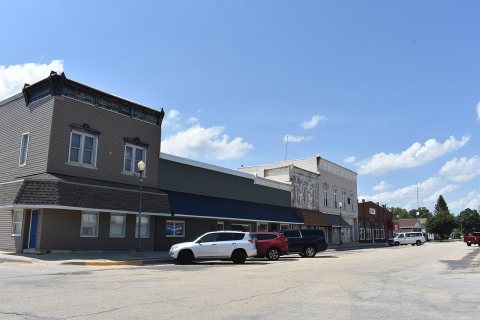
Mazon (məˈzɒn/) is a village in Mazon Township, Grundy County, Illinois, United States. The name derives from the Potawatomi word for "nettles" (mzan). The population was 979 at the 2020 census. Illinois' State Fossil, the unique and bizarre Tully Monster was first found in nearby Mazon Creek. Mazon was formerly served by the Santa Fe railway at the Mazon Depot. It was established in 1876.
Its first post office opened in 1837. Between the 2010 and 2020 censuses its population fell from 1,015 to 979 (-4%).
Intro from Wikipedia. Population: U.S. Census Bureau.
From the old history books
What they wrote about Mazon, 1882–1914
Passages that mention Mazon, cut from the printed page as they were published.
Historical encyclopedia of Illinois /cedited by Newton Bateman, Paul Selby,1914Read the page →
Read the text
ville as was the old name. The coming of the Pekin. St. Louis & Chicago Railroad stimulated business, but moved it to the vicinity of the depot, at Mazon. which was for a time prefixed by '"New" to distinguish it from the original Mazon. The new village was originally platted as Mazonville, but is now known as Mazon.
Text read by machine from the scan; it may contain errors.
Historical encyclopedia of Illinois /cedited by Newton Bateman, Paul Selby,1914Read the page →
Read the text
There is no doubt hut that the first schoolhouse of Mazon Township was built in 1837 on Section 24. At that time it was regarded as the finest schoolhouse in the surrounding country and the best cabin in the settlement.
Text read by machine from the scan; it may contain errors.
History of Grundy County, Illinois1882 · page 337Read the page →
Read the text
new looking wooden buildings, represent a village of some 500 inhabitants, which is known by the post-office and railroad authorities as Mazon, but is popularly designated by the addition of " New town" in parenthesis, to distinguish it from old Mazon.
Text read by machine from the scan; it may contain errors.
History of Grundy County, Illinois1882 · page 327Read the page →
Read the text
new looking wooden buildings, represent a village of some 500 inhabitants, which is known by the post-office and railroad authorities as Mazon, but is popularly designated by the addition of " New town" in parenthesis, to distinguish it from old Mazon.
Text read by machine from the scan; it may contain errors.
Scans and text from the Internet Archive. Books published in 1930 or earlier, which are in the public domain.
Founding dates: Wikidata, Wikipedia, the U.S. post office records of Blevins & Helbock (CC0) and the Census. Homes by year built: Census ACS 2020–24. National Register of Historic Places: National Park Service (list of May 22, 2026). Old photos, postcards and papers: Wikimedia Commons, the Library of Congress and other public archives, credited on each item’s page. Maps: U.S. Geological Survey historical topographic maps (via Esri) and Sanborn fire-insurance maps (Library of Congress). History text and census tables: Wikipedia (CC BY-SA 4.0). Places that used to be: USGS Geographic Names Information System (2021). How TownRatings grades history →
From Wikimedia Commons (5), the US Post Offices dataset (Blevins & Helbock), the USGS Geographic Names Information System and old county and town histories (Internet Archive). Archive images are copied here with their credits and licenses, shown on each photo’s page. Refreshed monthly.


 2026
 2011
 2011
 2011
 2006