Lockport’s post office opened in 1837, and 12% of its homes were built before 1940
More historic than 84% of U.S. towns · #139 of 768 in Illinois. What drives it
5 places in town are on the National Register, among them the Illinois and Michigan Canal, a National Historic Landmark, and a historic district with 68 buildings. Below: 18 old photos and papers, maps from 1886 on, and the census since 1870.
Founding year: the first Lockport post office (Blevins & Helbock, CC0). Wikidata: 1853.
History grade
What drives Lockport’s History grade
On its age, its old homes and the National Register, Lockport is more historic than 84% of U.S. towns, #139 of 768 in Illinois. All 3 inputs are above most U.S. towns; its National Register listings ranks highest and its share of homes from before 1940 lowest.
A−
HistoryA character grade: shown, never part of Lockport’s overall grade.
Few Illinois towns list much on the Register (a typical Illinois town has 0.5 per 10,000 residents, the U.S. 2.4), so Lockport’s 28.4 sits above most of its state (89% of Illinois towns have fewer) while its 75 historic buildings outnumber those of 88% of U.S. towns.
How sure. Graded on any two of the three inputs instead, the letter would range from B+ to A. The pre-1940 share (±2.2 points) is firm at this size. The founding year is the first post office, not a stated founding date; Wikidata gives 1853.
Founding year: the first post office (other dates in Quick answers). Homes: Census ACS 2020–24. National Register: National Park Service, May 2026 list; each listing counted once (boundary changes and added documentation belong to their listing), and a historic district counts its contributing buildings. How TownRatings grades history →
What stands out about Lockport’s past
Read from the archive, the National Register and the record. The page puts what stands out first.
Nothing in the archives for these yearsWeddings on Main Street, storms, parades, school pictures, the old store. If it’s in your family album, it belongs here.
Wikipedia doesn’t have a history of Lockport yet. The photos, dates and memories neighbors add here are how it gets written.
Lockport is a city in Will County, Illinois, United States, located 30 miles southwest of Chicago. Per the 2020 census, the population was 26,094. The city was incorporated in 1853. It is situated along the Illinois and Michigan (I&M) Canal, and was the headquarters of the canal when the canal was operating. A section of the canal runs through Lockport, including the remains of the canal's Lock No. 1 from which the town received its name. The canal right-of-way is now the Illinois and Michigan National Heritage Corridor.
Its first post office opened in 1837. Between the 2010 and 2020 censuses its population grew from 24,839 to 26,094 (+5%).
Intro from Wikipedia. Population: U.S. Census Bureau.
From the old history books
What they wrote about Lockport in 1878
Passages that mention Lockport, cut from the printed page as they were published.
The history of Will County, Illinois, containing a history of the county ... a directory of its real estate owners1878 · page 433Read the page →
Read the text
Before Lockport proper was laid out, and as early as 1836, Armstead Runyon laid out North Lockport, or what was long known as Runyontown, but now called Runyon's Addition to Lockport. West Lockport was laid out by William Gooding, Lyman Hawley, William Rogers and Eli Prescott, the parties that built the stone mill. At one time this was the most flourishing part of Lockport, but both it and Runyontown have been merged into the village proper.
Text read by machine from the scan; it may contain errors.
The history of Will County, Illinois, containing a history of the county ..1878 · page 433Read the page →
Read the text
Before Lockport proper was laid out, and as early as 1836, Armstead Runyon laid out North Lockport, or what was long known as Ilunyontown, but now called Ilunyon's Addition to Lockport. West Lockport was laid out by William Gooding, Lyman Hawley, William Rogers and Eli Prescott, the parties that built the stone mill. At one time this was the most flourishing part of Lockport, but both it and Runyotitown have been merged into the village proper.
Text read by machine from the scan; it may contain errors.
The history of Will County, Illinois, containing a history of the county ... a directory of its real estate owners1878 · page 259Read the page →
Read the text
nearly 72 years of age. To the list of Deacons in Yankee Settlement, we ought to add the name of Comstock Hanford, inasmuch as he was one of the original organizers of the Episcopal Church here. Some of these persons we have named would probably be included in the township of Lockport. It is said that Butterfield built the first house in the present township (of Lockport), and that a Mr. Everden built the first house on the town plat in 1831, little dreaming that he was beginning to found a city. It is also said that Armstead Runyon bought his claim, on which he laid out, in 1836, the town plat now known
Text read by machine from the scan; it may contain errors.
The history of Will County, Illinois, containing a history of the county ..1878 · page 259Read the page →
Read the text
nearly 72 years of age. To the list of Deacons in Yankee Settlement, we ought to add the name of Comstock Hanford, inasmuch as he was one of the orijxinal organizers of the Episcopal Church here. Some of these persons we have named would probably be included in the township of Lockport. It is said that Butterfield built the first house in the present township (of Lockport), and that a Mr. Everden built the first house on the town plat in 1831, little dreaming that he was beginning to found a city. It is also said that Armstead Runyon bought his claim, on which he laid out, in 1836, the town plat now known
Text read by machine from the scan; it may contain errors.
Scans and text from the Internet Archive. Books published in 1930 or earlier, which are in the public domain.
Timeline
Lockport, 1837 to 1993
Woven from the archive, old maps, post office records, the National Register and the people born here.
Fire insurance maps drew every building, what it was made of and what it was used for, so insurers could price the risk of fire. Pick a year, then a sheet.
The Lockport post office opened in 1837, the earliest record of the town by name (U.S. post office records). Wikidata gives 1853.
How does Lockport rank for history?
Lockport is more historic than 84% of U.S. towns, #139 of 768 in Illinois. The History grade combines the town’s founding era, the share of homes built before 1940 and its National Register listings. It’s a character grade, so it isn’t part of the overall grade. How it works.
What is on the National Register in Lockport?
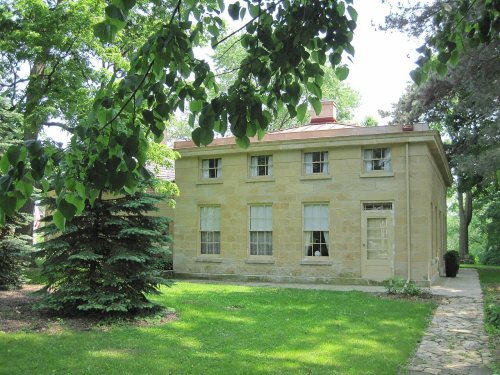
5 listings: 3 buildings, 1 historic district, the Lockport Historic District, with 68 contributing buildings, and 1 structure. 75 historic buildings in all.
How old are the homes in Lockport?
12% of Lockport’s homes were built before 1940 (Census estimate, ±2.2 points), against a typical 11% for an Illinois town; the median home was built in 1998.
Founding dates: Wikidata, Wikipedia, the U.S. post office records of Blevins & Helbock (CC0) and the Census. Homes by year built: Census ACS 2020–24. National Register of Historic Places: National Park Service (list of May 22, 2026). Old photos, postcards and papers: Wikimedia Commons, the Library of Congress and other public archives, credited on each item’s page. Maps: U.S. Geological Survey historical topographic maps (via Esri) and Sanborn fire-insurance maps (Library of Congress). History text and census tables: Wikipedia (CC BY-SA 4.0). Places that used to be: USGS Geographic Names Information System (2021).
From Wikimedia Commons (1), the Library of Congress (17), the National Register of Historic Places (5), Wikidata and Wikipedia for famous people, U.S. Geological Survey historical maps, U.S. Census counts (via Wikipedia), the US Post Offices dataset (Blevins & Helbock), the USGS Geographic Names Information System, Sanborn fire insurance maps (Library of Congress) and old county and town histories (Internet Archive). Archive images are copied here with their credits and licenses, shown on each photo’s page. Refreshed monthly.


 ★ Landmark



 1898
 1898
 1900
 1900
 1900
 1907
 1907
 1907
 1907
 1907
 1907
 1907
 1907
 1907
 1907
 1907
 1907
 1908


