Jacksonville’s post office opened in 1825, and 28% of its homes were built before 1940
More historic than 96% of U.S. towns · #22 of 768 in Illinois. What drives it
9 places in town are on the National Register, among them two historic districts with 816 buildings between them. Below: 6 old photos and papers, maps from 1887 on, and the census since 1850.
Founding year: the first Jacksonville post office (Blevins & Helbock, CC0).The full story ↓
History grade
What drives Jacksonville’s History grade
On its age, its old homes and the National Register, Jacksonville is more historic than 96% of U.S. towns, #22 of 768 in Illinois. All 3 inputs are above most U.S. towns; its National Register listings ranks highest and its age lowest.
A+
HistoryA character grade: shown, never part of Jacksonville’s overall grade.
Few Illinois towns list much on the Register (a typical Illinois town has 0.5 per 10,000 residents, the U.S. 2.4), so Jacksonville’s 457 sits above most of its state (98% of Illinois towns have fewer) while its 823 historic buildings outnumber those of 98% of U.S. towns.
How sure. Graded on any two of the three inputs instead, the letter would range from A to A+. The pre-1940 share is a Census survey estimate (±3.5 points). The founding year is the first post office, not a stated founding date.
Founding year: the first post office (other dates in Quick answers). Homes: Census ACS 2020–24. National Register: National Park Service, May 2026 list; each listing counted once (boundary changes and added documentation belong to their listing), and a historic district counts its contributing buildings. How TownRatings grades history →
What stands out about Jacksonville’s past
Read from the archive, the National Register and the record. The page puts what stands out first.
National Park Service, National Register of Historic Places. Photos from Wikimedia Commons, credited on each place’s page.
Every building
Jacksonville, building by building, 1887–1914
Fire insurance maps drew every building, what it was made of and what it was used for, so insurers could price the risk of fire. Pick a year, then a sheet.
Jacksonville was established by European Americans on a 160-acre (65 ha) tract of land in the center of Morgan County in 1825, two years after the county was founded. The founders of Jacksonville were settlers from New England, descended from the English Puritans who had settled New England in the 1600s. They were part of a wave of New England farmers who headed west into what was then the wilds of the Northwest Territory, during the early 1800s. Most of them arrived as a result of the completion of the Erie Canal and the end of the Black Hawk War.
Passages that mention Jacksonville, cut from the printed page as they were published.
History of Jacksonville, Florida and vicinity, 1513 to 19241925 · page 107Read the page →
Read the text
An Ordinance Regulating Patrols: Be it ordained by the intendant and councilmen of the town of Jacksonville, That the town marshal furnish the intendant, at such times as he may require, a full and complete list of the names of all white male inhabitants of the town of Jacksonville, between the ages of sixteen and fifty-five years; and it shall be the duty of the intendant to require and make said persons do and perform patrol duty within the limits of said corporation of Jacksonville, at any time and at all such times as he may deem necessary,
Text read by machine from the scan; it may contain errors.
History of Jacksonville, Florida and vicinity, 1513 to 19241925 · page 341Read the page →
Read the text
Eddy, all of Jacksonville. The Seminole Indian war and the panic of 1837 caused the abandonment of the enterprise.¢ In the 1840’s, a survey was made for a railroad from Jacksonville to Cedar Key, and another from Jacksonville to the Suwanee River. Then matters were allowed to rest and powerful opposition arose with the organization of a company, of which David Levy Yulee was the head, to build a railroad from Fernandina to Cedar Key. Yulee successfully
Text read by machine from the scan; it may contain errors.
Scans and text from the Internet Archive. Books published in 1930 or earlier, which are in the public domain.
Timeline
Jacksonville, 1825 to 1943
Woven from the archive, old maps, post office records, the National Register and the people born here.
Nothing in the archives for these yearsWeddings on Main Street, storms, parades, school pictures, the old store. If it’s in your family album, it belongs here.
The Jacksonville post office opened in 1825, the earliest record of the town by name (U.S. post office records).
How does Jacksonville rank for history?
Jacksonville is more historic than 96% of U.S. towns, #22 of 768 in Illinois. The History grade combines the town’s founding era, the share of homes built before 1940 and its National Register listings. It’s a character grade, so it isn’t part of the overall grade. How it works.
What is on the National Register in Jacksonville?
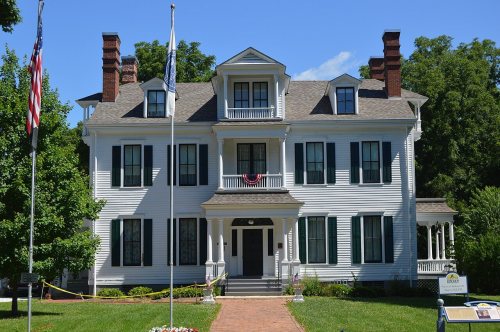
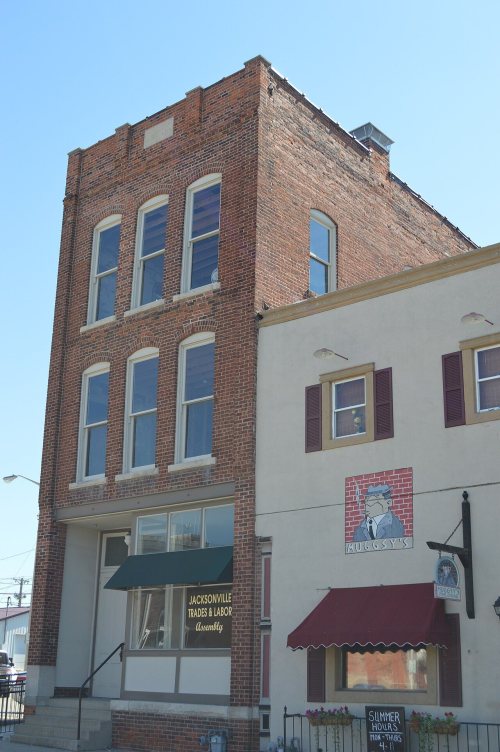
9 listings: 7 buildings, among them the Joseph Duncan House (listed 1971, the first), and 2 historic districts, the Jacksonville Historic District and the Jacksonville Downtown Historic District, with 816 contributing buildings. 823 historic buildings in all.
How old are the homes in Jacksonville?
28% of Jacksonville’s homes were built before 1940 (Census estimate, ±3.5 points), against a typical 11% for an Illinois town; the median home was built in 1962.
Founding dates: Wikidata, Wikipedia, the U.S. post office records of Blevins & Helbock (CC0) and the Census. Homes by year built: Census ACS 2020–24. National Register of Historic Places: National Park Service (list of May 22, 2026). Old photos, postcards and papers: Wikimedia Commons, the Library of Congress and other public archives, credited on each item’s page. Maps: U.S. Geological Survey historical topographic maps (via Esri) and Sanborn fire-insurance maps (Library of Congress). History text and census tables: Wikipedia (CC BY-SA 4.0). Places that used to be: USGS Geographic Names Information System (2021).
From Wikimedia Commons (6), the National Register of Historic Places (9), Wikipedia, Wikidata and Wikipedia for famous people, U.S. Geological Survey historical maps, U.S. Census counts (via Wikipedia), the US Post Offices dataset (Blevins & Helbock), the USGS Geographic Names Information System, Sanborn fire insurance maps (Library of Congress) and old county and town histories (Internet Archive). Archive images are copied here with their credits and licenses, shown on each photo’s page. Refreshed monthly.





 c. 1865
 c. 1865
 c. 1865


