Founding year: the first Heyworth post office (Blevins & Helbock, CC0).The full story ↓
History grade
What drives Heyworth’s History grade
On its age, its old homes and the National Register, Heyworth is more historic than 39% of U.S. towns, #472 of 768 in Illinois. Its share of homes from before 1940 holds the grade up; its National Register listings pull it down.
C+
HistoryA character grade: shown, never part of Heyworth’s overall grade.
Few Illinois towns list much on the Register (a typical Illinois town has 0.5 per 10,000 residents, the U.S. 2.4), so Heyworth’s 0.0 sits below most of its state (28% of Illinois towns have fewer) while its 0 listings outnumber those of 23% of U.S. towns.
How sure. Graded on any two of the three inputs instead, the letter would range from C− to B−. The pre-1940 share is a Census survey estimate (±6.1 points). The founding year is the first post office, not a stated founding date.
Founding year: the first post office (other dates in Quick answers). Homes: Census ACS 2020–24. National Register: National Park Service, May 2026 list; each listing counted once (boundary changes and added documentation belong to their listing), and a historic district counts its contributing buildings. How TownRatings grades history →
What stands out about Heyworth’s past
Read from the archive, the National Register and the record. The page puts what stands out first.
Fire insurance maps drew every building, what it was made of and what it was used for, so insurers could price the risk of fire. Pick a year, then a sheet.
1908Sheet 1 of 1
Edition
Sheets
BrickWoodStone
Sanborn Map Company, via the Library of Congress. Editions published in 1930 or earlier, which are in the public domain.
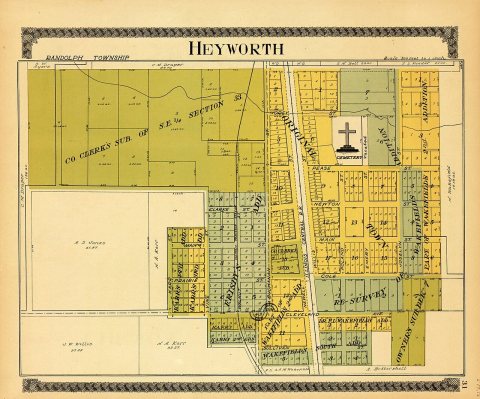
Heyworth was laid out by Campbell Wakefield on September 11, 1859. Before settlement, the locality now known as Heyworth was covered by a heavy growth of timber and underbrush which was inhabited by the Kickapoo Native Americans, and supported a great number of deer, wild turkeys, and packs of large gray wolves.
There were several grist mills on Kickapoo near Heyworth. The first large mill was put up in Heyworth in 1857, by Coursin & Wilson. It was situated west of the railroad and south of Main Street, near the place where the lumber yard is now located. Some time later, the engine exploded and killed the engineer. The mill burned in 1860. Alex Wilson came to Heyworth in 1857, and built the first good dwelling
Text read by machine from the scan; it may contain errors.
Light and Power In the early years of the present century, the Heyworth Electric Light Company was founded in Heyworth. The plant was located here and was owned by the town. Lynn Pumphrey was the manager.
Text read by machine from the scan; it may contain errors.
The schools of the village of Heyworth had a crude beginning, for the first schoolhouse was a single room log cabin, with puncheon floor and hewed logs for benches. Thomas Dunham was the first teacher, and he was followed by Mary Elder, William Leeper, J. W. Burrows and others.
Text read by machine from the scan; it may contain errors.
a church since 1867, and in 1907 the present building was erected. John R. Golden formed a congregation at Cooksville in 1902, succeeding the Blue Mound Church. Ellsworth Church succeeded the Old Town Church in 1867, and Heyworth Church was organized in 1872. In 1906 the present modern building was erected in Heyworth. A Christian Church has been at Holder since 1877, and at Hudson since 1877. Leroy Church was formed in 1888 by T. T. Holton, and a fine church erected in 1907. Lexington
Text read by machine from the scan; it may contain errors.
Scans and text from the Internet Archive. Books published in 1930 or earlier, which are in the public domain.
Timeline
Heyworth, 1858 to 1951
Woven from the archive, old maps, post office records, the National Register and the people born here.
Nothing in the archives for these yearsWeddings on Main Street, storms, parades, school pictures, the old store. If it’s in your family album, it belongs here.
Between 300 and 2,841 people in every census since 1870.
16 censuses, 1870–2020.
U.S. Census Bureau decennial counts, from the census table on Heyworth’s Wikipedia page.
Questions about Heyworth’s history
What year was Heyworth founded?
The Heyworth post office opened in 1858, the earliest record of the town by name (U.S. post office records).
How does Heyworth rank for history?
Heyworth is more historic than 39% of U.S. towns, #472 of 768 in Illinois. The History grade combines the town’s founding era, the share of homes built before 1940 and its National Register listings. It’s a character grade, so it isn’t part of the overall grade. How it works.
How old are the homes in Heyworth?
19% of Heyworth’s homes were built before 1940 (Census estimate, ±6.1 points), against a typical 11% for an Illinois town; the median home was built in 1975.
Founding dates: Wikidata, Wikipedia, the U.S. post office records of Blevins & Helbock (CC0) and the Census. Homes by year built: Census ACS 2020–24. National Register of Historic Places: National Park Service (list of May 22, 2026). Old photos, postcards and papers: Wikimedia Commons, the Library of Congress and other public archives, credited on each item’s page. Maps: U.S. Geological Survey historical topographic maps (via Esri) and Sanborn fire-insurance maps (Library of Congress). History text and census tables: Wikipedia (CC BY-SA 4.0). Places that used to be: USGS Geographic Names Information System (2021).
From Wikimedia Commons (3), Wikipedia, U.S. Geological Survey historical maps, U.S. Census counts (via Wikipedia), the US Post Offices dataset (Blevins & Helbock), the USGS Geographic Names Information System, Sanborn fire insurance maps (Library of Congress) and old county and town histories (Internet Archive). Archive images are copied here with their credits and licenses, shown on each photo’s page. Refreshed monthly.



 2006


