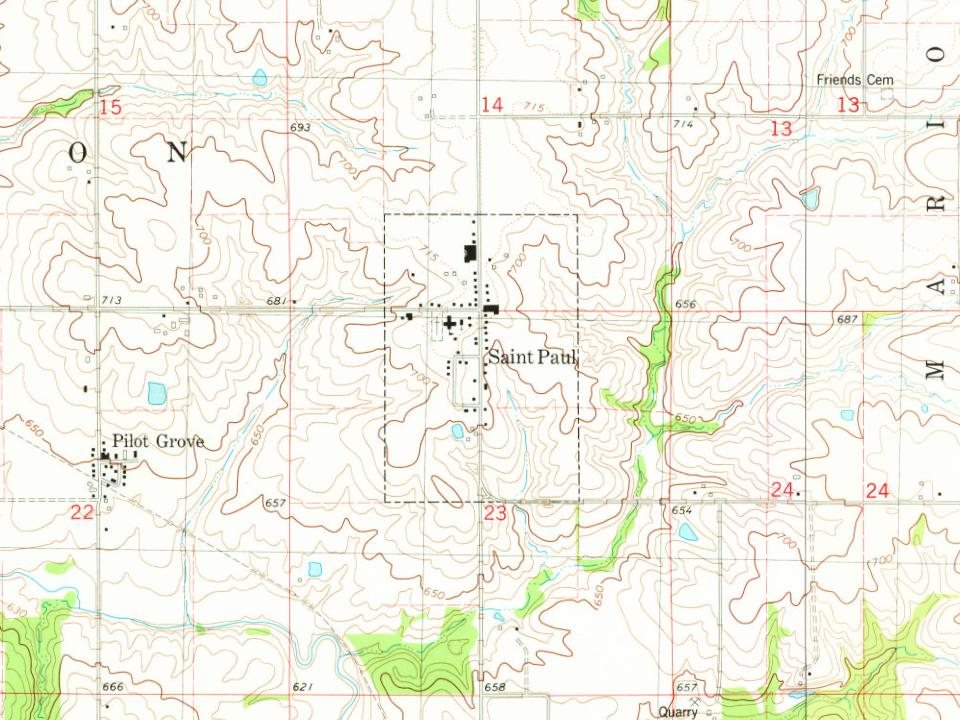
Most of St. Paul was built recently: 6% of its homes predate 1940 and the median home dates from 1971. Below: maps from 1981 on and the census since 1880.
The St. Paul post office opened in 1863, the earliest record of the town by name. Another post office, Saint Paul (1863), opened inside today’s city and later closed.
First census: 37 in 18802020 census: 109163 years
Founding year: the first St. Paul post office (Blevins & Helbock, CC0).
What stands out about St. Paul’s past
Read from the archive, the National Register and the record. The page puts what stands out first.
Wikipedia doesn’t have a history of St. Paul yet. The photos, dates and memories neighbors add here are how it gets written.
St. Paul or Saint Paul is a city in Lee County, Iowa, United States. The population was 109 at the time of the 2020 census. It is part of the Fort Madison-Keokuk Micropolitan Statistical Area
Its first post office opened in 1863. Between the 2010 and 2020 censuses its population fell from 129 to 109 (-16%).
Intro from Wikipedia. Population: U.S. Census Bureau.
From the old history books
What they wrote about St. Paul in 1879
Passages that mention St. Paul, cut from the printed page as they were published.
The history of Lee county, Iowa, containing a history of the county, its cities, towns, &c.1879 · page 625Read the page →
Read the text
rival points, and their enterprise foiled them at every turn. This enterprise has resulted in not only maintaining the natural advantages of location, but in fortifying it with a net-work of railroads that bids defiance to the combined influence of all rival interests between St. Louis and St. Paul, on the one hand, and Chicago and Omaha on the other. Keokuk enterprise and foresight secured a combined railway and wagon bridge across the Mississippi River, that not only secured the trade of a large section of Illinois, but opened direct communication with Eastern trade-centers. The same enterprising
Text read by machine from the scan; it may contain errors.
Scans and text from the Internet Archive. Books published in 1930 or earlier, which are in the public domain.
Timeline
St. Paul, 1863 to 1981
Woven from the archive, old maps, post office records, the National Register and the people born here.
Founding dates: Wikidata, Wikipedia, the U.S. post office records of Blevins & Helbock (CC0) and the Census. Homes by year built: Census ACS 2020–24. National Register of Historic Places: National Park Service (list of May 22, 2026). Old photos, postcards and papers: Wikimedia Commons, the Library of Congress and other public archives, credited on each item’s page. Maps: U.S. Geological Survey historical topographic maps (via Esri) and Sanborn fire-insurance maps (Library of Congress). History text and census tables: Wikipedia (CC BY-SA 4.0). Places that used to be: USGS Geographic Names Information System (2021). How TownRatings grades history →
From Wikimedia Commons (2), Wikidata and Wikipedia for famous people, U.S. Geological Survey historical maps, U.S. Census counts (via Wikipedia), the US Post Offices dataset (Blevins & Helbock), the USGS Geographic Names Information System and old county and town histories (Internet Archive). Archive images are copied here with their credits and licenses, shown on each photo’s page. Refreshed monthly.


 2024
 2004