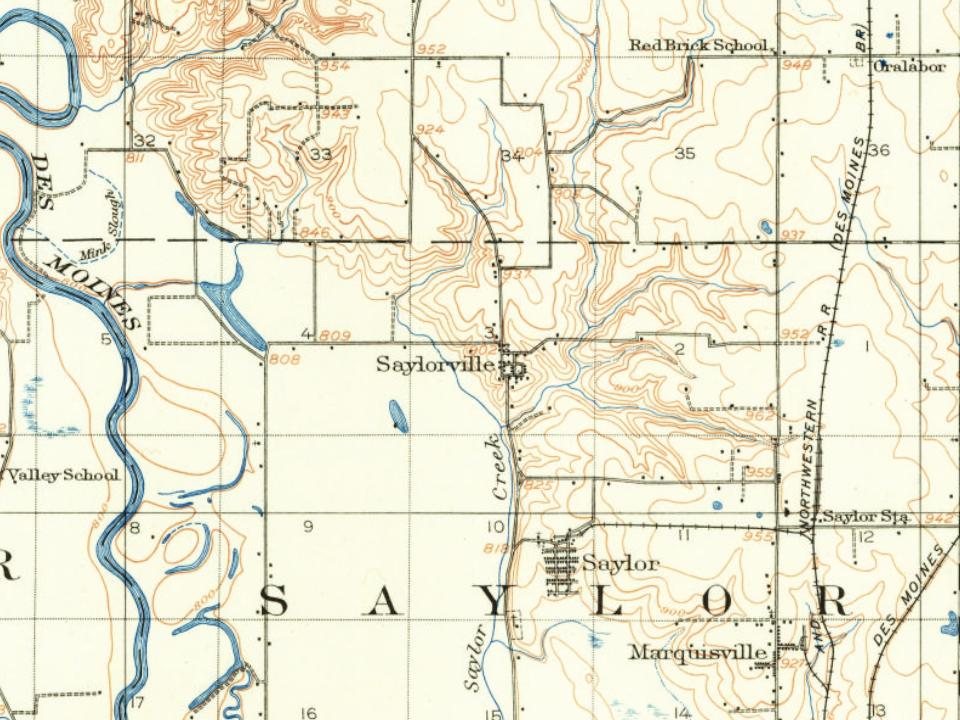
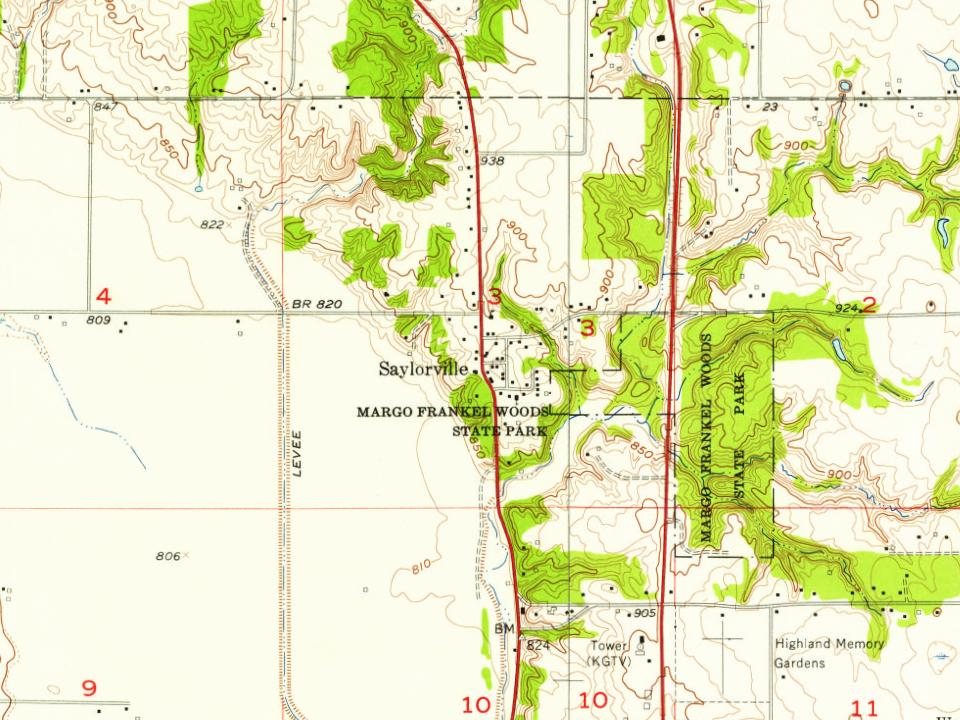
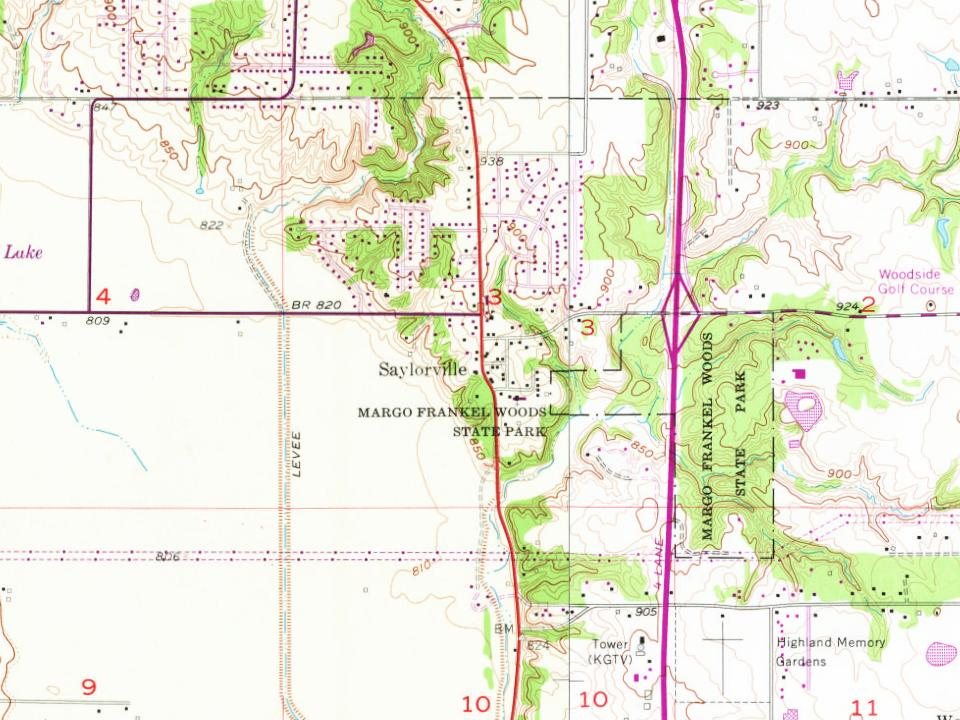
The Saylorville post office opened in 1850, the earliest record of the town by name. Two smaller post offices, Keen (1898) and Carney (1908), opened inside today’s town and later closed.
First census: 2,709 in 19902020 census: 3,584176 years
How historic is Saylorville?
C
More historic than 27% of U.S. towns, on its age, its old homes and the National Register.
Founding year: the first Saylorville post office (Blevins & Helbock, CC0).The full story ↓
History grade
What drives Saylorville’s History grade
On its age, its old homes and the National Register, Saylorville is more historic than 27% of U.S. towns, #114 of 140 in Iowa. Its share of homes from before 1940 holds the grade up; its National Register listings pull it down.
C
HistoryA character grade: shown, never part of Saylorville’s overall grade.
Iowa towns list more on the Register than most of the country (a typical Iowa town has 9.1 per 10,000 residents, the U.S. 2.4), so Saylorville’s 0.0 sits below most of its state (17% of Iowa towns have fewer) while its 0 listings outnumber those of 23% of U.S. towns.
How sure. Graded on any two of the three inputs instead, the letter would range from D to C+. The pre-1940 share is a Census survey estimate (±7.3 points). The founding year is the first post office, not a stated founding date.
Founding year: the first post office (other dates in Quick answers). Homes: Census ACS 2020–24. National Register: National Park Service, May 2026 list; each listing counted once (boundary changes and added documentation belong to their listing), and a historic district counts its contributing buildings. How TownRatings grades history →
What stands out about Saylorville’s past
Read from the archive, the National Register and the record. The page puts what stands out first.
Passages that mention Saylorville, cut from the printed page as they were published.
The history of Polk County, Iowa1880 · page 646Read the page →
Read the text
SAYLORVILLE was laid out by John B. Saylor in 1850. The town was located in the center of section three; a new town was laid out by Mr. Saylor in 1855, adjoining the old town, and called New Saylorville. On account of the location of the railroad some two miles east, and the establishment of a station, the town of Saylorville has been going back during the past few years.
Text read by machine from the scan; it may contain errors.
Des Moines, the pioneer of municipal progress and reform of the middle West, together with the history of Polk County, Iowa, the largest, most populous and most prosperous county in the state of Iowa1911 · page 1074Read the page →
Read the text
to be released from the contract. His request was acceded to and the building was completed, the total cost being two thousand and fifteen dollars. Saylor town¬ ship was separated from Des Moines township in 1848 and named in honor of the Saylor settlement. In 1850 Mr. Saylor laid out the town of Saylorville and five } eai s later made additions to its area. It prospered for a while and was a rival of the fort for the location of the county seat, but after the railroad was built through to Ames, passing the town at a distance of two miles, its glory departed and it rapidly dwindled away. During the Civil war Mr. Saylor joined the army
Text read by machine from the scan; it may contain errors.
Centennial history of Polk County, Iowa1876 · page 85Read the page →
Read the text
John Saylor, afterwards so prominent in the county, settled here in 1845, and gave the name to the township. He laid out Saylorville, May Ist, 1851, James Ewing built the first frame house, and Mr. Case from Four Mile Township taught the first school. The mills of Messrs. Tidrick and Bales were heavily patronized. The Methodists built a church in 1858. John Whitmer was one of the first settlers in the vicinity of Saylorville. The village having been left out
Text read by machine from the scan; it may contain errors.
The history of Polk County, Iowa1880 · page 951Read the page →
Read the text
continuing in business there until 1849; at that time he went to Terre Haute, Indiana, and opened a boot and shoe store, running a shop in connection with it. He made that place his home until 1855, when he came to Iowa and located near Saylorville, this county, engaging there in farming. The following year he moved into Saylorville, opened a shop, and in 1876 came to Altoona and there opened a shop which he still carries on.
Text read by machine from the scan; it may contain errors.
Scans and text from the Internet Archive. Books published in 1930 or earlier, which are in the public domain.
Timeline
Saylorville, 1850 to 1920
Woven from the archive, old maps, post office records, the National Register and the people born here.
The Saylorville post office opened in 1850, the earliest record of the town by name (U.S. post office records).
How does Saylorville rank for history?
Saylorville is more historic than 27% of U.S. towns, #114 of 140 in Iowa. The History grade combines the town’s founding era, the share of homes built before 1940 and its National Register listings. It’s a character grade, so it isn’t part of the overall grade. How it works.
How old are the homes in Saylorville?
10% of Saylorville’s homes were built before 1940 (Census estimate, ±7.3 points), against a typical 22% for an Iowa town; the median home was built in 1974.
Founding dates: Wikidata, Wikipedia, the U.S. post office records of Blevins & Helbock (CC0) and the Census. Homes by year built: Census ACS 2020–24. National Register of Historic Places: National Park Service (list of May 22, 2026). Old photos, postcards and papers: Wikimedia Commons, the Library of Congress and other public archives, credited on each item’s page. Maps: U.S. Geological Survey historical topographic maps (via Esri) and Sanborn fire-insurance maps (Library of Congress). History text and census tables: Wikipedia (CC BY-SA 4.0). Places that used to be: USGS Geographic Names Information System (2021).
From Wikipedia, U.S. Geological Survey historical maps, U.S. Census counts (via Wikipedia), the US Post Offices dataset (Blevins & Helbock), the USGS Geographic Names Information System and old county and town histories (Internet Archive). Archive images are copied here with their credits and licenses, shown on each photo’s page. Refreshed monthly.