7 places in town are on the National Register, among them two historic districts with 5 buildings between them. Below: maps from 1893 on and the census since 1870.
Founding year: Wikidata; Wikipedia’s history section gives the same year. First post office: 1857.The full story ↓
History grade
What drives Sac City’s History grade
On its age, its old homes and the National Register, Sac City is more historic than 78% of U.S. towns. Its share of homes from before 1940 holds the grade up; its age pulls it down.
A−
HistoryA character grade: shown, never part of Sac City’s overall grade.
Iowa towns list more on the Register than most of the country (a typical Iowa town has 9.1 per 10,000 residents, the U.S. 2.4), so Sac City’s 63.7 sits above most of its state (77% of Iowa towns have fewer) while its 12 historic buildings outnumber those of 77% of U.S. towns.
How sure. Graded on any two of the three inputs instead, the letter would range from B to A. The pre-1940 share is a Census survey estimate (±6.3 points). Two sources give 1855.
Founding year: Wikidata (other dates in Quick answers). Homes: Census ACS 2020–24. National Register: National Park Service, May 2026 list; each listing counted once (boundary changes and added documentation belong to their listing), and a historic district counts its contributing buildings. How TownRatings grades history →
What stands out about Sac City’s past
Read from the archive, the National Register and the record. The page puts what stands out first.
Peaked at 3,354 in 1960; 2,063 people lived here in 2020.
16 censuses, 1870–2020.
U.S. Census Bureau decennial counts, from the census table on Sac City’s Wikipedia page.
Every building
Sac City, building by building, 1893–1915
Fire insurance maps drew every building, what it was made of and what it was used for, so insurers could price the risk of fire. Pick a year, then a sheet.
Sac City was first platted in 1855 by Joshua Keith Powell of Fort Dodge, Iowa. The town was so named because the Sac and Meskwaki peoples were in possession of the land at the time of the Louisiana Purchase. The City of Sac City was incorporated 19 years later, in 1874.
Judge Eugene Criss, credited as the father of Sac City, left Wisconsin and crossed the Mississippi River in early 1855 by covered wagon. He was in search of waterpower and wanted to establish a settlement in new, untried country. Deciding upon the North Raccoon River for his settlement, Criss erected the first log cabin in Sac City, established himself in the hotel business, and kept a stage station and general store for nearby settlers.
the same to be held on the 12th day of July, A. D. 19 10, for the purpose of submitting to the qualified \oters of the incorporated city of Sac City, Iowa, the proposition of providing and maintaining a free public lilirary in the city of Sac City, Iowa; that a tax not to exceed thi-ee mills on the dollar of the assessable property of the incorporated city of Sac City, Iowa, be levied fo-r the maintenance of said library; that notice of the election be published in the Sac Sun and the Sac County Bulletin: and that the requirements and conditions of Andrew Carnegie be complied with in accepting his donations for
Text read by machine from the scan; it may contain errors.
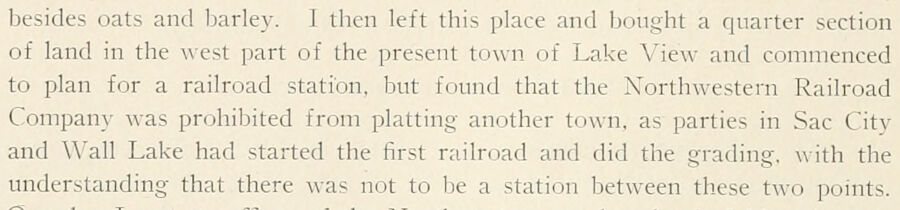
besides oats and barley. I then left this place and bought a quarter section of land in the west part of the present town of Lake View and commenced to plan for a railroad station, but found that the Northwestern Railroad Company was prohibited from platting another town, as parties in Sac City and Wall Lake had started the first railroad and did the grading, with the understanding that there was not to be a station between these two points.
Text read by machine from the scan; it may contain errors.
Scans and text from the Internet Archive. Books published in 1930 or earlier, which are in the public domain.
Timeline
Sac City, 1855 to 1980
Woven from the archive, old maps, post office records, the National Register and the people born here.
US Post Offices dataset (Blevins & Helbock, CC0). Places and cemeteries from the USGS Geographic Names Information System (2021).
Questions about Sac City’s history
What year was Sac City founded?
In 1855, according to Wikidata and Wikipedia’s history of the town. Sac City’s post office opened in 1857, and the census of 1870 counted 156 people here.
How does Sac City rank for history?
Sac City is more historic than 78% of U.S. towns. The History grade combines the town’s founding era, the share of homes built before 1940 and its National Register listings. It’s a character grade, so it isn’t part of the overall grade. How it works.
What is on the National Register in Sac City?
7 listings: 5 buildings, among them the Sac County Courthouse (listed 1981, the first), and 2 historic districts, the Sac City Monument Square Historic District and the Chautauqua Park Historic District, with 5 contributing buildings. 12 historic buildings in all.
How old are the homes in Sac City?
30% of Sac City’s homes were built before 1940 (Census estimate, ±6.3 points), against a typical 22% for an Iowa town; the median home was built in 1962.
Founding dates: Wikidata, Wikipedia, the U.S. post office records of Blevins & Helbock (CC0) and the Census. Homes by year built: Census ACS 2020–24. National Register of Historic Places: National Park Service (list of May 22, 2026). Old photos, postcards and papers: Wikimedia Commons, the Library of Congress and other public archives, credited on each item’s page. Maps: U.S. Geological Survey historical topographic maps (via Esri) and Sanborn fire-insurance maps (Library of Congress). History text and census tables: Wikipedia (CC BY-SA 4.0). Places that used to be: USGS Geographic Names Information System (2021).
From Wikimedia Commons (10), Wikidata (2), the National Register of Historic Places (7), Wikipedia, Wikidata and Wikipedia for famous people, U.S. Geological Survey historical maps, U.S. Census counts (via Wikipedia), the US Post Offices dataset (Blevins & Helbock), the USGS Geographic Names Information System, Sanborn fire insurance maps (Library of Congress) and old county and town histories (Internet Archive). Archive images are copied here with their credits and licenses, shown on each photo’s page. Refreshed monthly.




 2010
 2010
 2010
 2010
 2010
 2010
 2010
 2010
 2010
 2004