New Vienna was settled by Germans with assistance from the Emperor of Austria. It was founded in 1843.
St. Boniface Catholic Church was established for the local families that established New Vienna. This church is notable for its late 19th-century William Schuelke pipe organ, one of the few original remaining Schuelke Organs. Except for an electric blower, it has been basically unaltered since installation.
Passages that mention New Vienna, cut from the printed page as they were published.
The history of Dubuque County, Iowa1880 · page 381Read the page →
Read the text
Some settlements were made in Vernon and Taylor Townships, and a colony was established at New Vienna by Germans, where schoolhouses, blacksmithshops, grocery stores, a mill, tavern, church and other buildings were put up. The colonists belonged chiefly to the Catholic denomination, and were a frugal, industrious people.
Text read by machine from the scan; it may contain errors.
History of Dubuque County, Iowa1911 · page 879Read the page →
Read the text
and at first worshiped in a frame house near the bridge on Main street, under the ministrations of Rev. Fr. Langfelz. who, after five months, departed and the congregation was supplied from New Vienna. Soon a brick church was erected and in 1862 Rev. Fr. Kortenkamp became pastor and the congregation again became a separate parish. Among the first members were the families of Stoeckel, Schindler, Goerdt. Schultz, Holscher, Steger. Christoph, Henry, Burkle, Reittenger, Kramer, Stoeckl, Stockerl and others.
Text read by machine from the scan; it may contain errors.
History of Dubuque County, Iowa1911 · page 595Read the page →
Read the text
University. He then taught for a time in the public schools of Delaware county, Iowa, later entering the Chicago Homeopathic College and graduating therefrom in 1890 with the degree of Doctor of Medicine. Until 1896 he practiced his profession at New Vienna, Dubuque county, then returned to Chicago and took a one year's course in the College of Physicians and Surgeons. In 1900 he spent a number of months in Europe, doing hospital work. He located for eleven years at Dyersville and then took a post-graduate course
Text read by machine from the scan; it may contain errors.
Scans and text from the Internet Archive. Books published in 1930 or earlier, which are in the public domain.
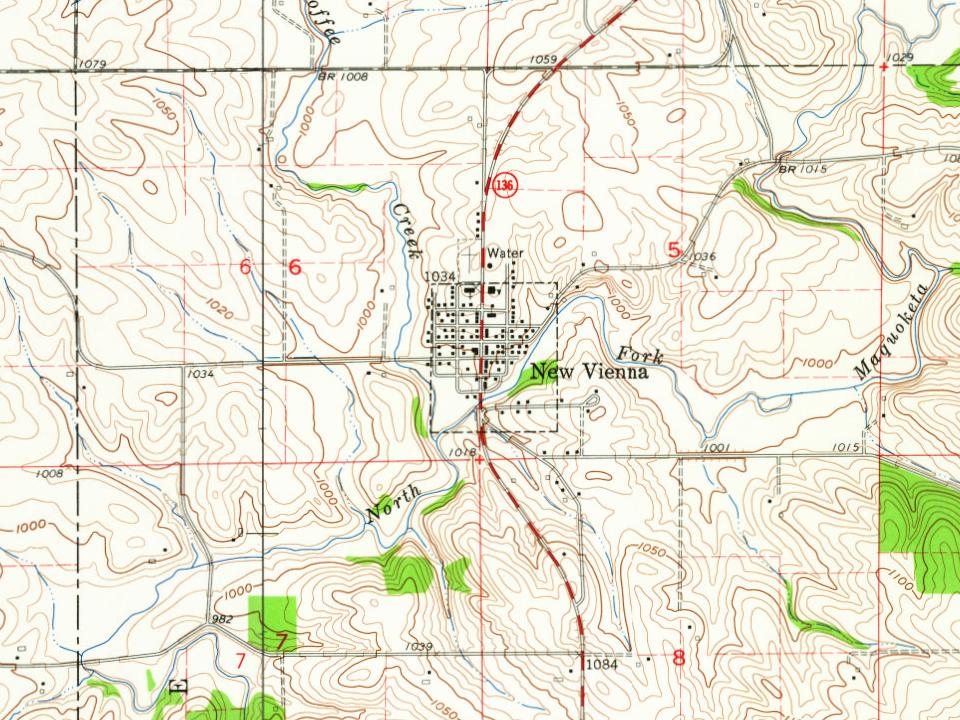
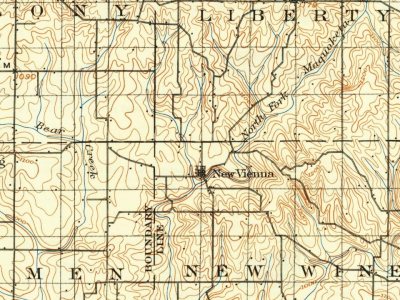
Founding dates: Wikidata, Wikipedia, the U.S. post office records of Blevins & Helbock (CC0) and the Census. Homes by year built: Census ACS 2020–24. National Register of Historic Places: National Park Service (list of May 22, 2026). Old photos, postcards and papers: Wikimedia Commons, the Library of Congress and other public archives, credited on each item’s page. Maps: U.S. Geological Survey historical topographic maps (via Esri) and Sanborn fire-insurance maps (Library of Congress). History text and census tables: Wikipedia (CC BY-SA 4.0). Places that used to be: USGS Geographic Names Information System (2021). How TownRatings grades history →
From Wikimedia Commons (1), the National Register of Historic Places (1), Wikipedia, Wikidata and Wikipedia for famous people, U.S. Geological Survey historical maps, U.S. Census counts (via Wikipedia), the US Post Offices dataset (Blevins & Helbock), the USGS Geographic Names Information System, Sanborn fire insurance maps (Library of Congress) and old county and town histories (Internet Archive). Archive images are copied here with their credits and licenses, shown on each photo’s page. Refreshed monthly.





 2004

