Knoxville dates to 1845, and 21% of its homes were built before 1940
More historic than 88% of U.S. towns · #28 of 140 in Iowa. What drives it
4 places in town are on the National Register, among them two historic districts with 35 buildings between them. Below: maps from 1886 on and the census since 1860.
Founding year: Wikipedia. First post office: 1846.The full story ↓
History grade
What drives Knoxville’s History grade
On its age, its old homes and the National Register, Knoxville is more historic than 88% of U.S. towns, #28 of 140 in Iowa. All 3 inputs are above most U.S. towns; its National Register listings ranks highest and its share of homes from before 1940 lowest.
A
HistoryA character grade: shown, never part of Knoxville’s overall grade.
Iowa towns list more on the Register than most of the country (a typical Iowa town has 9.1 per 10,000 residents, the U.S. 2.4), so Knoxville’s 49.5 sits above most of its state (75% of Iowa towns have fewer) while its 37 historic buildings outnumber those of 83% of U.S. towns.
How sure. Graded on any two of the three inputs instead, the letter would range from A− to A. The pre-1940 share is a Census survey estimate (±4.3 points). Two sources give 1845.
Founding year: Wikipedia (other dates in Quick answers). Homes: Census ACS 2020–24. National Register: National Park Service, May 2026 list; each listing counted once (boundary changes and added documentation belong to their listing), and a historic district counts its contributing buildings. How TownRatings grades history →
What stands out about Knoxville’s past
Read from the archive, the National Register and the record. The page puts what stands out first.
National Park Service, National Register of Historic Places. Photos from Wikimedia Commons, credited on each place’s page.
Every building
Knoxville, building by building, 1886–1913
Fire insurance maps drew every building, what it was made of and what it was used for, so insurers could price the risk of fire. Pick a year, then a sheet.
The site for the future county seat of Marion County was selected because it was within a mile of the county's geographic center, reasonably level, and near a good source of timber.
Knoxville is in south-central Iowa, 35 miles southeast of Des Moines. The area was originally inhabited by Native Americans of the Sac and Meskwaki tribes. At that time, prairie grass covered the countryside at heights of 8 to 10 feet. In 1835, Dragoons first explored the Des Moines River valley through this area. In 1842, the Sac and Fox Indians signed a treaty to sell lands in central Iowa to the new settlers known as the New Purchase of 1842. By 1843, settlers began moving here. The first Marion County Courthouse was erected three years later.
Passages that mention Knoxville, cut from the printed page as they were published.
History of Marion County, Iowa, and its people1915 · page 285Read the page →
Read the text
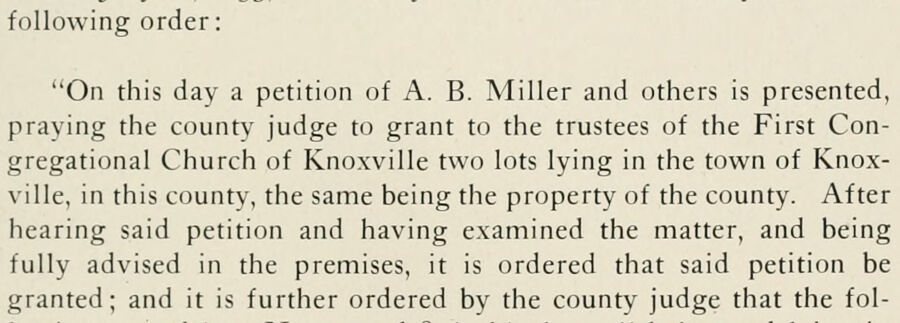
following order: "On this day a petition of A. B. Miller and others is presented, praying the county judge to grant to the trustees of the First Congregational Church of Knoxville two lots lying in the town of Knoxville, in this county, the same being the property of the county. After hearing said petition and having examined the matter, and being fully advised in the premises, it is ordered that said petition be granted; and it is further ordered bv the countv judge that the fol-
Text read by machine from the scan; it may contain errors.
History of Marion County, Iowa, and its people1915 · page 346Read the page →
Read the text
Union 540 553 425 Washington 986 1,043 830 Total 23,058 24,159 22,995 In the above table the City of Knoxville is included in Knoxville Township, Pella in Lake Prairie Township, and the several incorporated towns in the townships in which they are located. Since the census of 1910 was taken a new railroad has been built through the western part of the county and it is quite probable that the state census
Text read by machine from the scan; it may contain errors.
Pioneers of Marion county, consisting of a general history of the county from its early settlement to the present date. Also, the geography and history of each township, including brief biographical sketches of some of the more prominent early settlers in1872 · page 76Read the page →
Read the text
Boarding Houses — Sleeping in the Court Room — A Sketch of Judge Williams* Isaac B. Powers, county surveyor, platted part of the town of Knoxville shortly after it was located, and Claiborn Hall laid out the remainder in the winter of 1846-7. George Gillaspy was appointed auctioneer to sell lots, and the first sale came off on the 21st of October, 1845, and the second in April, 1846. In those days, as has been heretofore stated, money
Text read by machine from the scan; it may contain errors.
Scans and text from the Internet Archive. Books published in 1930 or earlier, which are in the public domain.
Timeline
Knoxville, 1845 to 1980
Woven from the archive, old maps, post office records, the National Register and the people born here.
Colonial Terrace Mobile Home ParkWheel Estates Mobile Home Park
1cemetery inside Knoxville
Schlotterback
US Post Offices dataset (Blevins & Helbock, CC0). Places and cemeteries from the USGS Geographic Names Information System (2021).
Questions about Knoxville’s history
What year was Knoxville founded?
In 1845, according to Wikipedia’s history of the town. Knoxville’s post office opened in 1846, and the census of 1860 counted 1,124 people here.
How does Knoxville rank for history?
Knoxville is more historic than 88% of U.S. towns, #28 of 140 in Iowa. The History grade combines the town’s founding era, the share of homes built before 1940 and its National Register listings. It’s a character grade, so it isn’t part of the overall grade. How it works.
What is on the National Register in Knoxville?
4 listings: 2 buildings, among them the Marion County Courthouse (listed 1981, the first), and 2 historic districts, the Knoxville WPA Athletic Field Historic District and the Knoxville Veterans Administration Hospital Historic District, with 35 contributing buildings. 37 historic buildings in all.
How old are the homes in Knoxville?
21% of Knoxville’s homes were built before 1940 (Census estimate, ±4.3 points), against a typical 22% for an Iowa town; the median home was built in 1971.
Founding dates: Wikidata, Wikipedia, the U.S. post office records of Blevins & Helbock (CC0) and the Census. Homes by year built: Census ACS 2020–24. National Register of Historic Places: National Park Service (list of May 22, 2026). Old photos, postcards and papers: Wikimedia Commons, the Library of Congress and other public archives, credited on each item’s page. Maps: U.S. Geological Survey historical topographic maps (via Esri) and Sanborn fire-insurance maps (Library of Congress). History text and census tables: Wikipedia (CC BY-SA 4.0). Places that used to be: USGS Geographic Names Information System (2021).
From Wikimedia Commons (5), Wikidata (1), the National Register of Historic Places (4), Wikipedia, Wikidata and Wikipedia for famous people, U.S. Geological Survey historical maps, U.S. Census counts (via Wikipedia), the US Post Offices dataset (Blevins & Helbock), the USGS Geographic Names Information System, Sanborn fire insurance maps (Library of Congress) and old county and town histories (Internet Archive). Archive images are copied here with their credits and licenses, shown on each photo’s page. Refreshed monthly.




 2016
 2014
 2012
 2007
 2007


