19 places in town are on the National Register, among them four historic districts with 54 buildings between them. Below: 4 old photos and papers from 1869 on and old-book passages.
Founding year: the first Guttenberg post office (Blevins & Helbock, CC0). Wikidata: 1851.The full story ↓
History grade
What drives Guttenberg’s History grade
On its age, its old homes and the National Register, Guttenberg is more historic than 96% of U.S. towns. All 3 inputs are above most U.S. towns; its National Register listings ranks highest and its age lowest.
A+
HistoryA character grade: shown, never part of Guttenberg’s overall grade.
Iowa towns list more on the Register than most of the country (a typical Iowa town has 9.1 per 10,000 residents, the U.S. 2.4), so Guttenberg’s 393 sits above most of its state (100% of Iowa towns have fewer) while its 70 historic buildings outnumber those of 87% of U.S. towns.
How sure. Graded on any two of the three inputs instead, the letter would range from A to A+. The pre-1940 share is a Census survey estimate (±7.5 points). The founding year is the first post office, not a stated founding date; Wikidata gives 1851.
Founding year: the first post office (other dates in Quick answers). Homes: Census ACS 2020–24. National Register: National Park Service, May 2026 list; each listing counted once (boundary changes and added documentation belong to their listing), and a historic district counts its contributing buildings. How TownRatings grades history →
What stands out about Guttenberg’s past
Read from the archive, the National Register and the record. The page puts what stands out first.
Prairie La Porte, meaning "the door to the prairie," was the first name given to Guttenberg by French explorers in 1673. The Guttenberg area was a site of Sauk and Meskwaki campgrounds until 1823. The Louisiana Purchase of 1803 transferred ownership to the United States and the Black Hawk Purchase of 1833 finally opened the area for legal settlement.
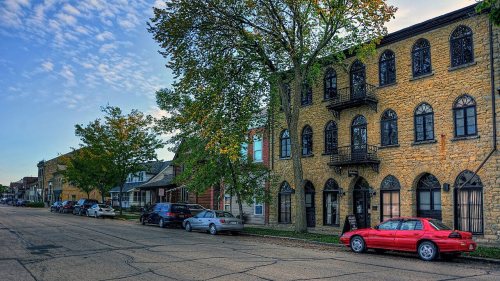
Guttenberg's past is preserved today in the many limestone buildings built by German immigrants in the mid-to-late 19th century. These structures were used for both residential and commercial purposes. Many such as the Albertus Building are pre–Civil War era and are preserved in the Front Street Historic District.
Passages that mention Guttenberg, cut from the printed page as they were published.
History of Clayton County, Iowa1916 · page 343Read the page →
Read the text
GUTTENBERG In 1900, Guttenberg voted an electric light franchise but this was allowed to default and it was proposed that the city would use gas. Guttenberg was organized under a special charter just as were many of the cities of the early day. Later legislation, however, gave cities regularly organized greater advantages than were held by the cities of the special charter and in 1902, Guttenberg abandoned its old charter and became as other Iowa cities. As a result of municipal
Text read by machine from the scan; it may contain errors.
History of Clayton County, Iowa1916 · page 433Read the page →
Read the text
About six miles below the town of Guttenberg, Turkey river discharges its waters into the main channel of the Mississippi nearly opposite the town of Cassville, Wisconsin. This river is about ninety miles in length, flowing by trunk and tributary through the counties of Howard, Winneshiek, Chickasaw, Fayette and Clayton. From the earliest acquaintance of the white trader with the different Indian tribes of the upper Mississippi, this river was recognized as being in the possession and occupancy of Saw-kee and Mus-qua-kee Indians,
Text read by machine from the scan; it may contain errors.
Scans and text from the Internet Archive. Books published in 1930 or earlier, which are in the public domain.
Timeline
Guttenberg, 1847 to 1995
Woven from the archive, old maps, post office records, the National Register and the people born here.
Nothing in the archives for these yearsWeddings on Main Street, storms, parades, school pictures, the old store. If it’s in your family album, it belongs here.
The Guttenberg post office opened in 1847, the earliest record of the town by name (U.S. post office records). Wikidata gives 1851.
How does Guttenberg rank for history?
Guttenberg is more historic than 96% of U.S. towns. The History grade combines the town’s founding era, the share of homes built before 1940 and its National Register listings. It’s a character grade, so it isn’t part of the overall grade. How it works.
What is on the National Register in Guttenberg?
19 listings: 15 buildings, among them the Albertus Building (listed 1979, the first), and 4 historic districts with 54 contributing buildings. 70 historic buildings in all.
How old are the homes in Guttenberg?
32% of Guttenberg’s homes were built before 1940 (Census estimate, ±7.5 points), against a typical 22% for an Iowa town; the median home was built in 1961.
Founding dates: Wikidata, Wikipedia, the U.S. post office records of Blevins & Helbock (CC0) and the Census. Homes by year built: Census ACS 2020–24. National Register of Historic Places: National Park Service (list of May 22, 2026). Old photos, postcards and papers: Wikimedia Commons, the Library of Congress and other public archives, credited on each item’s page. Maps: U.S. Geological Survey historical topographic maps (via Esri) and Sanborn fire-insurance maps (Library of Congress). History text and census tables: Wikipedia (CC BY-SA 4.0). Places that used to be: USGS Geographic Names Information System (2021).
From Wikimedia Commons (6), the National Register of Historic Places (19), Wikipedia, Wikidata and Wikipedia for famous people, the US Post Offices dataset (Blevins & Helbock), the USGS Geographic Names Information System and old county and town histories (Internet Archive). Archive images are copied here with their credits and licenses, shown on each photo’s page. Refreshed monthly.




 1996
 2007
 2004