Garner dates to 1870, and 22% of its homes were built before 1940
More historic than 58% of U.S. towns · #95 of 140 in Iowa. What drives it
Its Register listings are the Hancock County Courthouse and the Avery Theater, The. Below: 2 old photos and papers, maps from 1900 on, and the census since 1880.
Founding year: Wikipedia. First post office: 1871.The full story ↓
History grade
What drives Garner’s History grade
On its age, its old homes and the National Register, Garner is more historic than 58% of U.S. towns, #95 of 140 in Iowa. Its share of homes from before 1940 holds the grade up; its age pulls it down.
B
HistoryA character grade: shown, never part of Garner’s overall grade.
Iowa towns list more on the Register than most of the country (a typical Iowa town has 9.1 per 10,000 residents, the U.S. 2.4), so Garner’s 6.6 sits near the middle of its state (49% of Iowa towns have fewer) while its 2 listings outnumber those of 60% of U.S. towns.
How sure. Graded on any two of the three inputs instead, the letter would range from C+ to B+. The pre-1940 share is a Census survey estimate (±6.3 points). Two sources give 1870.
Founding year: Wikipedia (other dates in Quick answers). Homes: Census ACS 2020–24. National Register: National Park Service, May 2026 list; each listing counted once (boundary changes and added documentation belong to their listing), and a historic district counts its contributing buildings. How TownRatings grades history →
What stands out about Garner’s past
Read from the archive, the National Register and the record. The page puts what stands out first.
Garner was named after Col. W. W. Garner, a civil engineer on the Chicago, Milwaukee & St. Paul Railroad. In 1870, Garner was platted by the Chicago, Milwaukee and St. Paul Railway and was incorporated in 1881 with a population of 321 at that time. In the 1880s, the Duesenberg brothers, who later went on to build the Duesenberg automobile, operated a bicycle sales and repair business in Garner.
Passages that mention Garner, cut from the printed page as they were published.
History of Winnebago County and Hancock County, Iowa, a record of settlement, organization, progress and achievement ..1917Read the page →
Read the text
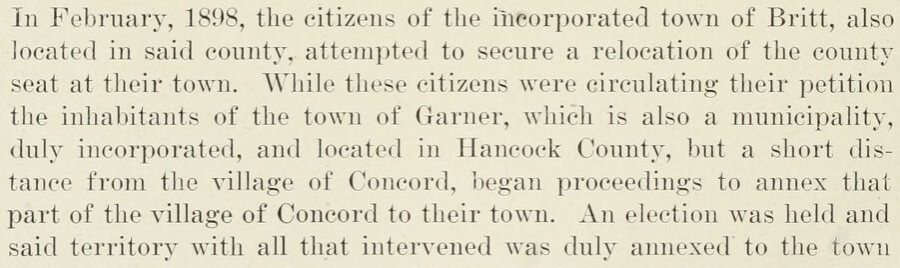
In February, 1898, the citizens of the incorporated town of Britt, also located in said county, attempted to secure a relocation of the county seat at their town. AVliile these citizens were circulating their petition the inhabitants of the town of Garner, which is also a municipality, duly incorporated, and located in Hancock County, but a short distance from the village of Concord, began proceedings to annex that part of the village of Concord to their town. An election was held and said territory with all that intervened was duly annexed to the town
Text read by machine from the scan; it may contain errors.
History of Winnebago County and Hancock County, Iowa, a record of settlement, organization, progress and achievement ..1917 · page 249Read the page →
Read the text
The question as to when the county seat was located at the town of Garner has not been satisfactorily answered by appellee's counsel. Of course, we will grant that, if Garner ever became the county seat the board of supervisors had the right to select a new site for the courthouse, provided they located it within the limits of the town. But we ask again : When did the legislature or the people of the county determine that Garner was the county seat? AVhen did the people of the county, who alone could determine u])on a relocation, say that it
Text read by machine from the scan; it may contain errors.
Scans and text from the Internet Archive. Books published in 1930 or earlier, which are in the public domain.
Timeline
Garner, 1870 to 1972
Woven from the archive, old maps, post office records, the National Register and the people born here.
Nothing in the archives for these yearsWeddings on Main Street, storms, parades, school pictures, the old store. If it’s in your family album, it belongs here.
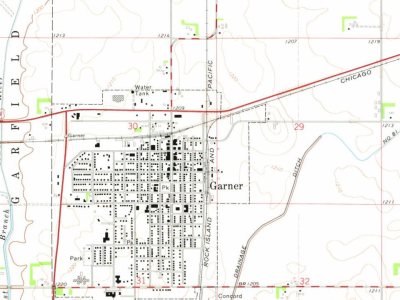
Every edition of the U.S. Geological Survey’s map of Garner. Tap a year, or press play to watch the town change.
1972Garner sheet · 1:24,000
U.S. Geological Survey historical topographic maps (public domain), via Esri’s collection of the scans. The red ring marks the center of Garner.
Every building
Garner, building by building, 1900–1907
Fire insurance maps drew every building, what it was made of and what it was used for, so insurers could price the risk of fire. Pick a year, then a sheet.
In 1870, according to Wikipedia’s history of the town. Garner’s post office opened in 1871, and the census of 1880 counted 321 people here.
How does Garner rank for history?
Garner is more historic than 58% of U.S. towns, #95 of 140 in Iowa. The History grade combines the town’s founding era, the share of homes built before 1940 and its National Register listings. It’s a character grade, so it isn’t part of the overall grade. How it works.
What is on the National Register in Garner?
Two places: the Hancock County Courthouse (listed 1981) and the Avery Theater, The (2008).
How old are the homes in Garner?
22% of Garner’s homes were built before 1940 (Census estimate, ±6.3 points), against a typical 22% for an Iowa town; the median home was built in 1972.
Founding dates: Wikidata, Wikipedia, the U.S. post office records of Blevins & Helbock (CC0) and the Census. Homes by year built: Census ACS 2020–24. National Register of Historic Places: National Park Service (list of May 22, 2026). Old photos, postcards and papers: Wikimedia Commons, the Library of Congress and other public archives, credited on each item’s page. Maps: U.S. Geological Survey historical topographic maps (via Esri) and Sanborn fire-insurance maps (Library of Congress). History text and census tables: Wikipedia (CC BY-SA 4.0). Places that used to be: USGS Geographic Names Information System (2021).
From Wikimedia Commons (5), the Library of Congress (1), the National Register of Historic Places (2), Wikipedia, Wikidata and Wikipedia for famous people, U.S. Geological Survey historical maps, U.S. Census counts (via Wikipedia), the US Post Offices dataset (Blevins & Helbock), the USGS Geographic Names Information System, Sanborn fire insurance maps (Library of Congress) and old county and town histories (Internet Archive). Archive images are copied here with their credits and licenses, shown on each photo’s page. Refreshed monthly.




 1907
 2021
 2013
 2013
 2004


