The Farmersburg post office opened in 1849, the earliest record of the town by name. Wikidata gives 1856. Another post office, Mendon (1849), opened inside today’s city and later closed.
First census: 143 in 19002020 census: 271177 years
Founding year: the first Farmersburg post office (Blevins & Helbock, CC0). Wikidata: 1856.The full story ↓
What stands out about Farmersburg’s past
Read from the archive, the National Register and the record. The page puts what stands out first.
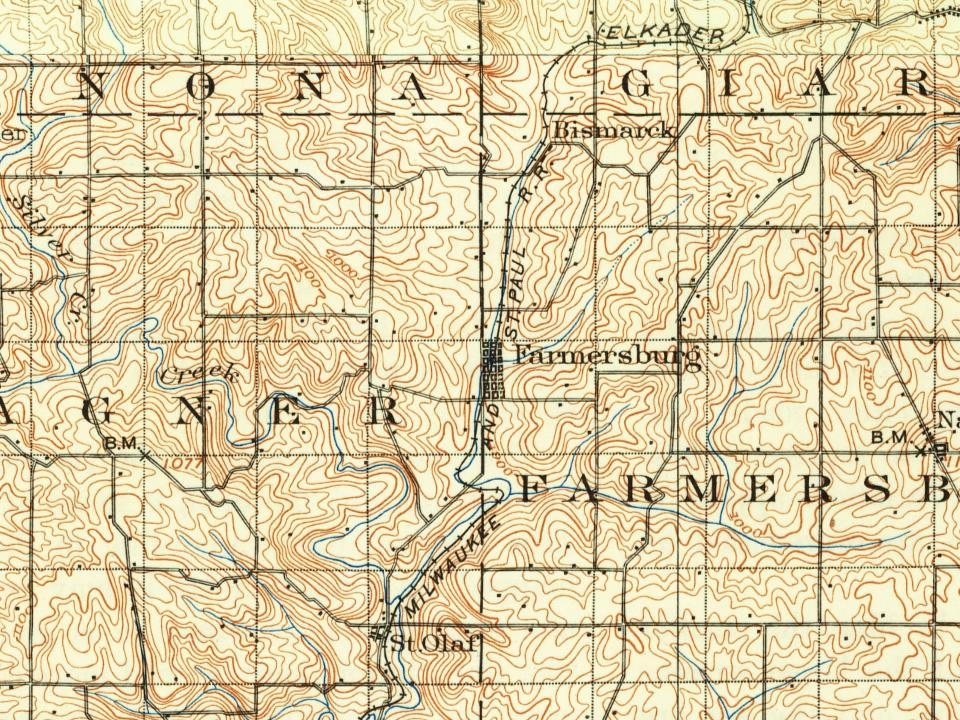
Every edition of the U.S. Geological Survey’s map of Farmersburg. Tap a year, or press play to watch the town change.
1902Elkader sheet · 1:125,000
U.S. Geological Survey historical topographic maps (public domain), via Esri’s collection of the scans. The red ring marks the center of Farmersburg.
From the old history books
What they wrote about Farmersburg in 1916
Passages that mention Farmersburg, cut from the printed page as they were published.
History of Clayton County, Iowa1916 · page 337Read the page →
Read the text
FARMERSBURG Farmersburg is a busy up-to-date little town of some 300 inhabitants, located on the Elkader branch of the Milwaukee railroad about midway between Beulah and Elkader. The pride of the city is in its opera house which was dedicated July 2, 1910, D. D. Murphy being the orator ; and the modern and substantial school house which was erected in 1914. The earlier history of Farmersburg has been given in preceding chapters. The present mayor is W. F. Fueling; clerk, Arnold
Text read by machine from the scan; it may contain errors.
History of Clayton County, Iowa1916 · page 209Read the page →
Read the text
has been erected and Patrick Heendan is station agent. The work on the Motor extension is to be prosecuted during the winter without cessation. At St. Claf station, T. C. Peterson is building a first class elevator and, at Farmersburg, Ben Johnson is about to double the capacity of his warehouse. At each of the stations there are buyers engaged in the purchase of grain and produce of all kinds. From all accounts we are disposed to think that better days are dawning on the career of the narrow gauge, and taking all things into con-
Text read by machine from the scan; it may contain errors.
Scans and text from the Internet Archive. Books published in 1930 or earlier, which are in the public domain.
Timeline
Farmersburg, 1849 to 1937
Woven from the archive, old maps, post office records, the National Register and the people born here.
Founding dates: Wikidata, Wikipedia, the U.S. post office records of Blevins & Helbock (CC0) and the Census. Homes by year built: Census ACS 2020–24. National Register of Historic Places: National Park Service (list of May 22, 2026). Old photos, postcards and papers: Wikimedia Commons, the Library of Congress and other public archives, credited on each item’s page. Maps: U.S. Geological Survey historical topographic maps (via Esri) and Sanborn fire-insurance maps (Library of Congress). History text and census tables: Wikipedia (CC BY-SA 4.0). Places that used to be: USGS Geographic Names Information System (2021). How TownRatings grades history →
From Wikimedia Commons (2), Wikipedia, Wikidata and Wikipedia for famous people, U.S. Geological Survey historical maps, U.S. Census counts (via Wikipedia), the US Post Offices dataset (Blevins & Helbock), the USGS Geographic Names Information System and old county and town histories (Internet Archive). Archive images are copied here with their credits and licenses, shown on each photo’s page. Refreshed monthly.


 2021
 2004