Charles City dates to 1851, and 28% of its homes were built before 1940
More historic than 77% of U.S. towns · #55 of 140 in Iowa. What drives it
13 places in town are on the National Register, among them three historic districts with 20 buildings between them. Below: 5 old photos and papers, maps from 1888 on, and the census since 1870.
Founding year: Wikidata. First post office: 1854.The full story ↓
History grade
What drives Charles City’s History grade
On its age, its old homes and the National Register, Charles City is more historic than 77% of U.S. towns, #55 of 140 in Iowa. Its share of homes from before 1940 holds the grade up; its age pulls it down.
A−
HistoryA character grade: shown, never part of Charles City’s overall grade.
Iowa towns list more on the Register than most of the country (a typical Iowa town has 9.1 per 10,000 residents, the U.S. 2.4), so Charles City’s 42.9 sits above most of its state (74% of Iowa towns have fewer) while its 31 historic buildings outnumber those of 82% of U.S. towns.
How sure. Graded on any two of the three inputs instead, the letter would range from B to A. The pre-1940 share is a Census survey estimate (±5.2 points). Two sources give 1851.
Founding year: Wikidata (other dates in Quick answers). Homes: Census ACS 2020–24. National Register: National Park Service, May 2026 list; each listing counted once (boundary changes and added documentation belong to their listing), and a historic district counts its contributing buildings. How TownRatings grades history →
What stands out about Charles City’s past
Read from the archive, the National Register and the record. The page puts what stands out first.
Fire insurance maps drew every building, what it was made of and what it was used for, so insurers could price the risk of fire. Pick a year, then a sheet.
The Ho-Chunk people, also known as Winnebago, had long occupied this area and had a village along the Cedar River.
In 1851 Joseph Kelly, the first-known European-American settler in the area, came here after the Ho-Chunk had been pushed out. He believed that the site was ideal for a town, as it had water from the Cedar River and adjacent timberland to supply building needs. The settlement was first called "Charlestown" after his son. By 1852, twenty-five other settler families had joined Kelly. The town name was changed, first to "St. Charles" and then to "Charles City," to avoid duplication of other Iowa town names.
Charles Kelly ^ for whom the town of Charles City was named, is a son of Joseph Kelly, a native of Ohio, and Malinda, nee Rader, of Virginia. Joseph Kelly came to Floyd County in 1856, and laid out the town of Charles City, naming it for his son, and built the first saw-mill in the county. They had a family of ten children, six living — Charles; Melvina, wife of Christopher Martin, of Monroe, Wis. ; Jane, wife of F. O. McCallister, a resident of Charles City; Harriet, widow of Chas. H. Haskell, is residing with
Text read by machine from the scan; it may contain errors.
Charles Kelly ^ for whom the town of Charles City was named, is a son of Joseph Eelly, a native of Ohio, and Malinda, nee Rader, of Virginia. Joseph Kelly came to Floyd County in 1856, and laid out the town of Charles City, naming it for his son, and built the first saw-mill in the county. They had a family of ten children, six living — Charles; Melvina, wife of Christopher Martin, of Monroe, Wis.; Jane, wife of F. O. McCallister, a resident of Charles City; Harriet, widow of Chas. H. Haskell, is residing with
Text read by machine from the scan; it may contain errors.
State, was a memorial to Congress asking for a grant of land to aid in tbe construction of a railroad on or near the forty-third parallel of north latitude, and passing from McGregor, on the Mississippi River, westward through his own town of Charles City. Repeated efforts had been made by others to obtain this land grant and secure the building of this railroad, but all had signally failed until the enterprise was taken hold of by Mr. Hildreth.
Text read by machine from the scan; it may contain errors.
State, was a memorial to Congress asking for a grant of land to aid in the construction of a railroad on or near the forty-third parallel of north latitude, and passing from McGregor, on the Mississippi River, westward through his own town of Charles City. Repeated eftorts had been made by others to obtain this land grant and secure the building of this railroad, but all had signally failed until the enterprise was taken hold of by Mr. Hildreth.
Text read by machine from the scan; it may contain errors.
Scans and text from the Internet Archive. Books published in 1930 or earlier, which are in the public domain.
Timeline
Charles City, 1851 to 1971
Woven from the archive, old maps, post office records, the National Register and the people born here.
Nothing in the archives for these yearsWeddings on Main Street, storms, parades, school pictures, the old store. If it’s in your family album, it belongs here.
Nothing in the archives for these yearsWeddings on Main Street, storms, parades, school pictures, the old store. If it’s in your family album, it belongs here.
In 1851, according to Wikidata. Charles City’s post office opened in 1854, and the census of 1870 counted 2,166 people here.
How does Charles City rank for history?
Charles City is more historic than 77% of U.S. towns, #55 of 140 in Iowa. The History grade combines the town’s founding era, the share of homes built before 1940 and its National Register listings. It’s a character grade, so it isn’t part of the overall grade. How it works.
What is on the National Register in Charles City?
13 listings: 9 buildings, 3 historic districts, the Wildwood Park Historic District, the Sherman Nursery Company Historic District and the Central Park-North Main Street Historic District, with 20 contributing buildings, and 1 structure. 31 historic buildings in all.
How old are the homes in Charles City?
28% of Charles City’s homes were built before 1940 (Census estimate, ±5.2 points), against a typical 22% for an Iowa town; the median home was built in 1960.
Founding dates: Wikidata, Wikipedia, the U.S. post office records of Blevins & Helbock (CC0) and the Census. Homes by year built: Census ACS 2020–24. National Register of Historic Places: National Park Service (list of May 22, 2026). Old photos, postcards and papers: Wikimedia Commons, the Library of Congress and other public archives, credited on each item’s page. Maps: U.S. Geological Survey historical topographic maps (via Esri) and Sanborn fire-insurance maps (Library of Congress). History text and census tables: Wikipedia (CC BY-SA 4.0). Places that used to be: USGS Geographic Names Information System (2021).
From Wikimedia Commons (5), the National Register of Historic Places (13), Wikipedia, U.S. Geological Survey historical maps, U.S. Census counts (via Wikipedia), the US Post Offices dataset (Blevins & Helbock), the USGS Geographic Names Information System, Sanborn fire insurance maps (Library of Congress) and old county and town histories (Internet Archive). Archive images are copied here with their credits and licenses, shown on each photo’s page. Refreshed monthly.


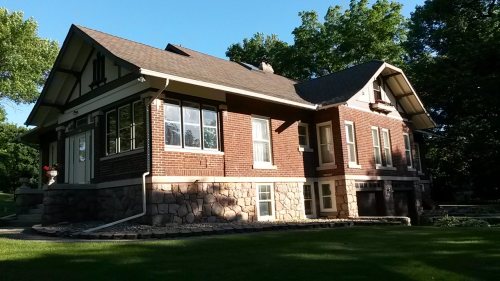


 1907
 1907

