Sandy Hook was founded in 1711 when several proprietors with land in the area relocated together to reduce isolation. Within a year of the settlement of Newtown, some of its proprietors began moving away from the central village to some of their larger parcels. Colonists found that the Pootatuck River at Sandy Hook allowed for saw and gristmills, leading to it becoming one of the first outlying areas to be settled.
Passages that mention Sandy Hook, cut from the printed page as they were published.
History of Fairfield county, Connecticut1881 · page 478Read the page →
Read the text
in this business, extending it from time to time, till 1842. Between the years 18.30 and 1842 he did a very heavy business, building and causing the erection of a large part of the village of Sandy Hook. In addition to his factory he ran a large general store, and bought a considerable tract of land and ran an extensive farm.
Text read by machine from the scan; it may contain errors.
History of Fairfield county, Connecticut1881 · page 462Read the page →
Read the text
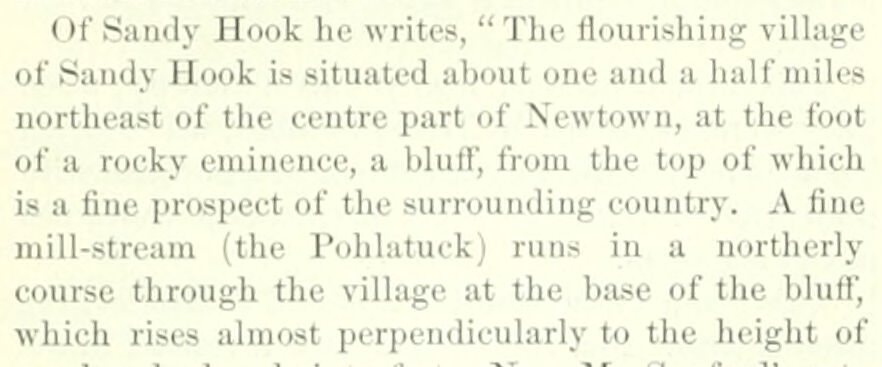
Of 8an(ly Hook he writes, "The flourishing village of Sandy Hook is situated about one and a half miles northeast of the eentrc part of Newtown, at the foot of a rocky eminence, a bluff, from the top of which is a fine prospect of the surrounding country. A fine mill-stream (the Pohlatuck) runs in a northerly course through the village at the base of the bluff, which rises almost perpendicularly to the height of
Text read by machine from the scan; it may contain errors.
History of Fairfield County, Connecticut, 1639-19281929Read the page →
Read the text
where he continued until 1906, when he became rector of Christ church at Oswego, New York. On the 11th of September, 1924, he entered upon his duties as rector of Trinity church of New¬ town and St. John’s church of Sandy Hook. The parishes have grown steadily and many young people have become identified with the two churches, which together have about three hundred communicants. He has not only won the love of his people but the respect and confidence of the entire community and his labors
Text read by machine from the scan; it may contain errors.
Scans and text from the Internet Archive. Books published in 1930 or earlier, which are in the public domain.
Founding dates: Wikidata, Wikipedia, the U.S. post office records of Blevins & Helbock (CC0) and the Census. Homes by year built: Census ACS 2020–24. National Register of Historic Places: National Park Service (list of May 22, 2026). Old photos, postcards and papers: Wikimedia Commons, the Library of Congress and other public archives, credited on each item’s page. Maps: U.S. Geological Survey historical topographic maps (via Esri) and Sanborn fire-insurance maps (Library of Congress). History text and census tables: Wikipedia (CC BY-SA 4.0). Places that used to be: USGS Geographic Names Information System (2021). How TownRatings grades history →
From Wikimedia Commons (4), Wikipedia, Wikidata and Wikipedia for famous people and old county and town histories (Internet Archive). Archive images are copied here with their credits and licenses, shown on each photo’s page. Refreshed monthly.



 2022
 2022
 2007
 2007