 Photo: Velatrix · CC0
3 old photographs of Waskaganish, 1910 to 1921
Its housing is mostly newer: 0% predates 1961, where the typical town has 18%. Building from 2016 to 2021 gave it 8.8% of its homes, where most towns have 4.1%.
Waskaganish through the years, 1910–1921
On one line by date: 3 old photographs of the town. Point at a dot for its year, or tap a picture to enlarge it.
 c. 1910
 1921
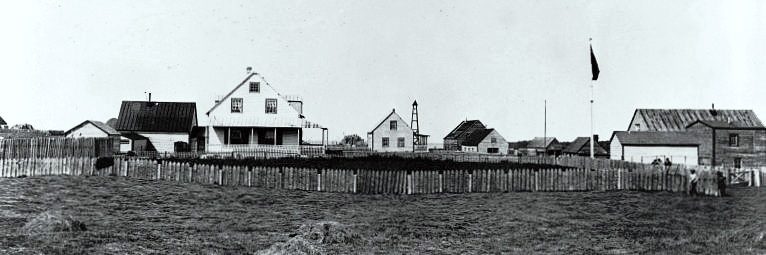 c. 1921
Public domain or CC0, made before 1950, from Wikimedia Commons; old views of places can be drawings, prints or maps of their time. Each credit opens the image’s page.
The biggest share of Waskaganish’s homes dates from 1981 to 2000: 55%
Half of the homes standing in Waskaganish today were built before 2001. Few of Waskaganish’s homes date from 1961 to 1980: 3.5%, the norm 27%. Waskaganish has an unusual share of homes built from 2001 to 2015: 32%, where most towns have 15%.
2021 Census, private dwellings by period of construction (Statistics Canada); the typical town is the middle Canadian town of 2,500 or more.
How Waskaganish compares with 16 towns its size
Towns of 2,700 to 2,700 residents, by places on the registers.
Just these have more: Saint-Charles-de-Bellechasse and Bonaventure. Their median is 0. For 14, the registers list nothing.
Waskaganish in brief
Its oldest homes, those from before 1961, are 0% of the total, against 18% in the typical town. Most towns its size have more historic places: the typical one has 0.
What this data can and can’t tell you
- People and events. Persons of national historic significance come with no location; a town gets one only by birthplace (name and both life years agreeing) or by one of its own places that bears the name and whose record tells the story. Events, which can’t be tied, are left out.
- Québec’s register. Québec’s Répertoire du patrimoine culturel records the province’s classements and declarations and every municipal citation, each with a description and a point.
- The federal register. Federal places come from Parks Canada’s directory, which counts National Historic Sites, federal heritage buildings, stations and lighthouses; their statements are the register’s own.
- The grade. History is described, not graded, for every Canadian town.
- The tiers. Three tiers: the top for National Historic Sites, classified federal buildings and Québec’s classements, a second for the other federal designations, a third for provincial and municipal listings.
- Protection. Here the register is also the protection: classement and citation under Québec’s cultural heritage law control changes, while federal recognition does not.
Questions about Waskaganish’s history
How old are the homes in Waskaganish?
0% predate 1961, where the typical town has 18%.
Contains information licensed under the Open Government Licence – Canada (Parks Canada).
Sources: Parks Canada, Directory of Federal Heritage Designations · Canadian Register of Historic Places (federal extract) · Wikidata (CC0) for map points, other names and articles · Statistics Canada, 2021 Census (homes by period of construction). Under the Statistics Canada Open Licence.
Adapted from Statistics Canada (Census of Population 2021, population estimates 2025, 2021 census boundaries) under the Statistics Canada Open Licence; this does not constitute an endorsement by Statistics Canada. Neighbourhood names in some cities © OpenStreetMap contributors (ODbL).