Classified heritage building (Québec) · 1889Maison Alix-Bail434 rue du Portage
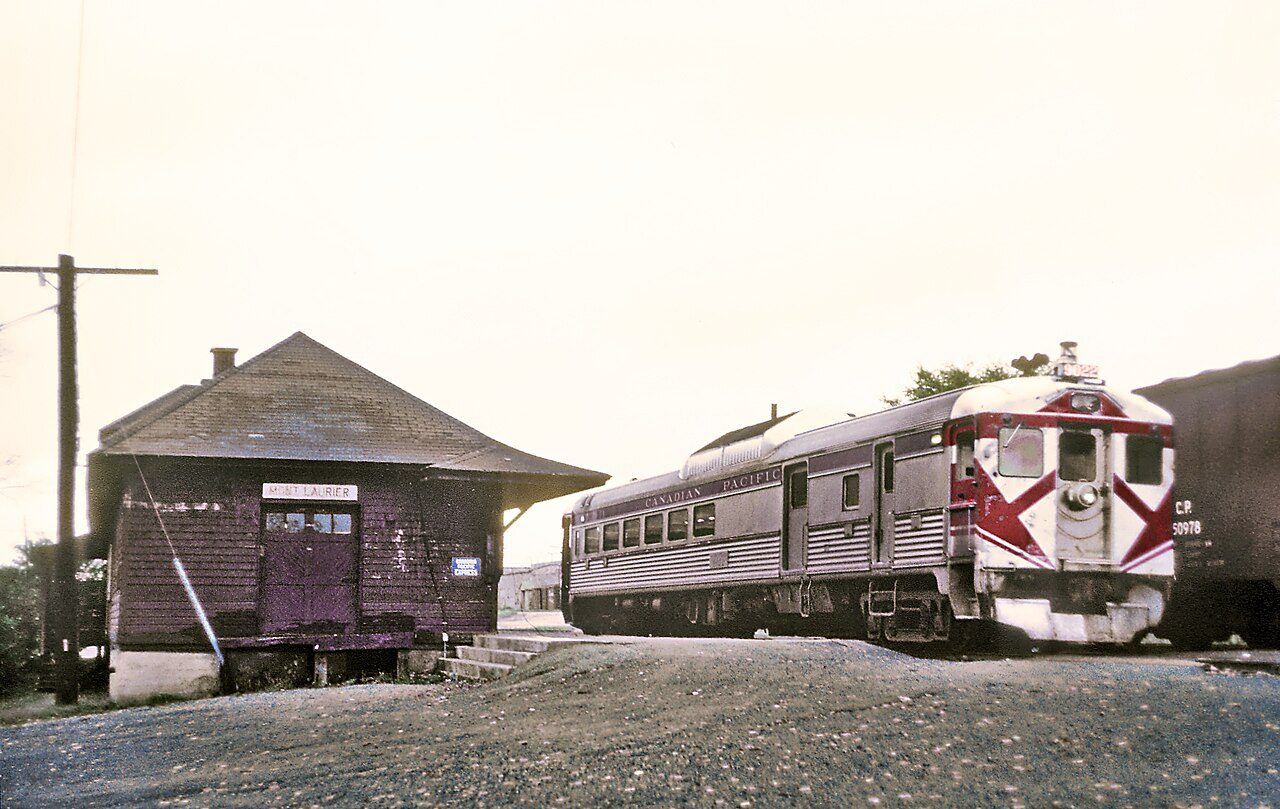 Canadian Pacific Railway Station, Mont-Laurier, Quebec · Photo: Roger Puta · Public domain
2historic places on the registers
History of Mont-Laurier · Canada’s heritage registers
One top designation among Mont-Laurier’s 2 historic places
Designations here include a heritage railway station. The earliest construction date, 1889, belongs to Maison Alix-Bail. The municipality’s date on Wikidata is October 14, 1909: a founding, an incorporation or an amalgamation, the record doesn’t say which. Per resident Mont-Laurier has more than 82% of Canadian towns: 1.4 for every 10,000 people.
Historic places
2
1.4 per 10,000 residents
Highest designations
1
National Historic Sites, classified federal buildings and Québec’s classements
Other federal designations
1
Recognized buildings, railway stations, lighthouses
Oldest building
1889
the first construction date on its record
Homes built before 1961
19%
typical town: 18%
The map
Where Mont-Laurier’s history is
Every place on the registers inside the town, by its designation.
Highest designationsOther federal designations
Tap any dot to open that place’s own page; hovering shows its name.
The 2, by tier
1 Highest designations1 Other federal designations
In Québec the record is fuller than elsewhere: beside Parks Canada’s designations, the province’s register lists its classements and every municipal citation.
Points from Wikidata (Parks Canada’s files carry none) and from Québec’s register, as mapped there.
Highest designations
One place in Mont-Laurier with the highest designation
National Historic Sites and Classified Federal Heritage Buildings, Canada’s highest federal recognition. Each one opens its own page.
Other federal designations
One other place Canada recognizes in Mont-Laurier
Recognized Federal Heritage Buildings, heritage railway stations and lighthouses. Each one opens its own page.
 Fed
Heritage Railway Station · 1909–1910Canadian Pacific Railway Station, Mont-Laurier, Quebec700 Vaudreuil RoadPhoto: Roger Puta · Public domain · Commons file
Around the town
La Concerne, 18 km from Mont-Laurier, is the closest
The radius of 25 km holds 5. They belong to 2 towns, chiefly Ferme-Neuve and Déléage.
The 5 nearest, within 25 km
| La ConcerneMunicipal citation (Québec) · 1850 · 18 km away, in Ferme-Neuve |
| Presbytère Notre-Dame-du-Très-Saint-SacrementMunicipal citation (Québec) · 1931 · 18 km away, in Ferme-Neuve |
| Église Notre-Dame-du-Très-Saint-SacrementMunicipal citation (Québec) · 1939–1940 · 18 km away, in Ferme-Neuve |
| Hôtel Isaïe-GodmerMunicipal citation (Québec) · 1928–1930 · 18 km away, in Ferme-Neuve |
| Maison Jean-Baptiste-RielMunicipal citation (Québec) · 1850 · 21 km away, in Déléage |
Just outside Mont-Laurier: 2
| Petit pont de Ferme-RougeClassified heritage building (Québec) · 1.7 km outside the town |
| Pont Est de Ferme-RougeClassified heritage building (Québec) · 1.8 km outside the town |
Homes by age
Mont-Laurier’s building boom came from 1961 to 1980: 37% of its homes
Like the typical town (18%), Mont-Laurier has 19% of its homes from before 1961. From 2016 on, Mont-Laurier built 4.7% of its homes, near the typical 4.1%. More than half of Mont-Laurier’s housing predates 1981.
19%
Before 1961
37%
1961–80
24%
1981–2000
15%
2001–15
4.7%
2016–21
Mont-LaurierTypical town
2021 Census, private dwellings by period of construction (Statistics Canada); the typical town is the middle Canadian town of 2,500 or more.
Towns its size
Mont-Laurier has the 3rd most of 16 towns its size
Towns of 14,500 to 14,700 residents, by places on the registers.
Mont-Laurier2
Just these have more: Vieux-Montréal and Truro. The middle one has 1. 8 of them have nothing on the registers.
Neighbours
Mont-Laurier and its neighbours
| Town | People | Places | Highest | Oldest |
|---|---|---|---|---|
| Mont-Laurier | 14,598 | 2 | 1 | 1889 |
| Lac-des-Écorces | 3,005 | 0 | 0 | — |
| Ferme-Neuve | 2,816 | 4 | 0 | 1850 |
In brief
Mont-Laurier in brief
Housing in Mont-Laurier includes 19% built before 1961, against 18% in the typical town. All told, the registers hold 2 historic places, one with the highest designation, Maison Alix-Bail among them. Just 2 towns of its size, out of 16, have more historic places. Everything else is close to the norm: the list grew between 1991 and 2014.
How to read these numbers
What this data can and can’t tell you
- The tiers. The highest designations are National Historic Sites, Classified Federal Heritage Buildings and Québec’s classements; then come the other federal designations; then provincial and local listings.
- Québec’s register. Québec is the one province whose register is open: classements, declarations and municipal citations, described by the ministry in French.
- The federal register. Every federal designation is in Parks Canada’s directory, and the Canadian Register of Historic Places gives most of them a bilingual statement of significance.
- Protection. A place classified or cited under Québec’s law is protected; National Historic Site status alone protects only what the federal government owns.
- The grade. This page gives no grade; history doesn’t count toward a Canadian town’s letter.
- Map points. Where a federal place sits on the map is Wikidata’s placing; the directory itself has no coordinates.
- People and events. Parks Canada’s open file gives its national historic persons no place. A town’s page names one only when the person was born there (matched by name and both life years) or one of its own historic places carries the name and its record speaks of them; national historic events stay off.
Questions about Mont-Laurier’s history
Which places in Mont-Laurier have the highest designation?
Just one: Maison Alix-Bail.
What is the oldest building in Mont-Laurier?
By its record, Maison Alix-Bail, from 1889 (Classified heritage building (Québec)).
How old are the homes in Mont-Laurier?
Before 1961: 19% of its homes; the typical town has 18%.
Contains information licensed under the Open Government Licence – Canada (Parks Canada). Québec register data: Ministère de la Culture et des Communications du Québec, CC BY 4.0.
Sources: Parks Canada, Directory of Federal Heritage Designations · Canadian Register of Historic Places (federal extract) · Répertoire du patrimoine culturel du Québec (MCC, Données Québec) · Wikidata (CC0) for map points, other names and articles · Statistics Canada, 2021 Census (homes by period of construction). Under the Statistics Canada Open Licence.
Adapted from Statistics Canada (Census of Population 2021, population estimates 2025, 2021 census boundaries) under the Statistics Canada Open Licence; this does not constitute an endorsement by Statistics Canada. Neighbourhood names in some cities © OpenStreetMap contributors (ODbL).