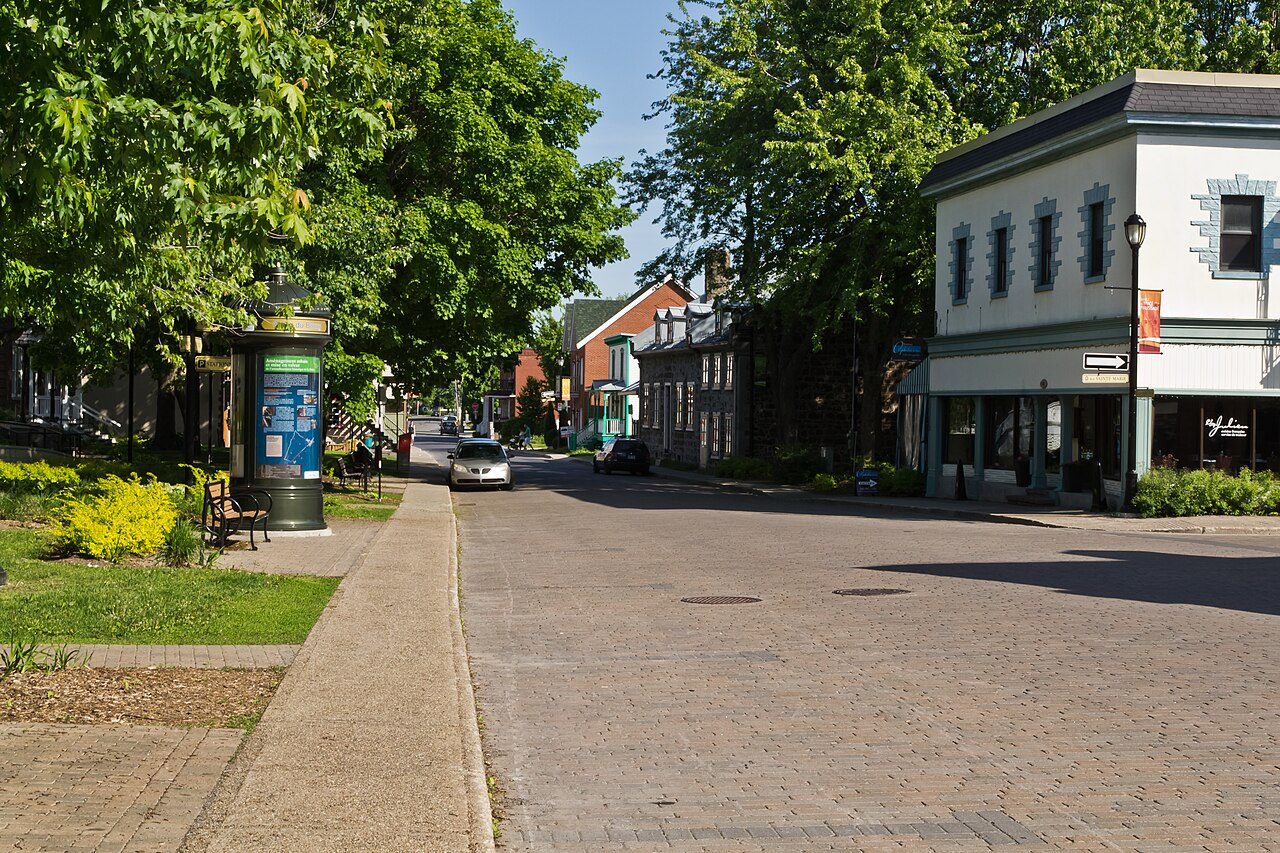
Arrondissement historique de La Prairie · Photo: MTLskyline · CC BY-SA 3.0
3historic places on the registers
History of La Prairie · Canada’s heritage registers
Fort Laprairie, from 1687, is La Prairie’s oldest designated place
All 3 historic places listed in La Prairie are of the highest rank. Measured against its size, 1.1 per 10,000 residents puts it ahead of 80% of Canadian towns.
National Historic Sites, classified federal buildings and Québec’s classements
Oldest building
1687
the first construction date on its record
Homes built before 1961
11%
typical town: 18%
How it began
La Prairie’s beginnings, from 1667
La Prairie got its start in 1667. It has been 359 years since then. The name Laprairie de la Magdeleine lasted until 1909, when La Prairie took another.
The date Wikidata keeps for La Prairie is March 30, 1846; whether it was a founding or a legal act, the entry leaves open.
Every place on the registers inside the town, by its designation.
Highest designations
Dots open their places’ pages; hover first to read the name.
The 3, by tier
3 Highest designations
Two open registers meet here: Parks Canada’s Directory of Federal Heritage Designations and Québec’s heritage register, which records both provincial classements and municipal citations.
Points from Wikidata (Parks Canada’s files carry none) and from Québec’s register, as mapped there. One place, placed by its register’s municipality, has no point and isn’t on the map.
Highest designations
La Prairie’s 3 top designations
The group holds 2 National Historic Sites and a place classified by Québec. National Historic Sites and Classified Federal Heritage Buildings, Canada’s highest federal recognition. Start with Fort Laprairie and Second Battle of Laprairie. Each one opens its own page.
National Historic SiteSecond Battle of LaprairieHwy 104 (Chemin de St-Jean) at Chemin de la Bataille North
Homes by age
La Prairie is still building: 13% of homes date from 2016 to 2021, against 4.1%
Count back from today and half of La Prairie’s homes are older than 2001. At 11%, La Prairie’s share of pre-1961 homes is under the typical town’s 18%. La Prairie’s largest group of homes, 35%, went up from 1981 to 2000.
11%
Before 1961
19%
1961–80
35%
1981–2000
23%
2001–15
13%
2016–21
La PrairieTypical town
2021 Census, private dwellings by period of construction (Statistics Canada); the typical town is the middle Canadian town of 2,500 or more.
Born here
La Prairie’s past in lives: one nationally designated
Best known is Robert Newton Hall, with articles in 5 Wikipedia languages. The first on the line is François Beaucourt (1740). Most of them, 11 of 14, came into the world in the years before Confederation. Counting only births before 1914, there are 14.
François Beaucourt
Michel Branamour Menard
Robert Newton Hall
Andrew Esinhart
Martin T. McMahon
John McIntosh
Léon-Benoît-Alfred Charlebois
Margaret Ridley Charlton
Louis Saint-Hilaire
Hermine Lanctôt
Pierre-Julien-Léonidas Bissonnette
Charles Lanctôt
Emmanuel Desrosiers
Euclide Sicotte
170017501800185019001950
Robert Newton Hall1836–1907 · Canadian politician
Martin T. McMahon1838–1906 · United States Army Medal of Honor recipient
François Beaucourt1740–1794 · Canadian painter
JM
John McIntosh1841–1904 · Canadian politician
Margaret Ridley Charlton1858–1931 · Designated nationally in 2003 · Canadian librarian
Hermine Lanctôt1861–1943 · French-Canadian author, journalist, and schoolteacher
Michel Branamour Menard1805–1856 · Canadian-born trader and merchant
AE
Andrew Esinhart1838–1915 · Canadian politician
Everyone born in La Prairie → Born before 1914. Birthplaces from Wikidata, each checked against Wikipedia; national historic persons from Parks Canada’s Directory of Federal Heritage Designations, matched by name and life years.
Towns its size
La Prairie has the 2nd most of 16 towns its size
Towns of 26,900 to 27,500 residents, by places on the registers.
Canada’s heritage lists give La Prairie 3 historic places, 3 with the highest designation. Of the 16 towns closest in size, just one has more historic places. Among the lives from its past: Robert Newton Hall (1836), Martin T. McMahon (1838) and François Beaucourt (1740). Pre-1961 homes are a small part of its stock: 11%, against 18% in the typical town. The other figures are unremarkable: its places were designated between 1921 and 1975.
How to read these numbers
What this data can and can’t tell you
•
The tiers. Tiers follow the designation: national recognition and classement first, other federal designations next, provincial and local listings last.
•
Protection. In Québec, a classement or a municipal citation under the Loi sur le patrimoine culturel protects the building in law; a federal designation recognises significance and binds only federal owners.
•
The grade. There is no history grade: the page sets out the record and compares it with other towns.
•
People and events. The open directory puts its national historic persons nowhere, so a town shows one only on firm ground: a birth there, matched by name and life years, or a historic place there named for the person whose record says so. Events are left out.
•
Map points. Where a federal place sits on the map is Wikidata’s placing; the directory itself has no coordinates.
•
The federal register. Parks Canada’s Directory of Federal Heritage Designations lists every National Historic Site, federal heritage building, heritage railway station and lighthouse; the Canadian Register of Historic Places adds their statements in English and French.
•
Québec’s register. Québec’s Répertoire du patrimoine culturel records the province’s classements and declarations and every municipal citation, each with a description and a point.
Questions about La Prairie’s history
What is the oldest building in La Prairie?
Fort Laprairie (National Historic Site): the first construction date on its record is 1687.
Which places in La Prairie have the highest designation?
Fort Laprairie, Second Battle of Laprairie and Arrondissement historique de La Prairie.
How old are the homes in La Prairie?
The 2021 Census dates 11% of its homes before 1961 (18% in the typical town).
Contains information licensed under the Open Government Licence – Canada (Parks Canada). Québec register data: Ministère de la Culture et des Communications du Québec, CC BY 4.0.
Sources: Parks Canada, Directory of Federal Heritage Designations · Canadian Register of Historic Places (federal extract) · Répertoire du patrimoine culturel du Québec (MCC, Données Québec) · Wikidata (CC0) for map points, other names and articles · Statistics Canada, 2021 Census (homes by period of construction). Under the Statistics Canada Open Licence.
 Top


