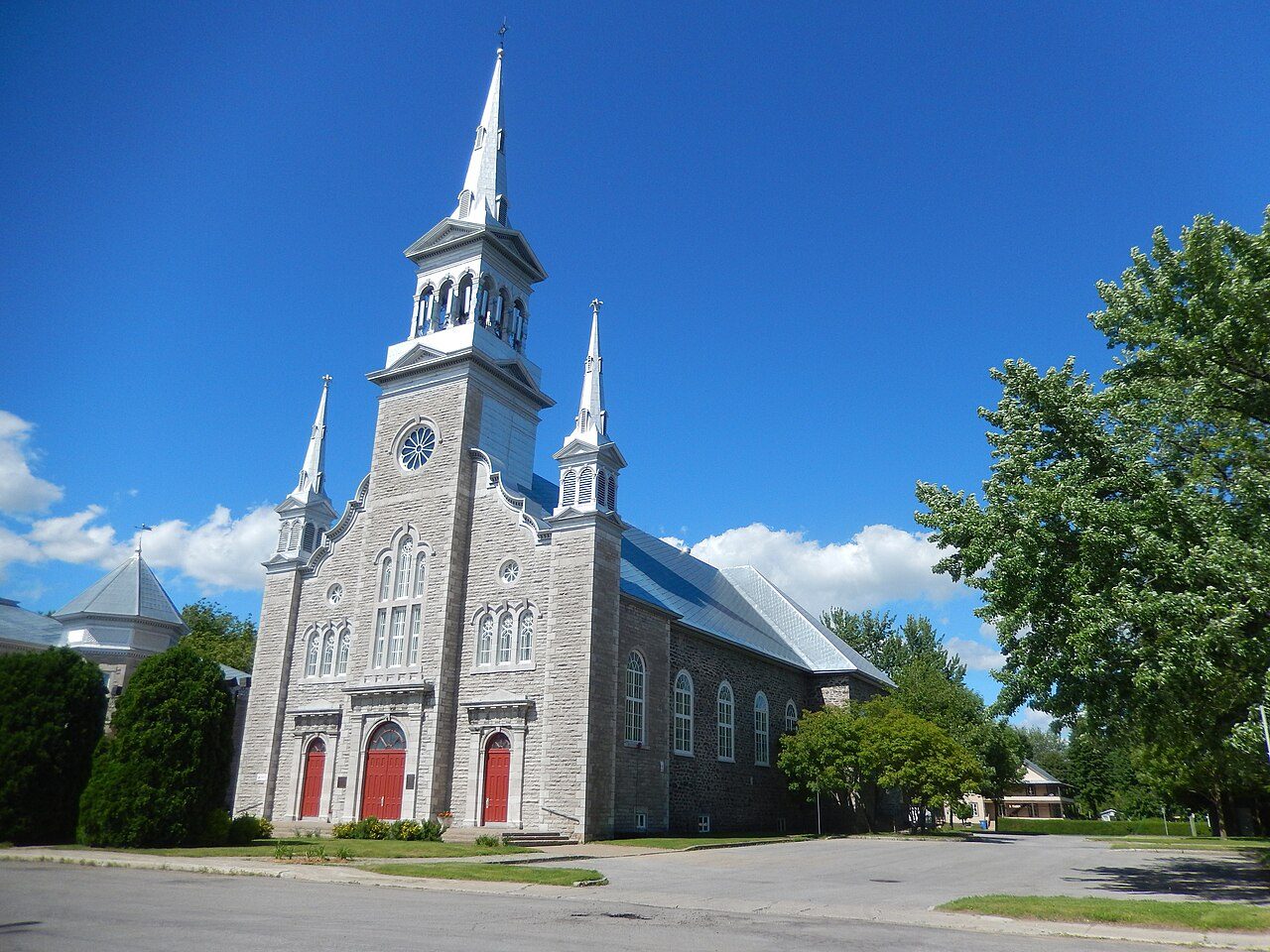
Church of St Edward · Photo: Fralambert · CC BY-SA 4.0
3historic places on the registers
History of Bécancour · Canada’s heritage registers
Back to 1774 in Bécancour, with Moulin Michel
Inside Bécancour there are 3 historic places, all of them top designations. That is 2 for every 10,000 people, a higher rate than 86% of Canadian towns.
Photos from Wikimedia Commons, each credited to its photographer with its licence; names open the place’s page. Tap a photo to step through them full screen.
Through time
Old pictures of Bécancour
The oldest view of one of its historic places, made before 1950. It opens full screen with a tap.
c. 1910Boom yearsIntérieur de l'église de Saint-Grégoire-le-Grand . - 1910Public domain
Public domain or CC0, made before 1950, from Wikimedia Commons; old views of places can be drawings, prints or maps of their time. Each credit opens the image’s page.
How it began
Back to 1965: Bécancour’s first record
11 former municipalities gave way to the present municipality in 1965. Wikidata gives the municipality of Bécancour the date October 17, 1965, which can mark a founding, an incorporation or a merger. Behind the name Bécancour is Pierre Robineau de Bécancour.
Every place on the registers inside the town, by its designation.
Highest designations
Tap any dot to open that place’s own page; hovering shows its name.
The 3, by tier
3 Highest designations
In Québec the record is fuller than elsewhere: beside Parks Canada’s designations, the province’s register lists its classements and every municipal citation.
Points from Wikidata (Parks Canada’s files carry none) and from Québec’s register, as mapped there.
Highest designations
3 places in Bécancour with the highest designation
They date from 1774 (Moulin Michel) to 1842. National Historic Sites and Classified Federal Heritage Buildings, Canada’s highest federal recognition. Their designations span 1957 to 1985. Each one opens its own page.
Bécancour is still building: 8.5% of homes date from 2016 to 2021, against 4.1%
Before 1961: 25% of Bécancour’s homes, against 18% in most towns. Bécancour has an unusual share of homes built from 2001 to 2015: 23%, where most towns have 15%. Half of the homes standing in Bécancour today were built before 2001.
25%
Before 1961
25%
1961–80
19%
1981–2000
23%
2001–15
8.5%
2016–21
BécancourTypical town
2021 Census, private dwellings by period of construction (Statistics Canada); the typical town is the middle Canadian town of 2,500 or more.
Born here
24 lives that began in Bécancour before 1914
The years before Confederation gave 20 of the 24. By Wikipedia’s reach, Louis-Zéphirin Moreau leads, with 9 articles. In 1779 came the earliest, Jean-Baptiste Hébert. At the other end is Lucien Dubois, from 1893. The 20 best known are on the timeline.
Jean-Baptiste Hébert
Joseph-Édouard Turcotte
Nicolas-Tolentin Hébert
Paul-Éloi Marier
Charles Cormier
Louis Richard
Joseph Gaudet
Léon Provancher
Louis-Zéphirin Moreau
Charles-Borromée Genest
Louis Adolphe Billy
Fabien Boisvert
Pierre-Clovis Beauchesne
Charles Alexander Lesage
Edmond Lareau
Athanase Gaudet
Aldéric-Joseph Benoit
Joseph-Adolphe Richard
Joseph-Achille Verville
Lucien Dubois
175017751800182518501875190019251950
Louis-Zéphirin Moreau1824–1901 · Canadian Catholic prelate, blessed
LP
Léon Provancher1820–1892 · Canadian Catholic parish priest and naturalist
Joseph Gaudet1818–1882 · Canadian politician
Edmond Lareau1848–1890 · Canadian politician
Louis Adolphe Billy1834–1907 · Canadian politician
FB
Fabien Boisvert1839–1897 · Canadian politician
JR
Joseph-Adolphe Richard1887–1964 · Canadian politician
LD
Lucien Dubois1893–1948 · Canadian politician
Everyone born in Bécancour → Born before 1914 (the page’s periods: Confederation to the First World War). Birthplaces from Wikidata, each checked against the person’s Wikipedia article.
Towns its size
Bécancour has the most of 16 towns its size
Towns of 14,900 to 15,000 residents, by places on the registers.
Of the homes standing in Bécancour, 25% went up before 1961, against 18% in the typical town. Together that makes 3 historic places, 3 with the highest designation, led by Moulin Michel. No town its size has more historic places: it leads the 16 nearest in population. Of its people of the past, the best known are Louis-Zéphirin Moreau (1824), Léon Provancher (1820) and Joseph Gaudet (1818). Beyond that, the list grew between 1957 and 1985.
How to read these numbers
What this data can and can’t tell you
•
The tiers. Tiers follow the designation: national recognition and classement first, other federal designations next, provincial and local listings last.
•
People and events. National historic persons carry no place in the open file. They appear on a town’s page when born there (same name, same birth and death years) or when a historic place inside it carries their name and its record names them with their dates; national historic events don’t appear.
•
The grade. There is no history grade: the page sets out the record and compares it with other towns.
•
The federal register. The federal list is complete and open: Parks Canada’s directory for the designations, the Canadian Register of Historic Places for what each one is and why it matters.
•
Québec’s register. In Québec the ministry of culture publishes its register openly: provincial classements, declared sites and the municipalities’ citations all appear, with their descriptions.
•
Protection. In Québec, a classement or a municipal citation under the Loi sur le patrimoine culturel protects the building in law; a federal designation recognises significance and binds only federal owners.
Questions about Bécancour’s history
What is the oldest building in Bécancour?
Moulin Michel — its record dates it to 1774 (Classified heritage building (Québec)).
Which places in Bécancour have the highest designation?
These: Moulin Michel, Church of St Gregory and Church of St Edward.
How old are the homes in Bécancour?
25% of its homes were built before 1961, against 18% in the typical Canadian town.
Contains information licensed under the Open Government Licence – Canada (Parks Canada). Québec register data: Ministère de la Culture et des Communications du Québec, CC BY 4.0.
Sources: Parks Canada, Directory of Federal Heritage Designations · Canadian Register of Historic Places (federal extract) · Répertoire du patrimoine culturel du Québec (MCC, Données Québec) · Wikidata (CC0) for map points, other names and articles · Statistics Canada, 2021 Census (homes by period of construction). Under the Statistics Canada Open Licence.


 c. 1910
 Top
 Top
 Top


