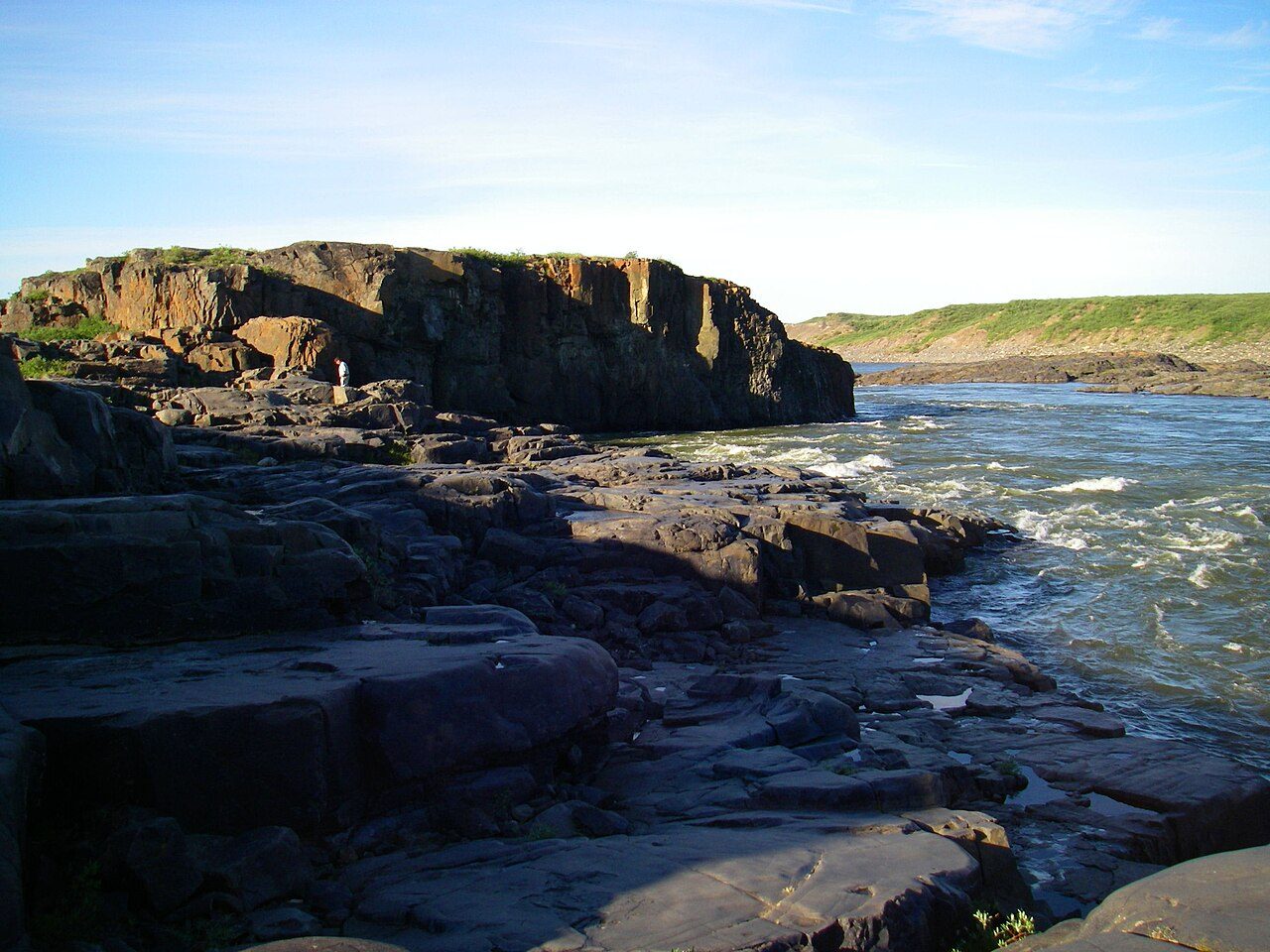
Bloody Falls
In French: Parc territorial Kugluk/Bloody Falls
Kugluk/Bloody Falls Territorial Park, Kugluktuk
About Bloody Falls
Bloody Falls is the one National Historic Site in Kugluktuk.
Bloody Falls National Historic Site of Canada is located within Kugluk / Bloody Falls Territorial Park, on the western shore of the Coppermine River, in Nunavut. The site encompasses pre-contact Aboriginal encampments set on river terraces along the broad, swift-flowing river. These encampments, of which there are no extant remains, were used as Aboriginal hunting and fishing stations for over three millennia, dating to 1700 B.C.E. Official recognition refers to the section of Kugluk / Bloody Falls Territorial Park that falls to the northwest of the Coppermine River.
From the Canadian Register of Historic Places, Bloody Falls National Historic Site of Canada · Open Government Licence – Canada · in the register’s words, not edited
National Historic Site status comes on the advice of the Historic Sites and Monuments Board of Canada.
Finding Bloody Falls
Kugluktuk


There is no walk from here to another historic place; see farther afield.
Questions about Bloody Falls
Can you visit Bloody Falls?
Yes from the outside; whether it opens its doors is for its owner to say.
Is Bloody Falls protected?
National Historic Site status commemorates; legal protection, where there is any, comes from the province or municipality, or from federal ownership.
What is Bloody Falls?
A National Historic Site: Canada designated Bloody Falls in 1978.
Contains information licensed under the Open Government Licence – Canada (Parks Canada).
Sources: Parks Canada, Directory of Federal Heritage Designations · Canadian Register of Historic Places (federal extract) · Photos: Wikimedia Commons, each credited with its licence and copied to our own server · Wikidata (CC0) for map points, other names and articles.
Adapted from Statistics Canada (Census of Population 2021, population estimates 2025, 2021 census boundaries) under the Statistics Canada Open Licence; this does not constitute an endorsement by Statistics Canada. Neighbourhood names in some cities © OpenStreetMap contributors (ODbL).