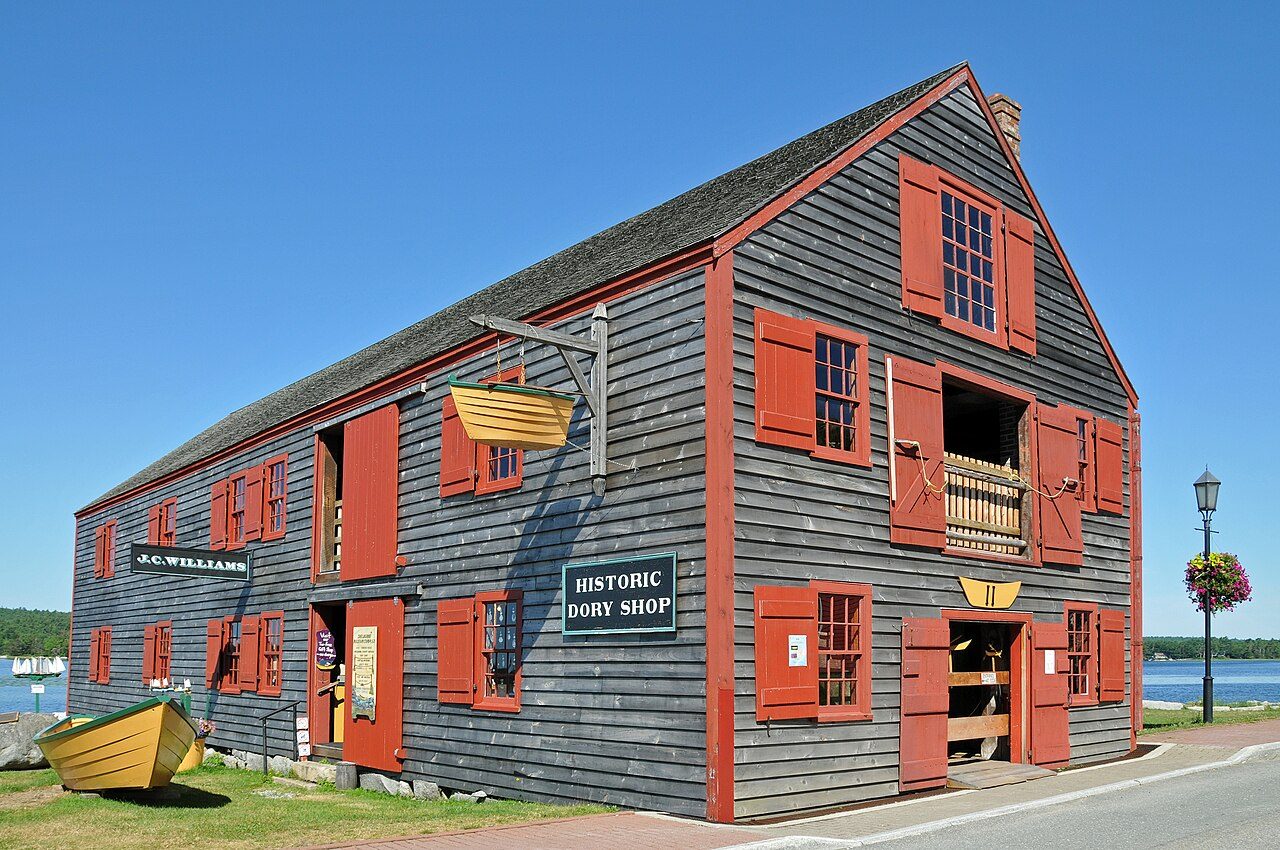
Dory Shop Museum · Photo: Dennis G. Jarvis · CC BY-SA 2.0
1historic place on the registers
History of Shelburne · Canada’s heritage registers
Older housing stands out in Shelburne: 51% predates 1961
Shelburne’s share is 2.9 times the typical 18%. Inside the town the registers count 1 historic place. There are also 17 listings on provincial or municipal registers with no open description, so no pages.
Historic places
1
Highest designations
0
National Historic Sites and Classified Federal Heritage Buildings
Provincial and local listings
1
provincial and municipal listings with an encyclopedia article
Homes built before 1961
51%
typical town: 18%
How it began
Shelburne’s record begins in 1783
A single date stands for Shelburne as a municipality on Wikidata, 1783, and it may be an incorporation rather than a founding. Shelburne took its legal form as a town in 1907.
Every place on the registers inside the town, by its designation.
Provincial and local listings
Each dot is a place: point at it for the name, tap it for its page.
The 1, by tier
1 Provincial and local listings
The federal directory kept by Parks Canada supplies most of these places; provincial and municipal lists outside Québec aren’t open data, so only the ones Wikidata documents with an article appear.
Points from Wikidata (Parks Canada’s files carry none) and from Québec’s register, as mapped there.
Provincial and local listings
One local listing in Shelburne
Provincial and municipal listings that Wikidata records and an encyclopedia describes. Each one opens its own page.
Only 1.3% of Shelburne’s homes were built from 2016 to 2021 (4.1% is typical)
Half of the homes standing in Shelburne today were built before 1961. Homes built from 2001 to 2015 make up just 6.3% of Shelburne’s, against 15% in the typical town. Shelburne built little from 1981 to 2000: 14% of its homes, where most towns have 23%.
51%
Before 1961
28%
1961–80
14%
1981–2000
6.3%
2001–15
1.3%
2016–21
ShelburneTypical town
2021 Census, private dwellings by period of construction (Statistics Canada); the typical town is the middle Canadian town of 2,500 or more.
Born here
1822 to 1910: the people Shelburne gave its past
Wilfred Dauphinee reached 97, the longest life here, ending in 2007. John Augustus Larson is the most written about, in 7 languages. There are 7 people born here before 1914 with an article to show for it. The decades after Confederation gave 4 of the 7.
Colin Campbell
George Augustus Cox
Robert Irwin
Frank R. Davis
John Augustus Larson
John Oates Bower
Wilfred Dauphinee
1800182518501875190019251950
JL
John Augustus Larson1892–1965 · American inventor
RI
Robert Irwin1865–1941 · Canadian politician
JB
John Oates Bower1901–1981 · Canadian politician
CC
Colin Campbell1822–1881 · Nova Scotia politician, born 1822
GC
George Augustus Cox1838–1925 · Canadian politician from Nova Scotia
FD
Frank R. Davis1888–1948 · Politician in Nova Scotia, Canada
WD
Wilfred Dauphinee1910–2007 · Canadian politician
Everyone born in Shelburne → Born before 1914 (the page’s periods: Confederation to the First World War). Birthplaces from Wikidata, each checked against the person’s Wikipedia article.
Shelburne has 51% of its homes from before 1961, against 18% in the typical town. The lists come to 1 historic place. Of its people of the past, the best known are John Augustus Larson (1892), Robert Irwin (1865) and John Oates Bower (1901).
How to read these numbers
What this data can and can’t tell you
•
Provincial and municipal lists. Outside Québec, provinces’ and municipalities’ heritage registers aren’t open data; their places are known only through Wikidata items with a register number, and only those with an encyclopedia article get a page.
•
People and events. The open directory puts its national historic persons nowhere, so a town shows one only on firm ground: a birth there, matched by name and life years, or a historic place there named for the person whose record says so. Events are left out.
•
The federal register. Parks Canada’s Directory of Federal Heritage Designations lists every National Historic Site, federal heritage building, heritage railway station and lighthouse; the Canadian Register of Historic Places adds their statements in English and French.
•
Protection. Federal recognition isn’t a planning control: buildings the federal government owns follow its heritage policy, while others are protected only by a provincial or municipal designation.
•
The tiers. The highest designations are National Historic Sites, Classified Federal Heritage Buildings and Québec’s classements; then come the other federal designations; then provincial and local listings.
•
Map points. Parks Canada publishes no coordinates, so federal places are pinned where Wikidata puts them.
•
The grade. This page gives no grade; history doesn’t count toward a Canadian town’s letter.
Questions about Shelburne’s history
How old are the homes in Shelburne?
The 2021 Census dates 51% of its homes before 1961 (18% in the typical town).
How many historic places does Shelburne have on the registers?
1 historic place in Shelburne, from Canada’s heritage registers.
Why might a heritage building in Shelburne be missing here?
Its province’s and council’s own lists can’t be reused here; 17 further listings in Shelburne show up only as Wikidata numbers.
Contains information licensed under the Open Government Licence – Canada (Parks Canada).
Sources: Parks Canada, Directory of Federal Heritage Designations · Canadian Register of Historic Places (federal extract) · Wikidata (CC0) for map points, other names and articles · Statistics Canada, 2021 Census (homes by period of construction). Under the Statistics Canada Open Licence.
 Local