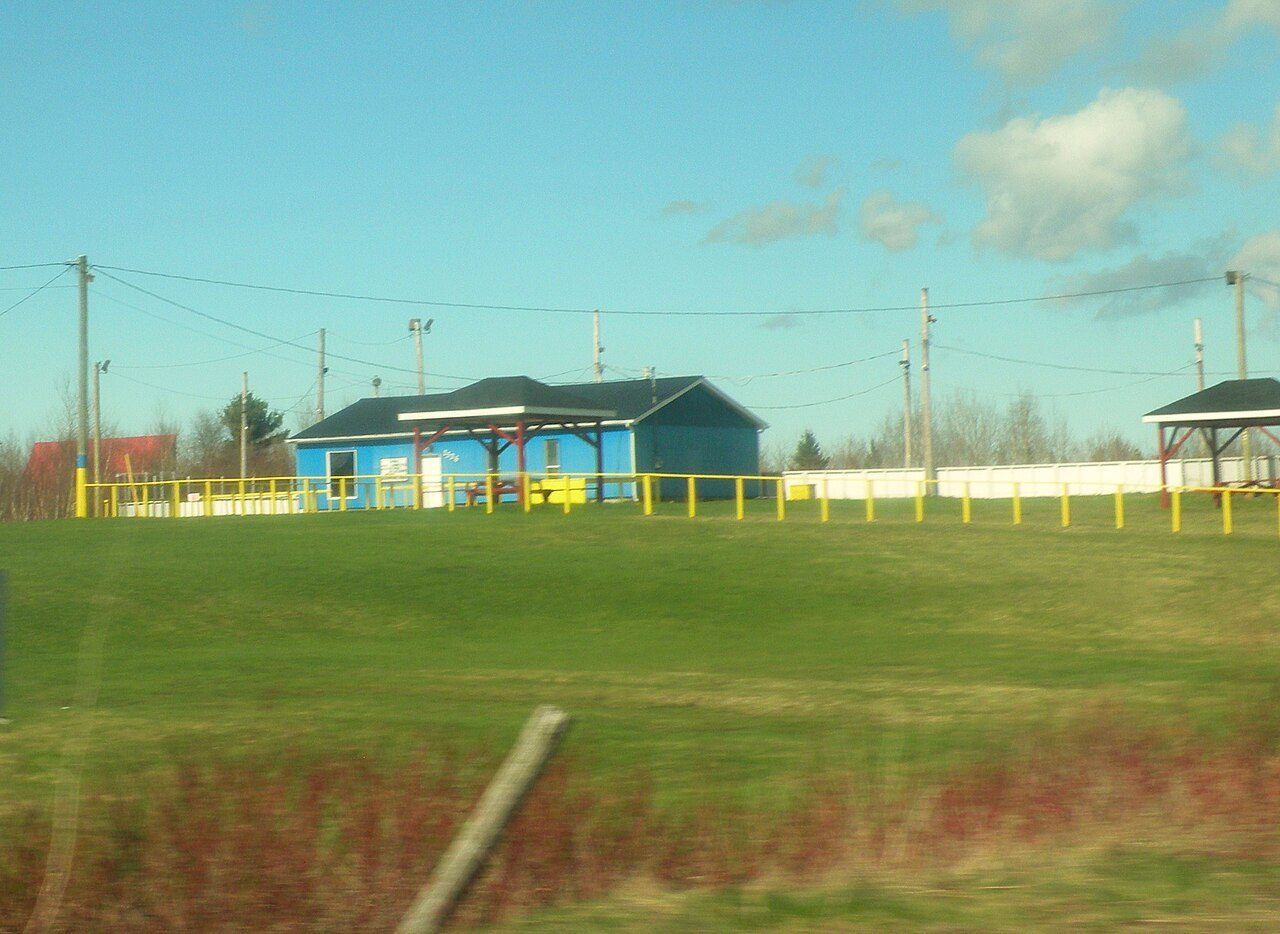
 Photo: Dr Wilson · CC BY-SA 3.0
The region around Saint-Isidore carries more chronic illness than the typical Canadian town: 20% to 17%
The survey puts the region’s share in very good or excellent health at 49%, ahead of the 44% for New Brunswick. For Saint-Isidore itself the measure is access, and it lags: 15 km to the nearest hospital, where 3.7 km is typical. The Health grade for Saint-Isidore is C+.
What stands out about health in Saint-Isidore
Far from a hospital
Distance is Saint-Isidore’s own health question: 0% of residents live beyond 30 km of a hospital, and the trip from its centre is 13 km. Getting care ↓
Life expectancy below the norm
Born around Saint-Isidore, a child can expect 1.3 fewer years than in the typical Canadian town’s region; at 65, another 20.4 (2022/2024). The wider area ↓
More households under strain
On the index’s situational vulnerability, which follows housing, income and education, Saint-Isidore’s neighbourhoods average 5.0 out of 5, among the most deprived fifth of the country. The wider area ↓
Beating its deprivation on life expectancy
Set against regions as deprived (4.2), Saint-Isidore’s region gains years: 80.2 where the trend says 76.5. For its deprivation ↓
From Statistics Canada: the health survey and life expectancy for the health region, the deprivation index for the town; distances from the healthcare facilities database and OpenStreetMap.
Saint-Isidore grades C+ for health
Each input ranked against Canadian towns of 2,500 or more: the region’s four, the town’s distance to a hospital.
The region’s four figures and the town’s distance to a hospital are each ranked against Canadian towns of 2,500 or more, then averaged.
How the grade works
Health is graded as a regional score, labelled as such: very good or excellent self-rated health, chronic conditions (arthritis, diabetes and high blood pressure averaged) and smoking from the Canadian Community Health Survey, each age-standardised so an older region isn’t marked down for age alone, and life expectancy at birth, all for the health region. The residents’ average distance to a hospital is the one input measured for the town itself, so towns in one region can still differ.
The region lives 3.7 years longer than its deprivation predicts
One dot per health region, 102 in all, since life expectancy and the index are published for regions; Saint-Isidore’s dot is marked, above the line.
Deprivation explains much of the gap between regions (correlation −0.83 over 102 of them), yet Saint-Isidore’s region beats it: 80.2 years against the 76.5 the trend gives a score of 4.2. Against the 10 regions with the nearest deprivation scores, none lives longer; the middle of the group is 77.9 years.
Life expectancy: Statistics Canada table 13-10-0988, 2022/2024, by health region. Deprivation: Canadian Index of Multiple Deprivation 2021 (situational vulnerability), averaged over each region’s towns by their residents; income: 2021 Census median household income, averaged the same way. The averages and the line are TownRatings calculations.
From Saint-Isidore, a hospital is 15 km away on average
Straight-line distances from each part of Saint-Isidore, weighted by who lives there.
Saint-Isidore is further out than the provincial norm of 11 km in New Brunswick, and than the typical Canadian town at 3.7 km. Few clinics are listed in New Brunswick, so the distance to one reads longer than it is.
Hospitals and clinics: Statistics Canada, Open Database of Healthcare Facilities. Pharmacies: © OpenStreetMap contributors (ODbL). Straight-line distances from each dissemination area, weighted by its 2021 population.
How the 7 health regions in New Brunswick compare on life expectancy
What Statistics Canada publishes above the town: life expectancy for each health region in New Brunswick, and the deprivation index for the town’s own areas.
Life expectancy at birth by health region · 2022/2024
The region comes 2nd of 7 in New Brunswick, where life expectancy runs from 78.9 to 81.5 years.
Canadian Index of Multiple Deprivation · national quintile, 1 least to 5 most deprived
These four scores average the national quintile of the areas where Saint-Isidore’s residents live; they carry no weight in the grade.
Life expectancy: Statistics Canada table 13-10-0988, three-year estimate 2022/2024, by health region.
37% of the region’s adults have high blood pressure and 14% diabetes
What the survey finds on conditions, weight and habits for the region, the province as the tick.
Conditions and weight · 2023/2024
Habits · 2023/2024
On weight the region is ordinary for New Brunswick: 40% report obesity, the province 42%.
Canadian Community Health Survey 2023/2024 (table 13-10-0972), as published, not adjusted for age; obesity from reported height and weight. The anxiety disorder figure is the 2021/2022 estimate: Statistics Canada found the latest too unreliable to publish here.
46% in the region call their health very good or excellent, more than in New Brunswick (43%)
How adults in the health region answered the survey, not adjusted for age; the tick marks the province.
Share of adults, as answered · 2023/2024
Mental health looks better than in the province too: 59% rate it very good or excellent, against 49% in New Brunswick, and 18% find most days quite stressful.
Canadian Community Health Survey 2023/2024 (Statistics Canada table 13-10-0972), adults 18 and over, as published.
Health in the places around Saint-Isidore
Nearby places: distance to a hospital and each one’s regional figures. Tap a town for its health page.
| Town | Hospital | Very good health | Life exp. | Health |
|---|---|---|---|---|
| Saint-Isidore | 15 km | 49% | 80.2 | C+ |
| Tracadie 10 km | 4.7 km | 49% | 80.2 | B− |
| Paquetville 17 km | 21 km | 49% | 80.2 | C |
Because the health region stops further out than these places, they all carry Saint-Isidore’s regional figures. Residents of Tracadie live nearer a hospital, at 4.7 km against 15 km in Saint-Isidore.
What this data can and can’t tell you
- Adjusted for age. The grade’s three survey shares are age-standardised to Canada’s adults, so an older region isn’t marked down for age alone, while the survey charts show answers as given.
- Who the survey asks. The survey’s frame skips reserves and other Indigenous settlements, institutions, the Forces and two Québec regions, so their figures come from elsewhere or not at all.
- Distances are straight lines. Roads, rivers and ferries aren’t in it: the figure is a straight line from where people live, averaged over residents.
- Regional figures. Statistics Canada reports the survey and life expectancy by health region, not by town: Saint-Isidore shares them with its neighbours, while the distances are measured for it alone.
- Deprivation is context. Deprivation is shown to set the scene and doesn’t count toward the grade; Statistics Canada left the territories out of the index.
- What counts as a hospital. A “hospital” here is whatever the provinces listed as one in Statistics Canada’s database, which can mean a site without an emergency department.
Questions about health in Saint-Isidore
How far is Saint-Isidore from a hospital?
Beyond the hospital, the average home in Saint-Isidore is 11 km from a pharmacy; clinics are too sparsely listed in the province to say.
What is the life expectancy in Saint-Isidore?
There is no figure for Saint-Isidore alone; its health region’s is 82.7 for women and 77.8 for men in 2022/2024.
How healthy is Saint-Isidore?
More of the region’s survey and life-expectancy figures trail the typical Canadian town than beat it. Its chronic-condition figure, age-standardised, is 20%.
How is Saint-Isidore’s Health Grade worked out?
No letter yet for Saint-Isidore: Canada is graded in one run, and Health will then compare its region and its access to care with the typical Canadian town.
Sources: Statistics Canada, Canadian Community Health Survey 2023/2024 (13-10-0972) · Statistics Canada, life expectancy 2022/2024 (13-10-0988) · Statistics Canada, health regions 2023 (82-402-X) · Statistics Canada, Open Database of Healthcare Facilities · pharmacies © OpenStreetMap contributors (ODbL) · Statistics Canada, Canadian Index of Multiple Deprivation 2021. Under the Statistics Canada Open Licence.
Adapted from Statistics Canada (Census of Population 2021, population estimates 2025, 2021 census boundaries) under the Statistics Canada Open Licence; this does not constitute an endorsement by Statistics Canada. Neighbourhood names in some cities © OpenStreetMap contributors (ODbL).