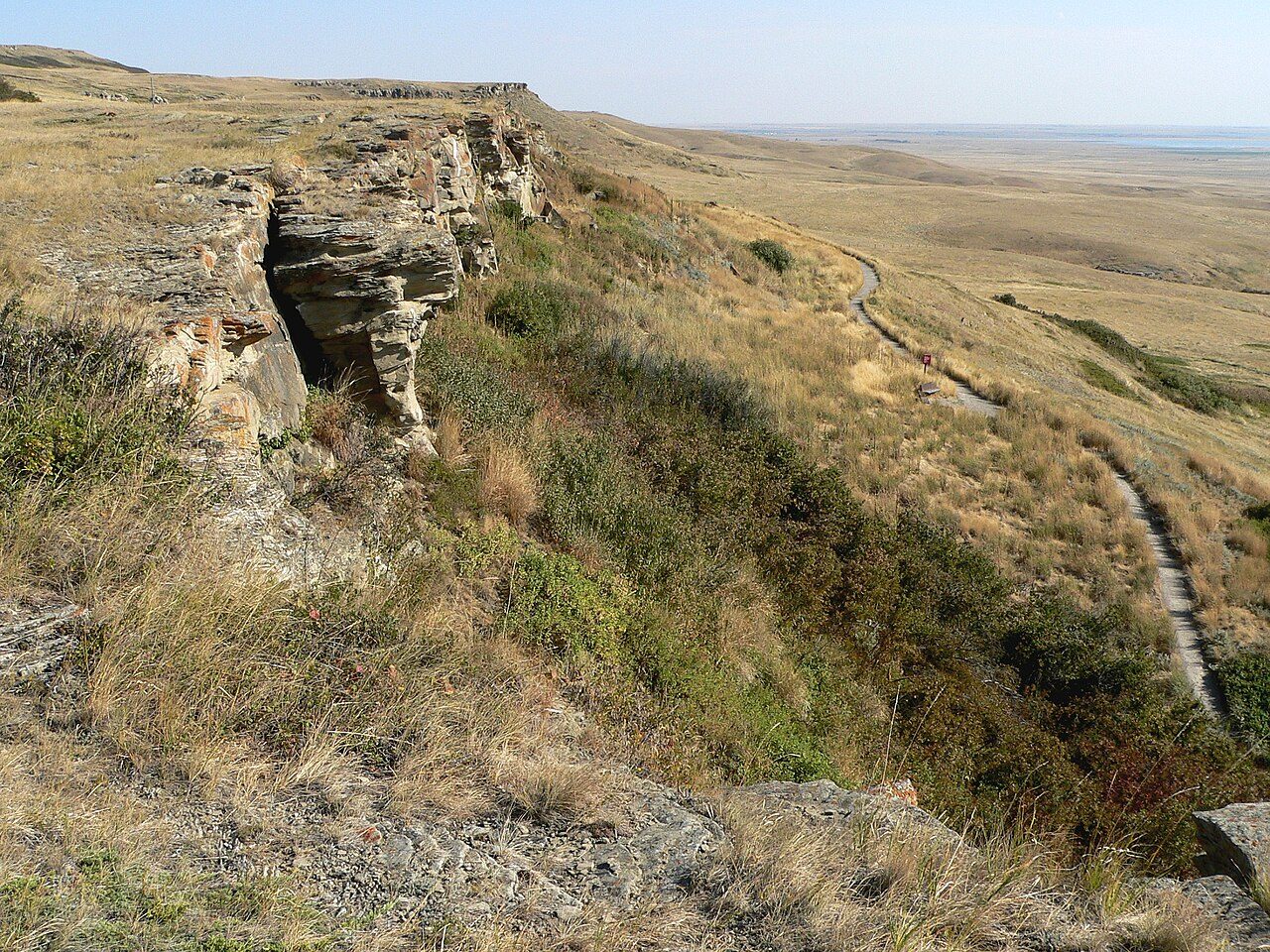
 Head-Smashed-In Buffalo Jump · Photo: Ken Thomas · Public domain
Willow Creek No. 26: 1 historic place on Canada’s heritage registers
For every 10,000 residents Willow Creek No. 26 has 1.6, ahead of 83% of Canadian towns. 3 further listings on provincial or municipal registers are known only through Wikidata, so they have no page of their own.
Where Willow Creek No. 26’s history is
Every place on the registers inside the town, by its designation.
Tap any dot to open that place’s own page; hovering shows its name.
Most entries are federal, from Parks Canada’s Directory of Federal Heritage Designations; local listings outside Québec are known only through Wikidata items with an article.
Points from Wikidata (Parks Canada’s files carry none) and from Québec’s register, as mapped there.
One local listing in Willow Creek No. 26
Provincial and municipal listings that Wikidata records and an encyclopedia describes. Each one opens its own page.
 Local
Around Willow Creek No. 26, within 100 km, the dated heritage reaches back to 1869
Reaching 100 km out from Willow Creek No. 26: the historic places by their first construction date on record.
First by date comes Fort Whoop-Up in Cardston County, from 1869. The bars count 41 dated places within 100 km.
The closest heritage to Willow Creek No. 26 is Fort Macleod, 26 km off
They stand in 9 towns, Foothills County, Fort Macleod and Crowsnest Pass among them. All told, 47 places are within 100 km. By designation: 30 Classified Federal Heritage Buildings, 8 National Historic Sites and 8 provincial or municipal listings.
The 12 nearest, within 100 km
| Fort MacleodNational Historic Site · 1874–1875 · 26 km away, in Fort Macleod |
| Empress TheatreProvincial historic resource · 1912 · 27 km away, in Fort Macleod |
| Territorial Court HouseNational Historic Site · 1902–1905 · 27 km away, in Fort Macleod |
| Fort Whoop-UpNational Historic Site · 1869–1870 · 60 km away, in Cardston County |
| Old Women's Buffalo JumpNational historic site of Canada · 64 km away, in Foothills County |
| LilleProvincial historic resource · 66 km away, in Crowsnest Pass |
| Frank SlideProvincial historic resource · 69 km away, in Crowsnest Pass |
| Bar U RanchNational Historic Site · 1883–1951 · 71 km away, in Foothills County |
| Privy, Building 28Classified Federal Heritage Building · 1927–1928 · 71 km away, in Foothills County |
| Foreman’s HouseClassified Federal Heritage Building · 1884–1888 · 71 km away, in Foothills County |
| Feed MillClassified Federal Heritage Building · 1909–1911 · 71 km away, in Foothills County |
| Tractor Garage, Building 7Classified Federal Heritage Building · 1940–1941 · 71 km away, in Foothills County |
27% of Willow Creek No. 26’s homes are older than 1961, against a usual 18%
19% of Willow Creek No. 26’s homes date from 2001 to 2015, well above the typical 15%. New building in Willow Creek No. 26 runs at the usual pace: 4.2% of homes from 2016–21, the typical town 4.1%. Over half of the homes in Willow Creek No. 26 were already standing by 1981.
2021 Census, private dwellings by period of construction (Statistics Canada); the typical town is the middle Canadian town of 2,500 or more.
Willow Creek No. 26 has the 3rd most of 16 towns its size
Towns of 6,200 to 6,300 residents, by places on the registers.
Just these have more: Woodstock and Grosvenor Park. Their median is 0. 10 of them have none.
Willow Creek No. 26 and its neighbours
| Town | People | Places | Highest | Oldest |
|---|---|---|---|---|
| Willow Creek No. 26 | 6,225 | 1 | 0 | — |
| Claresholm | 4,242 | 0 | 0 | — |
Willow Creek No. 26 in brief
Of the homes standing in Willow Creek No. 26, 27% went up before 1961, against 18% in the typical town. In all there are 1 historic place. Only 2 of the 16 towns nearest its size have more historic places.
What this data can and can’t tell you
- Map points. Pins for federal places come from Wikidata rather than Parks Canada, which gives no points.
- People and events. Persons of national historic significance come with no location; a town gets one only by birthplace (name and both life years agreeing) or by one of its own places that bears the name and whose record tells the story. Events, which can’t be tied, are left out.
- The federal register. Federal places come from Parks Canada’s directory, which counts National Historic Sites, federal heritage buildings, stations and lighthouses; their statements are the register’s own.
- Provincial and municipal lists. Provincial and municipal listings here come from Wikidata alone, since the provinces’ own registers can’t be reused; a listing needs an encyclopedia article to get a page.
- The grade. There is no history grade: the page sets out the record and compares it with other towns.
- Protection. National historic designation honours a place but binds only federal owners; a private building’s protection depends on its province or municipality.
- The tiers. Tiers follow the designation: national recognition and classement first, other federal designations next, provincial and local listings last.
Questions about Willow Creek No. 26’s history
How many historic places does Willow Creek No. 26 have on the registers?
Inside Willow Creek No. 26: 1 historic place.
How old are the homes in Willow Creek No. 26?
Before 1961: 27% of its homes; the typical town has 18%.
Why might a heritage building in Willow Creek No. 26 be missing here?
Provincial and municipal registers outside Québec aren’t open data. Wikidata knows 3 more listings in Willow Creek No. 26, but without an open description or an encyclopedia article they get no page.
Contains information licensed under the Open Government Licence – Canada (Parks Canada).
Sources: Parks Canada, Directory of Federal Heritage Designations · Canadian Register of Historic Places (federal extract) · Wikidata (CC0) for map points, other names and articles · Statistics Canada, 2021 Census (homes by period of construction). Under the Statistics Canada Open Licence.
Adapted from Statistics Canada (Census of Population 2021, population estimates 2025, 2021 census boundaries) under the Statistics Canada Open Licence; this does not constitute an endorsement by Statistics Canada. Neighbourhood names in some cities © OpenStreetMap contributors (ODbL).