The registers count 16 places within 50 km of Airdrie; the closest, Heritage Hall - Southern Alberta Institute of Technology, is 24 km away. The typical town keeps 18% of its homes from before 1961; here it is 0.9%. The nearest town with a top designation is Hillhurst, 25 km away.
Historic places within 50 km
16
8 of the highest designation
Nearest historic place
24 km
Heritage Hall - Southern Alberta Institute of Technology
Homes built before 1961
0.9%
typical town: 18%
How it began
Where Airdrie’s story starts: 1889
It was in 1889 that Airdrie was founded. It has been 137 years since then. For the municipality of Airdrie itself, Wikidata records 1899, a date that can be a founding as much as a merger.
The 50 km around Airdrie keep buildings from as early as 1875
Out to 50 km from Airdrie, outside the town: each place by when its record says building began.
British North America 1760–18660
After Confederation 1867–19139
Wars and Depression 1914–19453
Since 1946 1946 on0
The bars count 12 dated places within 50 km. The earliest is Fort Calgary in Downtown East Village, begun in 1875.
Around the town
The registers find 16 places within 50 km of Airdrie
Closest of all is Heritage Hall - Southern Alberta Institute of Technology, in Hillhurst, 24 km off. Oldest of them is Fort Calgary (1875), 26 km off. Their towns number 8: Downtown Commercial Core, Beltline and Downtown East Village first.
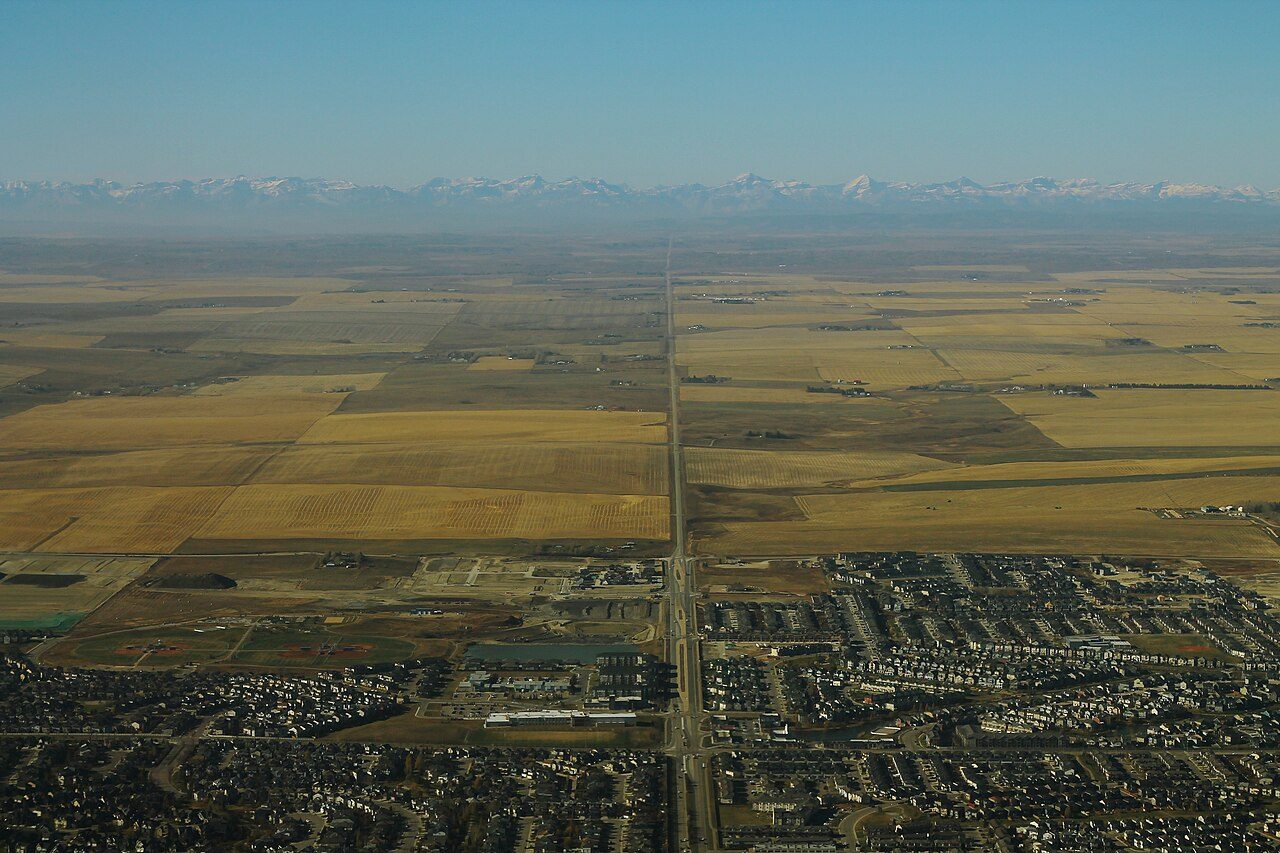
A growing town: 18% of Airdrie’s homes went up from 2016 to 2021, against 4.1%
Airdrie has an unusual share of homes built from 2001 to 2015: 55%, where most towns have 15%. Few of Airdrie’s homes date from 1961 to 1980: 8.6%, the norm 27%. Homes built from 1981 to 2000 make up just 18% of Airdrie’s, against 23% in the typical town.
0.9%
Before 1961
8.6%
1961–80
18%
1981–2000
55%
2001–15
18%
2016–21
AirdrieTypical town
2021 Census, private dwellings by period of construction (Statistics Canada); the typical town is the middle Canadian town of 2,500 or more.
Most of its homes are post-1960: only 0.9% came earlier, against 18% in the typical town. For the rest, it has no historic place, against 3 for the middle town its size.
How to read these numbers
What this data can and can’t tell you
•
People and events. National historic persons carry no place in the open file. They appear on a town’s page when born there (same name, same birth and death years) or when a historic place inside it carries their name and its record names them with their dates; national historic events don’t appear.
•
The grade. There is no history grade: the page sets out the record and compares it with other towns.
•
The tiers. Tiers follow the designation: national recognition and classement first, other federal designations next, provincial and local listings last.
•
Provincial and municipal lists. Outside Québec, provinces’ and municipalities’ heritage registers aren’t open data; their places are known only through Wikidata items with a register number, and only those with an encyclopedia article get a page.
•
Protection. Federal recognition isn’t a planning control: buildings the federal government owns follow its heritage policy, while others are protected only by a provincial or municipal designation.
•
The federal register. The federal list is complete and open: Parks Canada’s directory for the designations, the Canadian Register of Historic Places for what each one is and why it matters.
Questions about Airdrie’s history
How many historic places does Airdrie have on the registers?
Airdrie has none of its own; Heritage Hall - Southern Alberta Institute of Technology, in Hillhurst, the closest at 24 km, holds the highest designation.
How old are the homes in Airdrie?
Before 1961: 0.9% of its homes; the typical town has 18%.
Contains information licensed under the Open Government Licence – Canada (Parks Canada).
Sources: Parks Canada, Directory of Federal Heritage Designations · Canadian Register of Historic Places (federal extract) · Wikidata (CC0) for map points, other names and articles · Statistics Canada, 2021 Census (homes by period of construction). Under the Statistics Canada Open Licence.