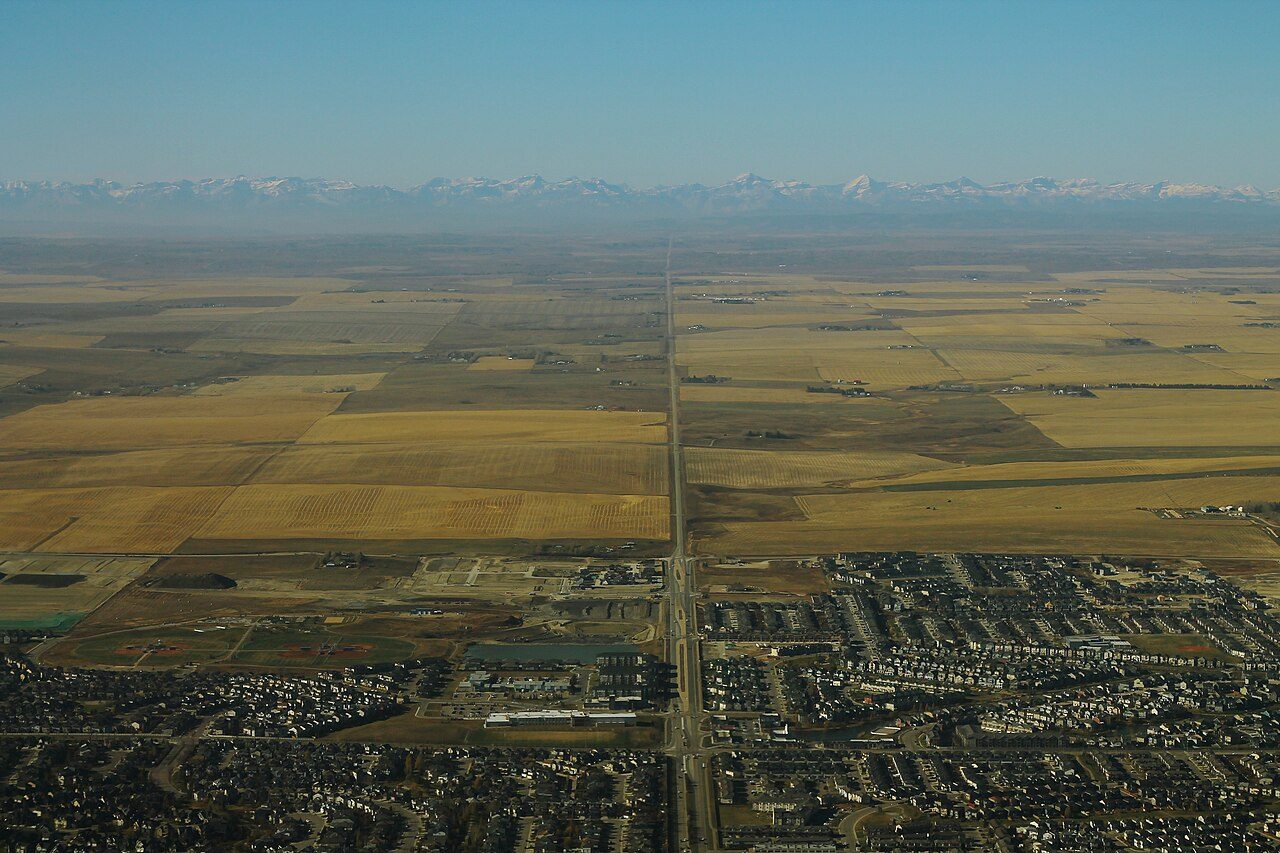
 Photo: formulanone · CC BY-SA 2.0
Airdrie is drier than 82% of Canadian towns: 445 mm of rain and snow a year
Peak summer warmth arrives in July, with afternoons near 23.5°C. By July afternoons alone, it runs cooler than 80% of Canadian towns. From frozen January to warm July, readings climb 37°C. If you like long walks, July and August offer highs of 23–24°C.
These are not Airdrie’s own readings: ECCC keeps no normals there, so the page uses Calgary (Airport), 18 km south.
A year in Airdrie at a glance
Each month’s typical high and low, in °C.
What stands out about Airdrie’s climate
Compared with Canadian towns, with its place among towns of 2,500+ in Alberta beside it.
What a year in Airdrie feels like
Typical highs and lows by season and by month, from ECCC’s 1991–2020 normals.
193 frost days and 87 days above 20°C a year
Frost comes from September to May; in December almost every night freezes. Some 22 nights a year drop under −20°C.
Frost days by month
Average days at 0°C or below
Days above 20°C by month
Average days
About 445 mm of rain and snow a year
The most falls in June, the least in January. On about 72 days a year, 1 mm or more falls.
Rain and snow by month
Millimetres
Rain alone by month
Millimetres
139 cm of snow in a typical year
Snow falls from September to May, most of all in March (about 24 cm).
Snowfall by month
Centimetres
Snow on the ground by month
Centimetres at month’s end
Heating a home in Airdrie
85% of a year’s heating need falls between October and April. Months averaging under 10°C: October to May.
Behind the figure: the degrees each day’s mean falls under 18°C, summed for the year. Homes here need more heating than 68% of Canadian towns.
Living with Airdrie’s climate
Gardening, time outside, winter cold and summer heat, from the 1991–2020 normals.
Count on about 119 frost-free days: the last frost averages 21 May, the first 18 September.
Warm afternoons without cold nights, 17–27°C and 8°C or more, mark Jul and Aug.
Parks & trails →Frostbite weather, a wind chill under −20, turns up on about 42 days a year.
Expect around 9 sticky days a year with the humidex above 30.
A normal year has no blizzard, flood or heat wave in it; Airdrie’s hazards page looks at those.
Flood & hazards →ECCC’s normals location: Calgary (Airport)
Behind the 1991–2020 normals for Calgary (Airport) are 2 stations, which ECCC combines into one record.
| Distance from the town | 18 km south |
| Station altitude | 1,099 m |
| Completeness | at least 20 years |
| WMO standard normals | No |
| Coldest reading, 1991–2020 | −39.7°C |
| Hottest reading, 1991–2020 | 36.5°C |
| Average wind | 13.8 km/h on average, most often from the south |
| Next-nearest location | Sundre, 72 km |
How Airdrie compares
Placed among 2,611 Canadian towns and neighbourhoods of 2,500+, each on its nearest normals location; each dot is another location used in Alberta.
Nearby towns’ climate
Places around Airdrie whose figures come from another normals location. Airdrie has few close neighbours with figures, so the list reaches 31–60 km out.
| Town | July high | January low | Rain & snow |
|---|---|---|---|
| Airdrie Calgary (Airport) | 23.5°C | −13.5°C | 445 mm |
| Carstairs 31 km · Sundre | 22.8°C 0.7°C cooler | −18.0°C 4.5°C colder | 496 mm |
| Stoney 142, 143, 144 60 km · Banff | 22.5°C 1.0°C cooler | −13.5°C about the same | 454 mm |
Airdrie weather by month
Month by month, 1991–2020: the usual high, low and mean, the rain and snow, and the snowfall.
| Month | High | Low | Mean | Rain & snow | Snow |
|---|---|---|---|---|---|
| January | −1.5°C | −13.5°C | −7.6°C | 10 mm | 17 cm |
| February | 0.1°C | −11.8°C | −5.9°C | 12 mm | 17 cm |
| March | 3.8°C | −8.1°C | −2.2°C | 18 mm | 24 cm |
| April | 10.8°C | −1.9°C | 4.5°C | 30 mm | 23 cm |
| May | 16.4°C | 3.4°C | 9.9°C | 61 mm | 10 cm |
| June | 19.7°C | 7.7°C | 13.7°C | 113 mm | under 1 cm |
| July | 23.5°C | 10.2°C | 16.9°C | 66 mm | 0 cm |
| August | 23.1°C | 9.2°C | 16.2°C | 54 mm | 0 cm |
| September | 18.3°C | 4.7°C | 11.5°C | 37 mm | 2 cm |
| October | 11.1°C | −1.3°C | 4.9°C | 17 mm | 12 cm |
| November | 4.1°C | −7.5°C | −1.7°C | 16 mm | 19 cm |
| December | −0.4°C | −12.1°C | −6.3°C | 13 mm | 16 cm |
| Year | 10.8°C | −1.8°C | 4.5°C | 445 mm | 139 cm |
From year to year, February moves by 4.1°C, more than any month, and June least
Over 1991–2020, December saw both −38.2°C (1996) and 19.5°C (1999), the widest span of any month.
Where Airdrie’s numbers come from
Averages over 30 years, not a forecast.
- Normals: ECCC’s normals for Calgary (Airport), 1991–2020, chosen as the nearest location with a full temperature record.
- Comparisons: every Canadian town and neighbourhood of 2,500 or more, each read from its own nearest location; city totals and reserves are left out.
- Not on this page: sunshine, which none of ECCC’s 450 locations publishes for 1991–2020, and the town’s own height above sea level, so no figure is adjusted for altitude.
Canadian Climate Normals 1991–2020 · ECCC Data Services End-use Licence. Data Source: Environment and Climate Change Canada
Questions about Airdrie’s climate
How warm does Airdrie get in summer?
Peak warmth comes in July, at about 23.5°C by mid-afternoon.
How cold does Airdrie get in winter?
Overnight lows average −13.5°C in January, the coldest month.
How much rain and snow does Airdrie get?
The yearly total is about 445 mm. June gets 113 mm, the most of any month; January gets 10 mm, the least.
How long does snow stay on the ground?
About 93 days a year have 1 cm of snow or more on the ground.
Are these figures for Airdrie itself?
They are the closest available: the normals for Calgary (Airport), since Airdrie has none.
Data Source: Environment and Climate Change Canada · ECCC Data Services End-use Licence Today’s forecast for Airdrie →
Adapted from Statistics Canada (Census of Population 2021, population estimates 2025, 2021 census boundaries) under the Statistics Canada Open Licence; this does not constitute an endorsement by Statistics Canada. Neighbourhood names in some cities © OpenStreetMap contributors (ODbL).