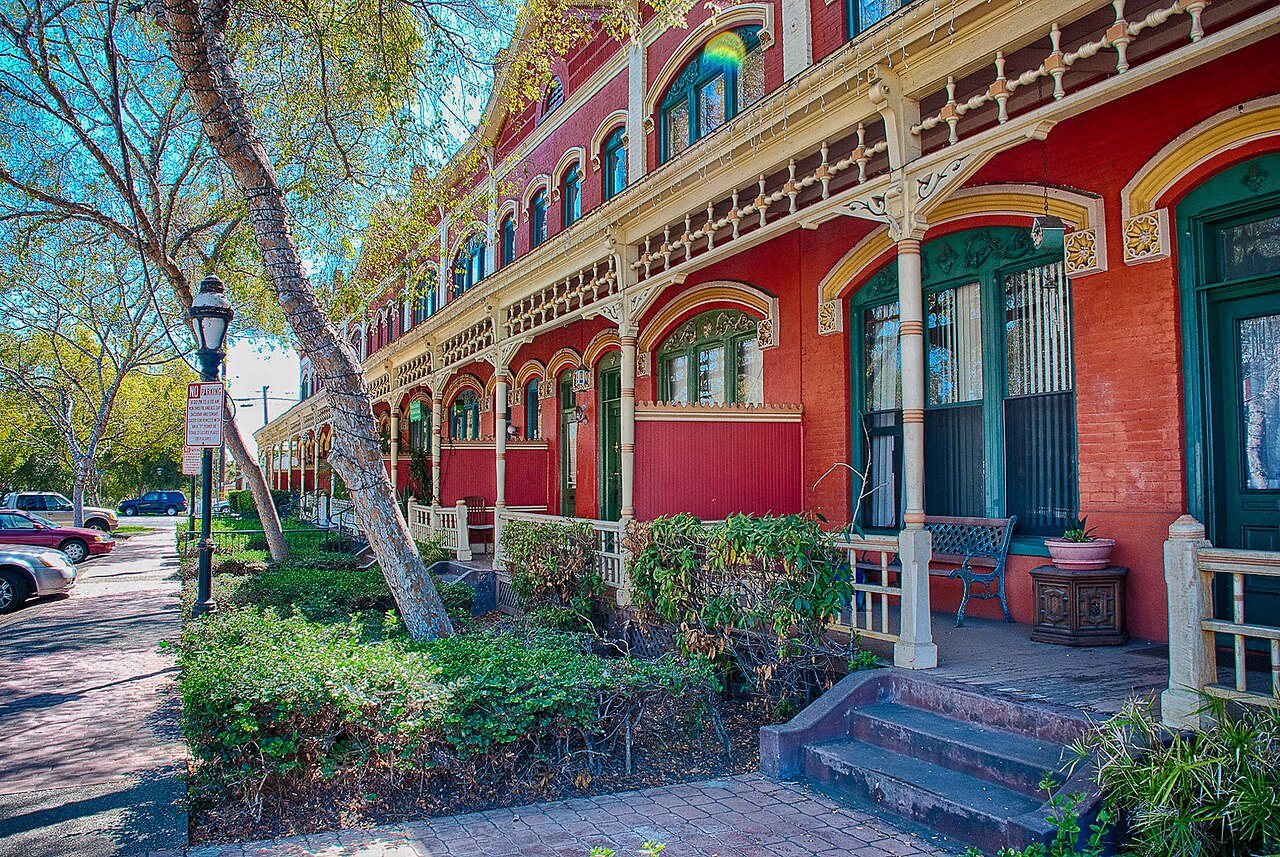
Brick Row
Also known as Kimball Block
Many listed buildings are private homes. Please enjoy them from the street.
About Brick Row
Brick Row, at A Ave. between 9th and 10th Sts., was added to the National Register of Historic Places on Jul 16, 1973: the first place in National City to be listed. Only 201 of California’s 2,865 listings are older. The Register lists it for its architecture, at the local level. It describes its style as Victorian, as it does for 51 other California listings.
What it isHistoric building in National City, California, United States. From Wikidata (CC0).
PDFRead the original nominationThe form that put it on the Register, with its history, photos and a map · 52 MB · National Archives↗Make it a walk: 2 landmarks in about 10 minutes
A Ave. between 9th and 10th Sts., National City · about 0.3 miles on foot, as the crow flies


- 1Brick RowStart here
- 2
 St. Matthew's Episcopal ChurchGothic · 0.3 mi on
2 more Register listings within 2 miles
★ National Historic Landmark · D district · B building · S site. Each opens its own page.
Memories of Brick Row
The record says what it is. Neighbors know what it means.
Your answer becomes a post in Town Square.
Questions about Brick Row
Is Brick Row on the National Register of Historic Places?
Yes. It was added on Jul 16, 1973 (Register number 73000431).
Is Brick Row a National Historic Landmark?
No. It is on the National Register; California has 141 National Historic Landmarks. The nearest is Chicano Park, 2.9 miles away.
Can you visit Brick Row?
Our record doesn’t say whether it is open to visitors. Many listed buildings are private, so it may only be seen from the street.
Where can I read the history of Brick Row?
In its National Register nomination, the form that put it on the Register: a 52 MB PDF at the National Archives, linked on this page.
Sources: National Park Service, National Register of Historic Places (05/22/2026) · National Archives catalog record 123860825 · Wikidata. Map tiles © OpenStreetMap contributors.