Founding year: the first French Camp post office (Blevins & Helbock, CC0).The full story ↓
History grade
What drives French Camp’s History grade
On its age, its old homes and the National Register, French Camp is more historic than 32% of U.S. towns, #325 of 847 in California. Its share of homes from before 1940 holds the grade up; its National Register listings pull it down.
C
HistoryA character grade: shown, never part of French Camp’s overall grade.
Few California towns list much on the Register (a typical California town has 0.0 per 10,000 residents, the U.S. 2.4), so French Camp’s 0.0 sits below most of its state (31% of California towns have fewer) while its 0 listings outnumber those of 23% of U.S. towns.
How sure. Graded on any two of the three inputs instead, the letter would range from C− to C+. The pre-1940 share is a Census survey estimate (±10.1 points). The founding year is the first post office, not a stated founding date.
Founding year: the first post office (other dates in Quick answers). Homes: Census ACS 2020–24. National Register: National Park Service, May 2026 list; each listing counted once (boundary changes and added documentation belong to their listing), and a historic district counts its contributing buildings. How TownRatings grades history →
What stands out about French Camp’s past
Read from the archive, the National Register and the record. The page puts what stands out first.
French Camp was the southernmost regular camp site of the Hudson's Bay Company southern fur brigades sent from Fort Vancouver (now Vancouver, Washington), established by Michel Laframboise in 1832. Its Spanish name was preserved in a land grant dated January 13, 1844 as Rancho Campo de los Franceses. It is commemorated as California State Historic Landmark 668:
Passages that mention French Camp, cut from the printed page as they were published.
History of San Joaquin County, California1923 · page 285Read the page →
Read the text
French Camp One of the oldest of these towns is the historic village of French Camp. We remember that the Hudson Bay Company had their trappers at that point in 1837, and that in 1844, Benjamin Kelsey and his family located for a season. After the discovery of gold and the founding of Stockton, it became quite a trad-
Text read by machine from the scan; it may contain errors.
History of San Joaquin County, California1923 · page 121Read the page →
Read the text
the first, was the bridge across Mormon Channel. It was built by the merchants as a business proposition in their trade with the mountain camps by the way of French Camp. They came before the council of 1853 and petitioned them to reimburse them for the money paid out. The council refused, as the city had paid half of the cost. In March, '53, a contract was
Text read by machine from the scan; it may contain errors.
History of the State of California and biographical record of San Joaquin County1909 · page 322Read the page →
Read the text
perience, one which has been of untold value to him since his assumption of the duties of superintendent of the County Hospital, located in the village of French Camp. Dr. Dameron is the descendant of southern antecedents, and was himself born in one of the bordering southern states, his birth occurring in Chariton county, Mo., in 1867, the son of
Text read by machine from the scan; it may contain errors.
A history of Stockton from its organization up to the present time, including a sketch of San Joaquin County1880Read the page →
Read the text
ing christened after it came intathe possession of a civilized race, has a name of English origin. When the settlement was first started, it was called and known everywhere as "Weber's settlement, or as French Camp, the latter name being best known. Captain Weber and his partner were undecided about the name which the new settlement should have. New Albany was the choice of the jsartner, because of his birth in Albany, New York. Captain Weber,
Text read by machine from the scan; it may contain errors.
Scans and text from the Internet Archive. Books published in 1930 or earlier, which are in the public domain.
Timeline
French Camp, 1854 to 1985
Woven from the archive, old maps, post office records, the National Register and the people born here.
Nothing in the archives for these yearsWeddings on Main Street, storms, parades, school pictures, the old store. If it’s in your family album, it belongs here.
The French Camp post office opened in 1854, the earliest record of the town by name (U.S. post office records).
How does French Camp rank for history?
French Camp is more historic than 32% of U.S. towns, #325 of 847 in California. The History grade combines the town’s founding era, the share of homes built before 1940 and its National Register listings. It’s a character grade, so it isn’t part of the overall grade. How it works.
How old are the homes in French Camp?
12% of French Camp’s homes were built before 1940 (Census estimate, ±10.1 points), against a typical 3.4% for a California town; the median home was built in 1975.
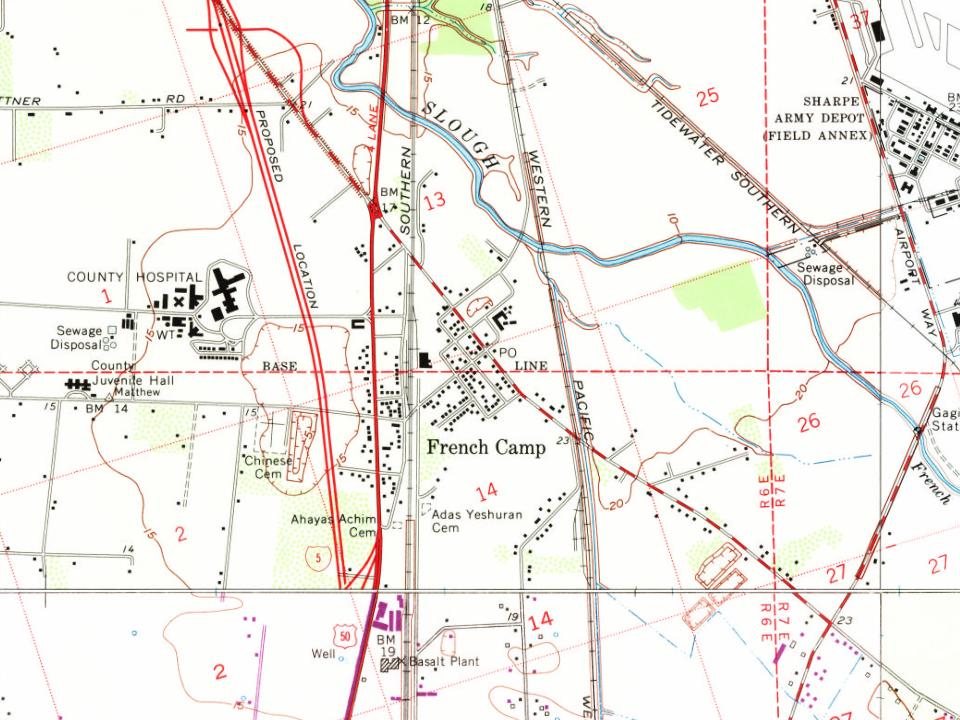
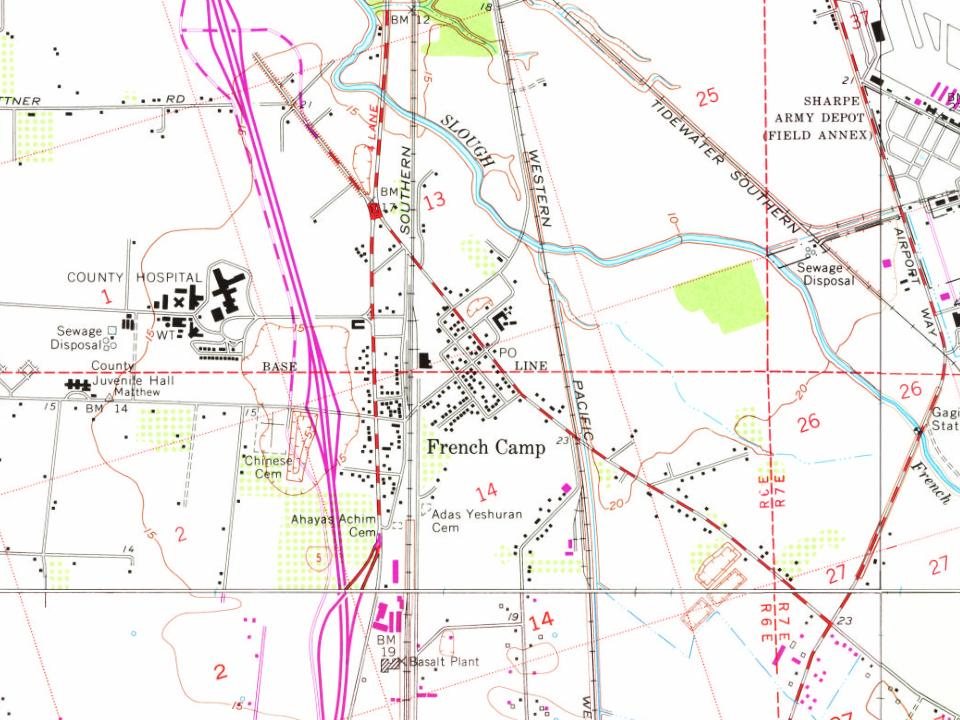
Founding dates: Wikidata, Wikipedia, the U.S. post office records of Blevins & Helbock (CC0) and the Census. Homes by year built: Census ACS 2020–24. National Register of Historic Places: National Park Service (list of May 22, 2026). Old photos, postcards and papers: Wikimedia Commons, the Library of Congress and other public archives, credited on each item’s page. Maps: U.S. Geological Survey historical topographic maps (via Esri) and Sanborn fire-insurance maps (Library of Congress). History text and census tables: Wikipedia (CC BY-SA 4.0). Places that used to be: USGS Geographic Names Information System (2021).
From Wikimedia Commons (1), the Library of Congress (1), Wikipedia, Wikidata and Wikipedia for famous people, U.S. Geological Survey historical maps, U.S. Census counts (via Wikipedia), the US Post Offices dataset (Blevins & Helbock), the USGS Geographic Names Information System and old county and town histories (Internet Archive). Archive images are copied here with their credits and licenses, shown on each photo’s page. Refreshed monthly.




 Date?