On its age, its old homes and the National Register, August is more historic than 40% of U.S. towns, #223 of 847 in California. Its share of homes from before 1940 holds the grade up; its National Register listings pull it down.
C+
HistoryA character grade: shown, never part of August’s overall grade.
Few California towns list much on the Register (a typical California town has 0.0 per 10,000 residents, the U.S. 2.4), so August’s 0.0 sits below most of its state (31% of California towns have fewer) while its 0 listings outnumber those of 23% of U.S. towns.
How sure. Graded on two of the three inputs, so a change in either one moves the letter more than it would with three. The pre-1940 share is a Census survey estimate (±5.7 points).
Founding year: our sources. Homes: Census ACS 2020–24. National Register: National Park Service, May 2026 list; each listing counted once (boundary changes and added documentation belong to their listing), and a historic district counts its contributing buildings. How TownRatings grades history →
What stands out about August’s past
Read from the archive, the National Register and the record. The page puts what stands out first.
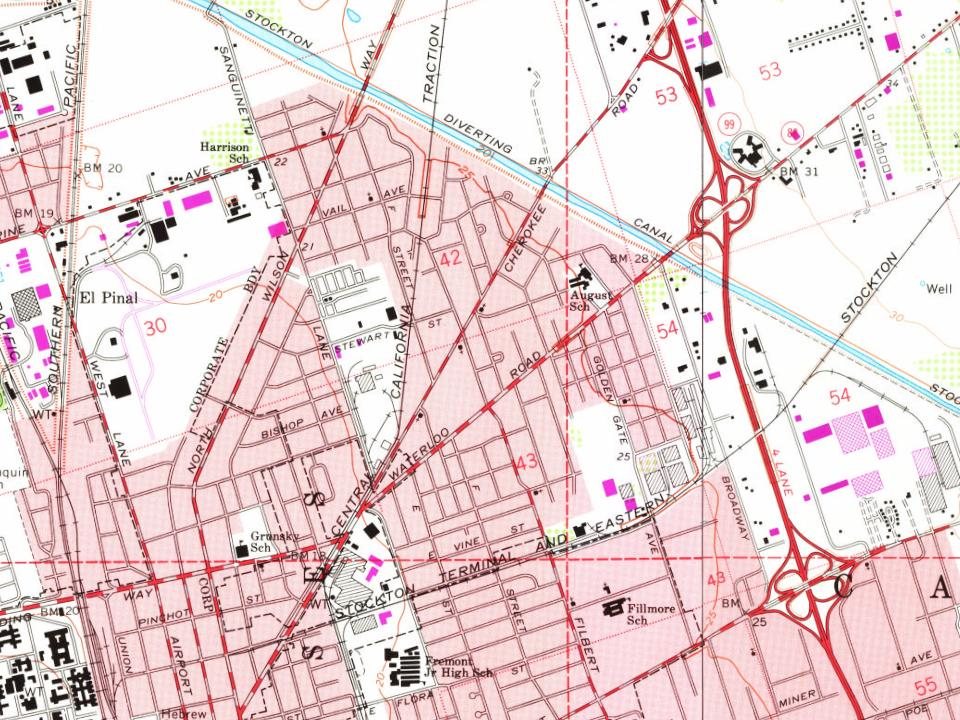
Every edition of the U.S. Geological Survey’s map of August. Tap a year, or press play to watch the town change.
1913Stockton sheet · 1:31,680
U.S. Geological Survey historical topographic maps (public domain), via Esri’s collection of the scans. The red ring marks the center of August.
The story so far
August, in brief
Wikipedia doesn’t have a history of August yet. The photos, dates and memories neighbors add here are how it gets written.
August is a census-designated place (CDP) in San Joaquin County, California, United States. The population was 8,628 at the 2020 census, up from 8,390 at the 2010 census.
Between the 2010 and 2020 censuses its population grew from 8,390 to 8,628 (+3%).
Intro from Wikipedia. Population: U.S. Census Bureau.
From the old history books
What they wrote about August, 1919–1920
Passages that mention August, cut from the printed page as they were published.
The story of the Fourth army in the battles of the hundred days, August 8th to November 11th, 19181920Read the page →
Read the text
During the period from August 11th to August 20th, the First French Army, operating south of the Amiens-Roye road on the right flank of the The progress of the First Canadian Corps, had made good progress and advanced French Army, August its line to within machinc-gun range of Roye. This nth— 20th advance was materially assisted by the Third French Army, which on August 10th attacked south of Montdidier in a northeasterly direction, and finally effected a junction with the First French Army north-cast of that town.^ The advance of the First French Army
Text read by machine from the scan; it may contain errors.
The story of the Fourth army in the battles of the hundred days, August 8th to November 11th, 19181920 · page 296Read the page →
Read the text
For bravery in the face of the enemy in the " Llandovery Castle " operations in front of Amiens, August 8th to August 12th, 1918. On August 8th, in the first phase of the attack, the advance was checked by a terrific machine-gun fire from Beaucourt Wood. Lieut. Tait rallied his company and led them forward with consummate skill and dash under a hail of bullets. One cleverly concealed machine-gun continued to cause us many casualties. Lieut. Tait, taking a rifle and bayonet from a casualty, dashed forward alone and killed the German gunner single-handed. Inspired by his example his men rushed the wood, which yielded 12 machine-guns and 20 prisoners,
Text read by machine from the scan; it may contain errors.
History of the Seventy seventh division, August 25th, 1917, November 11th, 19181919 · page 139Read the page →
Read the text
Chronological History of 77th Division August 25, 1917 The 77th Division was organized August 25, 1917, at Camp Upton, New York. The majority of officers and all enlisted men were from New York State and practically all of the enlisted men from the Metropolitan District. The Division is named the "Liberty Division" and its shoulder insignia is a Statue of Liberty in gold on a blue background.
Text read by machine from the scan; it may contain errors.
Scans and text from the Internet Archive. Books published in 1930 or earlier, which are in the public domain.
By decade
No old photos in the archives yet
Weddings on Main Street, storms, parades, school pictures, the old store. If it’s in your family album, it belongs here.
Be the first to add onePhotograph a print flat, in daylight, no flash.
August is more historic than 40% of U.S. towns, #223 of 847 in California. The History grade combines the town’s founding era, the share of homes built before 1940 and its National Register listings. It’s a character grade, so it isn’t part of the overall grade. How it works.
How old are the homes in August?
15% of August’s homes were built before 1940 (Census estimate, ±5.7 points), against a typical 3.4% for a California town; the median home was built in 1956.
Founding dates: Wikidata, Wikipedia, the U.S. post office records of Blevins & Helbock (CC0) and the Census. Homes by year built: Census ACS 2020–24. National Register of Historic Places: National Park Service (list of May 22, 2026). Old photos, postcards and papers: Wikimedia Commons, the Library of Congress and other public archives, credited on each item’s page. Maps: U.S. Geological Survey historical topographic maps (via Esri) and Sanborn fire-insurance maps (Library of Congress). History text and census tables: Wikipedia (CC BY-SA 4.0). Places that used to be: USGS Geographic Names Information System (2021).
From U.S. Geological Survey historical maps, U.S. Census counts (via Wikipedia), the USGS Geographic Names Information System and old county and town histories (Internet Archive). Archive images are copied here with their credits and licenses, shown on each photo’s page. Refreshed monthly.