Florence’s post office opened in 1818, and 29 of its places are on the National Register
More historic than 80% of U.S. towns · #11 of 187 in Alabama. What drives it
Most of Florence was built recently: 7% of its homes predate 1940 and the median home dates from 1973. 29 places in town are on the National Register, among them the Wilson Dam, a National Historic Landmark, and ten historic districts with 677 buildings between them. Below: 6 old photos and papers, maps from 1884 on, and the census since 1850.
The Florence post office opened in 1818, the earliest record of the town by name. Wikidata gives 1826. Two smaller post offices, Indian Springs (1839) and East Florence (1894), opened inside today’s city and later closed.
First census: 802 in 18502020 census: 40,184208 years
How historic is Florence?
A−
More historic than 80% of U.S. towns, on its age, its old homes and the National Register.
Founding year: the first Florence post office (Blevins & Helbock, CC0). Wikidata: 1826.The full story ↓
History grade
What drives Florence’s History grade
On its age, its old homes and the National Register, Florence is more historic than 80% of U.S. towns, #11 of 187 in Alabama. Its National Register listings hold the grade up; its share of homes from before 1940 pulls it down.
A−
HistoryA character grade: shown, never part of Florence’s overall grade.
Alabama towns list about as much on the Register as the country (a typical Alabama town has 2.7 per 10,000 residents, the U.S. 2.4), so Florence’s 166 sits above most of its state (89% of Alabama towns have fewer) while its 691 historic buildings outnumber those of 98% of U.S. towns.
How sure. Graded on any two of the three inputs instead, the letter would range from B to A. The pre-1940 share (±1.8 points) is firm at this size. The founding year is the first post office, not a stated founding date; Wikidata’s 1826 falls in the same era, so the grade doesn’t depend on which one is used.
Founding year: the first post office (other dates in Quick answers). Homes: Census ACS 2020–24. National Register: National Park Service, May 2026 list; each listing counted once (boundary changes and added documentation belong to their listing), and a historic district counts its contributing buildings. How TownRatings grades history →
What stands out about Florence’s past
Read from the archive, the National Register and the record. The page puts what stands out first.
The country’s official list of buildings and places worth saving. One is a National Historic Landmark, the highest tier. Boundary changes and added documentation are counted with their listing.
Antioch Presbyterian ChurchchurchBurrell-Slater High SchoolschoolCoffee High SchoolschoolEast Alabama Street Church of ChristchurchEnterprise Street Presbyterian ChurchchurchFlorence High SchoolschoolFlorence Synodical Female CollegeschoolFour Mile SchoolschoolHickory Hill PlantationlocaleJoy-Lan Drive-InlocaleMars Hill SchoolschoolMoore Chapel Methodist Episcopal ChurchchurchSweetwater PlantationlocaleThree Points Schoolschool
12cemeteries and burying grounds inside Florence
CoffeeFlorenceGreenview MemorialGreshamHawkinsJones HillKachelmanMooreMount CalvaryPriceTri - Cities Memorial GardensWilson
US Post Offices dataset (Blevins & Helbock, CC0). Places and cemeteries from the USGS Geographic Names Information System (2021).
Evidence for human habitation in the Florence area goes back to at least 500 BCE, when the Florence Indian Mound, the largest of its type in the Tennessee Valley, was constructed as an earthwork during the Woodland period. Successive cultures arose after this. In the historic period, the area of present-day Florence was occupied by the Chickasaw Nation. They first encountered white traders and settlers beginning in the late 1700s, and were forced to cede their land to the Federal government through a series of treaties in early 1800s, as part of the Indian Removal policy to extinguish tribal land claims east of the Mississippi River. The land on which Florence stands was ceded in 1816. The Chickasaw were removed to west of the river in Indian Territory (now Oklahoma).
Nothing in the archives for these yearsWeddings on Main Street, storms, parades, school pictures, the old store. If it’s in your family album, it belongs here.
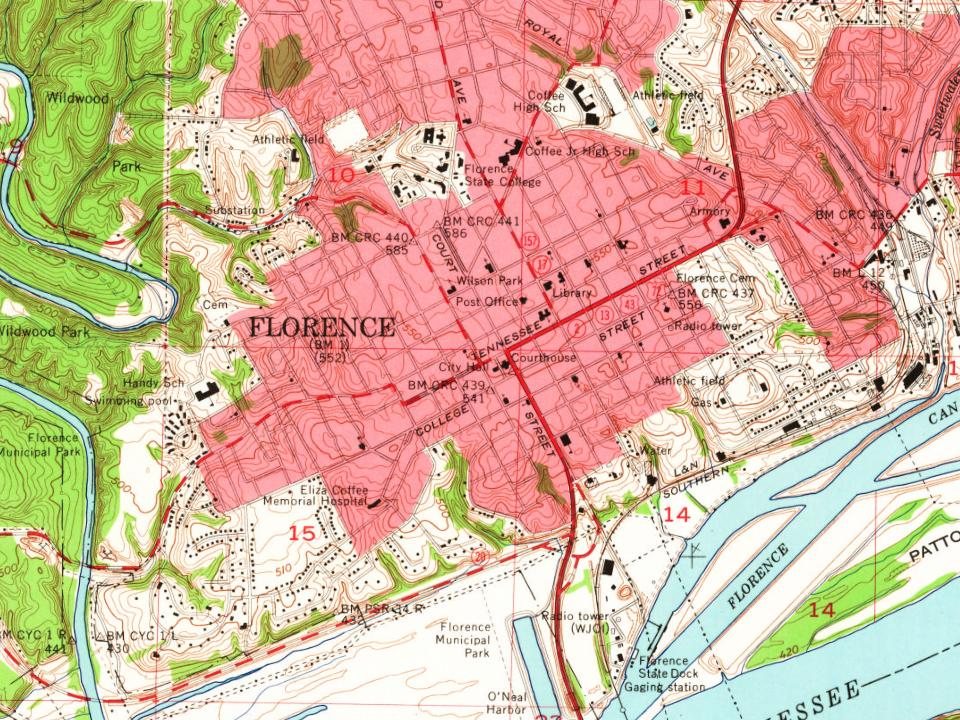
Every edition of the U.S. Geological Survey’s map of Florence. Tap a year, or press play to watch the town change.
1916Muscle Shoals sheet · 1:62,500
U.S. Geological Survey historical topographic maps (public domain), via Esri’s collection of the scans. The red ring marks the center of Florence.
Every building
Florence, building by building, 1884–1928
Fire insurance maps drew every building, what it was made of and what it was used for, so insurers could price the risk of fire. Pick a year, then a sheet.
1884Sheet 1 of 1
Edition
Sheets
BrickWoodStone
Sanborn Map Company, via the Library of Congress. Editions published in 1930 or earlier, which are in the public domain.
Then & now
Stand where they stood
No then-and-now pairs yet. Take a photo from the same spot as an old one and they appear here side by side.
Retake this viewFlorence Alabama female college, June 1862, 1862
Find the spot, match the angle, and add your photo. It becomes the first then-and-now pair on Florence’s page.
The Florence post office opened in 1818, the earliest record of the town by name (U.S. post office records). Wikidata gives 1826.
How does Florence rank for history?
Florence is more historic than 80% of U.S. towns, #11 of 187 in Alabama. The History grade combines the town’s founding era, the share of homes built before 1940 and its National Register listings. It’s a character grade, so it isn’t part of the overall grade. How it works.
What is on the National Register in Florence?
29 listings: 14 buildings, 10 historic districts with 677 contributing buildings, 3 sites, and 2 structures. 691 historic buildings in all.
How old are the homes in Florence?
7% of Florence’s homes were built before 1940 (Census estimate, ±1.8 points), against a typical 3.2% for an Alabama town; the median home was built in 1973.
Founding dates: Wikidata, Wikipedia, the U.S. post office records of Blevins & Helbock (CC0) and the Census. Homes by year built: Census ACS 2020–24. National Register of Historic Places: National Park Service (list of May 22, 2026). Old photos, postcards and papers: Wikimedia Commons, the Library of Congress and other public archives, credited on each item’s page. Maps: U.S. Geological Survey historical topographic maps (via Esri) and Sanborn fire-insurance maps (Library of Congress). History text and census tables: Wikipedia (CC BY-SA 4.0). Places that used to be: USGS Geographic Names Information System (2021).
From Wikimedia Commons (3), the Library of Congress (3), the National Register of Historic Places (29), Wikipedia, Wikidata and Wikipedia for famous people, U.S. Geological Survey historical maps, U.S. Census counts (via Wikipedia), the US Post Offices dataset (Blevins & Helbock), the USGS Geographic Names Information System and Sanborn fire insurance maps (Library of Congress). Archive images are copied here with their credits and licenses, shown on each photo’s page. Refreshed monthly.


 ★ Landmark


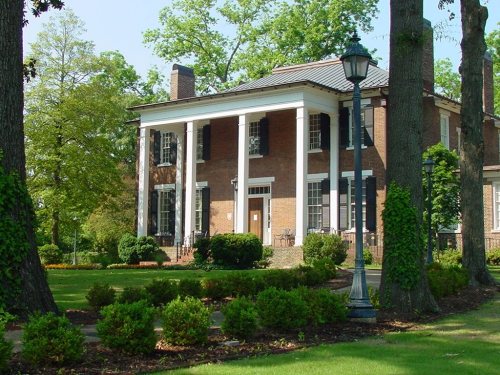


 1862
 1862
 1862