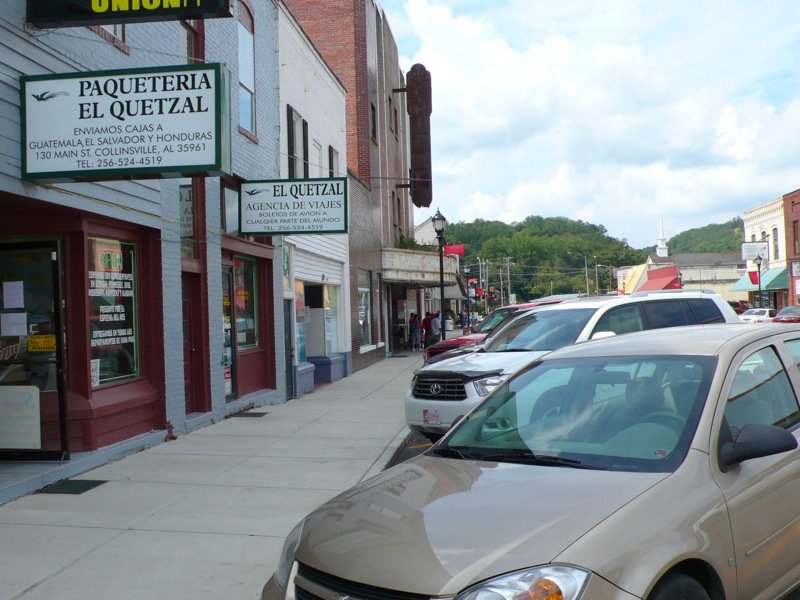
 Photo: DwayneP · CC BY-SA 3.0
On CDC estimates, Collinsville is healthier than 4% of U.S. towns
Collinsville trails Alabama on 18 of 32 measures CDC estimates, and leads on none.
Modeled estimates for adults 18+, CDC’s own estimate for Collinsville. How CDC estimates town health
What stands out about health in Collinsville
Dental care lags in Collinsville
39.3% of adults saw a dentist this year, vs 56.9% across Alabama. Among those 65 and older, 27.1% have lost all their teeth (Alabama 15.4%). Checkups ↓
3 in 10 working-age adults in Collinsville have no health insurance
27.8% of adults 18–64 have no health insurance, vs 9.9% across Alabama. Checkups ↓
More Collinsville adults get no exercise
42.9% of adults get no exercise outside work, vs 28.7% across Alabama. Habits ↓
Collinsville is healthier than its income would predict
Against all U.S. towns, Collinsville is healthier than 4%. Against the 746 towns with similar household incomes ($24K–$40K), it’s healthier than 42%. Health Grade ↓
Written from the CDC, Medicare and HRSA data on this page. CDC PLACES 2025 release: modeled estimates for adults, not counts; “higher” and “lower” mean the Alabama figure falls outside Collinsville’s likely range.
What’s behind Collinsville’s grade
On seven CDC estimates for adults, Collinsville is healthier than 4% of U.S. towns. All seven of Collinsville’s estimates fall in the lowest 15% of U.S. towns. The furthest from typical is no exercise: 42.9% of adults, against 28.7% across Alabama and 24.7% nationally.
Health estimates follow income closely across the country: towns with higher household incomes usually score higher (a correlation of 0.77 across 21,157 graded towns). Collinsville’s median household income is $31,652; among the 746 U.S. towns within 25% of that ($24K–$40K), it’s healthier than 42%, so it sits below most towns with similar incomes, too.
Keeping up with care
Share of Collinsville adults getting routine care. The full ring is 100%; the dark tick marks Alabama.
Everyday habits, side by side with Alabama
Share of adults, with the Alabama figure marked.
Walk with neighbors
The easiest exercise habit to keep is one with company.
Out of every 100 Collinsville adults…
Collinsville runs above AL on 5 of 12 conditions. Tap one to see it as people.
Care in and near Collinsville
No hospital or community health center in Collinsville itself. These are the nearest.
Hospitals: Medicare overall star ratings, 1–5. Community health centers charge on a sliding scale by income. Distances are straight-line from the center of Collinsville; ≈ marks a hospital located by its town, not its street. Shortage areas: HRSA Health Professional Shortage Areas (a “population” designation covers specific residents, such as those with low incomes).
How Collinsville adults are doing
About the same as Alabama on each measure.
2 in 5 Collinsville adults feel lonely. A hello is a start.
Groups are the easiest way in: a walking group, a book club, your street.
If you or someone you know is struggling, call or text 988, the Suicide & Crisis Lifeline. It’s free, confidential and open 24/7.
Making ends meet
Needs that shape health as much as any doctor visit: food, housing, utilities and a way to get around.
27.3% of Collinsville adults receive SNAP (food stamps), compared with 14% across Alabama.
Collinsville and the towns around it
How health changes across the town line.
Health next door
| Town | Health | Obesity | Diabetes | Smoking | Figures from |
|---|---|---|---|---|---|
| Collinsville | D− | 41.4% | 18.5% | 19.4% | CDC place |
Same-state neighbors only, ordered by length of shared border.
Living with a disability
Shown without a better/worse judgment.
of Collinsville adults live with a disability (Alabama 36.5%). Walking or climbing stairs is the most common.
Every CDC estimate for Collinsville
Share of adults, 40 measures, with CDC’s likely range.
On the 32 measures below that have a better and a worse direction, Collinsville is better than Alabama on 0 and worse on 18; on the rest, the Alabama figure falls inside Collinsville’s likely range, so we call them about the same. Disability and SNAP are described, not compared as better or worse.
| Adults who… | Collinsville | AL | U.S. | vs AL |
|---|---|---|---|---|
| Overall health | ||||
| Fair or poor health | 36.5%31.5–41.6 | 22.8% | 19.4% | Worse |
| Frequent physical distress (physical health not good 14+ days a month) | 19.9%17.2–22.7 | 14.2% | 13% | Worse |
| Frequent mental distress (mental health not good 14+ days a month) | 19.4%17–22 | 17.2% | 15.9% | About the same |
| Conditions | ||||
| Obesity | 41.4%33.7–49.6 | 39.4% | 32.9% | About the same |
| Diabetes | 18.5%16.2–21 | 14.8% | 12% | Worse |
| High blood pressure | 45.2%41.1–49.4 | 43.3% | 34.4% | About the same |
| High cholesterol (adults screened in 5 years) | 41.8%37.5–46.4 | 40.7% | 37.1% | About the same |
| Arthritis | 31.2%28.1–34.4 | 30.3% | 25.3% | About the same |
| Asthma | 10%8.8–11.4 | 10% | 9.9% | About the same |
| Cancer, other than skin cancer | 7.8%6.9–8.7 | 8.2% | 7.9% | About the same |
| Coronary heart disease | 9.9%8.6–11.2 | 7.3% | 6.4% | Worse |
| COPD | 11.5%9.5–13.5 | 8% | 6.3% | Worse |
| Stroke | 5.6%4.8–6.3 | 4.1% | 3.4% | Worse |
| Lost all teeth (ages 65+) | 27.1%22.8–31.8 | 15.4% | 12.3% | Worse |
| Habits | ||||
| Smoke cigarettes | 19.4%16.3–22.7 | 15.1% | 11.8% | Worse |
| No exercise outside work | 42.9%36.5–49.2 | 28.7% | 24.7% | Worse |
| Binge drinking | 12.3%10–15.1 | 14.1% | 15.4% | About the same |
| Sleep under 7 hours | 43%36.2–50.2 | 39.1% | 36% | About the same |
| Checkups and coverage | ||||
| No health insurance (ages 18–64) | 27.8%23.1–33 | 9.9% | 11% | Worse |
| Checkup in the past year | 77.2%73.4–80.9 | 80.4% | 77.4% | About the same |
| Dentist visit in the past year | 39.3%35.4–43.5 | 56.9% | 63.2% | Worse |
| Cholesterol check in 5 years | 79.9%77.1–82.7 | 85.8% | 87.1% | Worse |
| Taking blood pressure medicine (adults with high blood pressure) | 76.2%73.8–78.7 | 78% | 76.5% | About the same |
| Colorectal cancer screening (ages 45–75) | 55.9%50.5–61.3 | 67% | 65.5% | Worse |
| Mammogram in 2 years (women 50–74) | 68.6%59.9–76.7 | 77.9% | 76.4% | Worse |
| Mind and connection | ||||
| Ever told they have depression | 24.1%20.5–28.1 | 23.3% | 20.6% | About the same |
| Feel lonely | 38.2%32.7–44.2 | 35.4% | 32.5% | About the same |
| Lack social and emotional support | 28.5%24.2–33.2 | 24.8% | 23.6% | About the same |
| Everyday needs | ||||
| Worried about having enough food | 35.9%30.7–41.1 | 19.2% | 15% | Worse |
| Worried about keeping housing | 23.8%20.4–27.4 | 13.9% | 12% | Worse |
| Threatened with a utility shut-off | 15.3%13.2–17.6 | 9.6% | 7.6% | Worse |
| Lack reliable transportation | 16.9%14.5–19.4 | 9.8% | 7.9% | Worse |
| Received SNAP (food stamps) | 27.3%23–31.8 | 14% | 11.6% | Higher |
| Disability | ||||
| Any disability | 48.9%43.3–54.6 | 36.5% | 30.1% | Higher |
| Difficulty walking or climbing stairs | 25.1%21.7–28.5 | 17.1% | 13.6% | Higher |
| Difficulty concentrating or remembering | 23.3%20.1–26.8 | 16.1% | 13.9% | Higher |
| Hearing difficulty | 11.7%10.2–13.3 | 8.2% | 6.7% | Higher |
| Vision difficulty | 11.7%10.1–13.4 | 6% | 5.4% | Higher |
| Difficulty doing errands alone | 15.3%13.1–17.7 | 9.8% | 7.9% | Higher |
| Difficulty dressing or bathing | 7.7%6.7–8.9 | 4.6% | 3.8% | Higher |
Each figure is the share of adults 18+ unless the label says otherwise; small numbers after it are CDC’s likely range (95% interval). “About the same” means the Alabama figure falls inside that range.
Questions about health in Collinsville
Is Collinsville a healthy place to live?
On seven CDC estimates for adults, Collinsville is healthier than 4% of U.S. towns: D− for health. Among U.S. towns with similar household incomes it’s healthier than 42%. These are modeled estimates of who lives there, not a measure of local care or habits alone.
What is the obesity rate in Collinsville?
CDC estimates 41.4% of adults have obesity, likely between 33.7% and 49.6%, against 39.4% across Alabama and 32.9% nationally.
What hospital is closest to Collinsville?
Dekalb Regional Medical Center in Fort Payne, 13.5 miles in a straight line from Collinsville’s center point, is the nearest general hospital with an emergency room; Medicare rates it 2 of 5 stars.
How many people in Collinsville have no health insurance?
CDC estimates 27.8% of adults ages 18–64 have no health insurance (likely 23.1–33%), against 9.9% across Alabama.
How accurate are these numbers?
They’re modeled estimates: CDC applies national survey answers to each area’s age, sex, race and education mix, so they describe who lives in Collinsville more than anything measured there. At the ends of CDC’s ranges the grade could be anywhere from D− to C−.
Neighbors talk health
Doctors taking patients, urgent care, staying active in Collinsville.
Health estimates: CDC PLACES: Local Data for Better Health, 2025 release. The Alabama figure combines its counties, weighted by adult population. Hospitals and star ratings: Medicare Care Compare (CMS). Health centers and shortage areas: HRSA. The Health Grade is our own summary of CDC’s estimates, not an official rating. Ages: U.S. Census Bureau, American Community Survey. Town boundaries: U.S. Census Bureau. This page isn’t medical advice. In an emergency, call 911.