Ripon dates to 1849, and 21% of its homes were built before 1940
More historic than 93% of U.S. towns · #21 of 362 in Wisconsin. What drives it
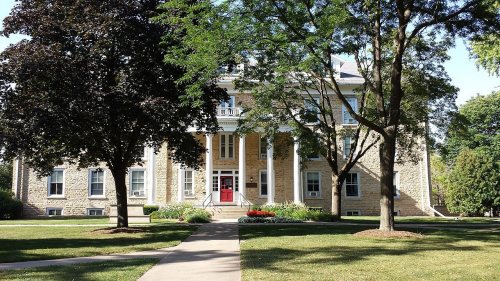
14 places in town are on the National Register, among them the Little White Schoolhouse, a National Historic Landmark, and four historic districts with 312 buildings between them. Below: 5 old photos and papers, maps from 1884 on, and the census since 1860.
Founding year: Wikidata; Wikipedia’s history section gives the same year. First post office: 1844.The full story ↓
History grade
What drives Ripon’s History grade
On its age, its old homes and the National Register, Ripon is more historic than 93% of U.S. towns, #21 of 362 in Wisconsin. All 3 inputs are above most U.S. towns; its National Register listings ranks highest and its share of homes from before 1940 lowest.
A
HistoryA character grade: shown, never part of Ripon’s overall grade.
Wisconsin towns list more on the Register than most of the country (a typical Wisconsin town has 3.0 per 10,000 residents, the U.S. 2.4), so Ripon’s 416 sits above most of its state (100% of Wisconsin towns have fewer) while its 323 historic buildings outnumber those of 96% of U.S. towns.
How sure. Graded on any two of the three inputs instead, the letter would range from A− to A+. The pre-1940 share is a Census survey estimate (±4.4 points). Two sources give 1849.
Founding year: Wikidata (other dates in Quick answers). Homes: Census ACS 2020–24. National Register: National Park Service, May 2026 list; each listing counted once (boundary changes and added documentation belong to their listing), and a historic district counts its contributing buildings. How TownRatings grades history →
What stands out about Ripon’s past
Read from the archive, the National Register and the record. The page puts what stands out first.
National Park Service, National Register of Historic Places. Photos from Wikimedia Commons, credited on each place’s page.
Every building
Ripon, building by building, 1884–1913
Fire insurance maps drew every building, what it was made of and what it was used for, so insurers could price the risk of fire. Pick a year, then a sheet.
Ripon was founded in 1849 by David P. Mapes, a former New York steamboat captain. Within two years the city had absorbed the nearby commune of Ceresco, established in 1844 by the Wisconsin Phalanx, a group of settlers inspired by the communitarian socialist philosophy of Charles Fourier. Mapes was a founder of Ripon College, originally incorporated as Brockway College in 1851.
The city was named for the English cathedral city of Ripon, North Yorkshire, by John S. Horner, one of the community's original settlers, because that was where his immigrant ancestors originated. Horner also named most of the streets. His house is still standing today.
Passages that mention Ripon, cut from the printed page as they were published.
The history of Fond du Lac County, Wisconsin1880 · page 325Read the page →
Read the text
Silver Creek has its source in a spring which is the largest in Fond du Lac County, situated on the farm of Almon Osborn, in Section 2, in the town of Metomen, and in another very large spring on M. Hargraves' farm on Section 1, in the town of Metomen. It flows to the westward through the city of Ripon, where it makes a rapid descent and furnishes a strong, though limited, water-power, into Green Lake. It turns, during a large portion of the year Dellinger's and Bateman's flouring-mills, in the city of Ripon, and Strong's and Crawford's mills, in the town of Ripon.
Text read by machine from the scan; it may contain errors.
The history of Fond du Lac County, Wisconsin, containing ... war record, biographical sketches ... history of Wisconsin ... etc1880 · page 321Read the page →
Read the text
Silver Creek has its source in a spring which is the largest in Fond du Lac County, situated on the farm of Almon Osborn, in Section 2, in the town of Metomen, and in another very large spring on M. Hargraves' farm on Section 1, in the town of Metomen. It flows to the westward through the city of Ripon, where it makes a rapid descent and furnishes a strong, though limited, water-power, into Green Lake. It turns, during a large portion of the year Dellinger's and Bateman's flouring-mills, in the city of Ripon, and Strong's and Crawford'smills, in the town of Ripon.
Text read by machine from the scan; it may contain errors.
The history of Fond du Lac County, Wisconsin1880 · page 320Read the page →
Read the text
St. Peters Sandstone. — Upon the wavy and irregular surface of the lower magnesian limestone, rests the St. Peters sandstone. It is the only sandstone which outcrops in the county, and then only in two towns, in Section 31, town of Metomen, and in the town of Ripon, west and north of the city of Ripon. In Section 17, it is cut through by the Sheboygan & Fond du Lac Railroad, and in Section 9 by the Chicago, Milwaukee & St. Paul Railroad. It is exposed in several places in the bluffs west of Ripon, and is everywhere a soft, crumbling sandstone, usually white or yellow : being permeable to water, it forms the reservoir for the principal supply of the deep wells in the city of Fond du Lac and vicinity. At the high-school
Text read by machine from the scan; it may contain errors.
The history of Fond du Lac County, Wisconsin, containing ... war record, biographical sketches ... history of Wisconsin ... etc1880 · page 766Read the page →
Read the text
Although a rich and important town, Ripon has little history of interest not to be found in the history of the Wisconsin Phalanx and the city of Ripon. The first settlement and all important events took place within the limits of the city of Ripon. As to who made the first settlement of that portion of the town outside of the city is not undisputed, though D. P.
Text read by machine from the scan; it may contain errors.
Scans and text from the Internet Archive. Books published in 1930 or earlier, which are in the public domain.
Timeline
Ripon, 1844 to 1974
Woven from the archive, old maps, post office records, the National Register and the people born here.
Nothing in the archives for these yearsWeddings on Main Street, storms, parades, school pictures, the old store. If it’s in your family album, it belongs here.
In 1849, according to Wikidata and Wikipedia’s history of the town. Ripon’s post office opened in 1844, and the census of 1860 counted 2,025 people here.
How does Ripon rank for history?
Ripon is more historic than 93% of U.S. towns, #21 of 362 in Wisconsin. The History grade combines the town’s founding era, the share of homes built before 1940 and its National Register listings. It’s a character grade, so it isn’t part of the overall grade. How it works.
What is on the National Register in Ripon?
14 listings: 9 buildings, among them the Little White Schoolhouse (a National Historic Landmark since 1974), 4 historic districts with 312 contributing buildings, and 1 site. 323 historic buildings in all.
How old are the homes in Ripon?
21% of Ripon’s homes were built before 1940 (Census estimate, ±4.4 points), against a typical 12% for a Wisconsin town; the median home was built in 1966.
Founding dates: Wikidata, Wikipedia, the U.S. post office records of Blevins & Helbock (CC0) and the Census. Homes by year built: Census ACS 2020–24. National Register of Historic Places: National Park Service (list of May 22, 2026). Old photos, postcards and papers: Wikimedia Commons, the Library of Congress and other public archives, credited on each item’s page. Maps: U.S. Geological Survey historical topographic maps (via Esri) and Sanborn fire-insurance maps (Library of Congress). History text and census tables: Wikipedia (CC BY-SA 4.0). Places that used to be: USGS Geographic Names Information System (2021).
From Wikimedia Commons (4), the Library of Congress (1), Wikidata (5), the National Register of Historic Places (14), Wikipedia, Wikidata and Wikipedia for famous people, U.S. Geological Survey historical maps, U.S. Census counts (via Wikipedia), the US Post Offices dataset (Blevins & Helbock), the USGS Geographic Names Information System, Sanborn fire insurance maps (Library of Congress) and old county and town histories (Internet Archive). Archive images are copied here with their credits and licenses, shown on each photo’s page. Refreshed monthly.




 1900
 1908
 1909


