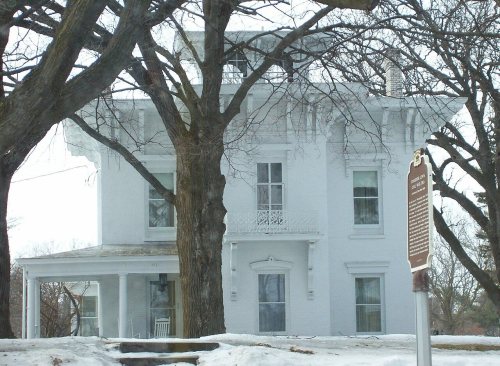
Columbus’ post office opened in 1846, and 34% of its homes were built before 1940
More historic than 97% of U.S. towns · #5 of 362 in Wisconsin. What drives it
20 places in town are on the National Register, among them four historic districts with 136 buildings between them. Below: 1 old photo or paper, maps from 1955 on, and the census since 1850.
Founding year: the first Columbus post office (Blevins & Helbock, CC0).The full story ↓
History grade
What drives Columbus’ History grade
On its age, its old homes and the National Register, Columbus is more historic than 97% of U.S. towns, #5 of 362 in Wisconsin. All 3 inputs are above most U.S. towns; its National Register listings ranks highest and its age lowest.
A+
HistoryA character grade: shown, never part of Columbus’ overall grade.
Wisconsin towns list more on the Register than most of the country (a typical Wisconsin town has 3.0 per 10,000 residents, the U.S. 2.4), so Columbus’ 284 sits above most of its state (98% of Wisconsin towns have fewer) while its 156 historic buildings outnumber those of 92% of U.S. towns.
How sure. Graded on any two of the three inputs instead, the letter would range from A to A+. The pre-1940 share is a Census survey estimate (±6.6 points). The founding year is the first post office, not a stated founding date.
Founding year: the first post office (other dates in Quick answers). Homes: Census ACS 2020–24. National Register: National Park Service, May 2026 list; each listing counted once (boundary changes and added documentation belong to their listing), and a historic district counts its contributing buildings. How TownRatings grades history →
What stands out about Columbus’ past
Read from the archive, the National Register and the record. The page puts what stands out first.
Before European settlement of the region, the area was territory of the Ho-Chunk Nation, who were the primary inhabitants of south-central Wisconsin, including the Columbus region. The Crawfish River was an important part of their trade. Sometimes, other tribes challenged the ownership over the region. For example, the Sauk and Meskwaki peoples.
The earliest European settlers of Columbus were Majors Elbert Dickason and Lewis Ludington, arriving in 1838 and 1839, respectively. Dickason, following military discharge from the Black Hawk War, returned in 1839 to find Lewis Ludington enjoying the same area of land that he had purchased through the government land office for $1.25 an acre.
Passages that mention Columbus, cut from the printed page as they were published.
The history of Columbia county, Wisconsin, containing an account of its settlement ..1880 · page 381Read the page →
Read the text
The Territorial Legislature in 1848, passed an act, approved March 6, of that year, temporarily locating the county seat at Columbus for the period of five years. The act declared : " That for the term of five years from, and after the passage of this act, the seat of justice of Columbia County shall be established at the village of Columbus, on section thirteen (13), township ten (10), range twelve (12), east; and all district courts to be held in and for said county, during said time, shall be held at the public schoolhouse in said village, until some other and more suitable place shall be provided for that purpose. The several county ofiices required by law, to be kept at the county seat, shall be removed to and kept at the said county seat as
Text read by machine from the scan; it may contain errors.
The history of Columbia county, Wisconsin, containing an account of its settlement ..1880 · page 676Read the page →
Read the text
The most important feature of the school history of Columbus is that embracing the free high-school system now in vogue. The act of February 26, 1874, incorporating the City of Columbus provided, among other things, for the establishment of a school system, which should be independent of the jurisdiction of the County Superintendent, and committing the educational interests of the city to a Board of Education whose duties and powers were prescribed- In the month of July following, the Common Council elected a Board of Education, and in the fall of 1874 the public schools were opened under the new -system. On the 5th of March, 1875, the Legislature enacted a general law authorizing the extablishment of free high schools. The city
Text read by machine from the scan; it may contain errors.
Scans and text from the Internet Archive. Books published in 1930 or earlier, which are in the public domain.
Timeline
Columbus, 1846 to 1960
Woven from the archive, old maps, post office records, the National Register and the people born here.
The Columbus post office opened in 1846, the earliest record of the town by name (U.S. post office records).
How does Columbus rank for history?
Columbus is more historic than 97% of U.S. towns, #5 of 362 in Wisconsin. The History grade combines the town’s founding era, the share of homes built before 1940 and its National Register listings. It’s a character grade, so it isn’t part of the overall grade. How it works.
What is on the National Register in Columbus?
20 listings: 16 buildings, among them the Columbus City Hall (listed 1979, the first), and 4 historic districts with 136 contributing buildings. 156 historic buildings in all.
How old are the homes in Columbus?
34% of Columbus’ homes were built before 1940 (Census estimate, ±6.6 points), against a typical 12% for a Wisconsin town; the median home was built in 1961.
Founding dates: Wikidata, Wikipedia, the U.S. post office records of Blevins & Helbock (CC0) and the Census. Homes by year built: Census ACS 2020–24. National Register of Historic Places: National Park Service (list of May 22, 2026). Old photos, postcards and papers: Wikimedia Commons, the Library of Congress and other public archives, credited on each item’s page. Maps: U.S. Geological Survey historical topographic maps (via Esri) and Sanborn fire-insurance maps (Library of Congress). History text and census tables: Wikipedia (CC BY-SA 4.0). Places that used to be: USGS Geographic Names Information System (2021).
From Wikimedia Commons (1), Wikidata (5), the National Register of Historic Places (20), Wikipedia, Wikidata and Wikipedia for famous people, U.S. Geological Survey historical maps, U.S. Census counts (via Wikipedia), the US Post Offices dataset (Blevins & Helbock), the USGS Geographic Names Information System and old county and town histories (Internet Archive). Archive images are copied here with their credits and licenses, shown on each photo’s page. Refreshed monthly.