Everett’s post office opened in 1891, and 16% of its homes were built before 1940
More historic than 70% of U.S. towns · #24 of 285 in Washington. What drives it
25 places in town are on the National Register, among them three historic districts with 103 buildings between them. Below: 6 old photos and papers, maps from 1892 on, and the census since 1900.
The Everett post office opened in 1891, the earliest record of the town by name. Two smaller post offices, Lowell (1871) and Pinehurst (1911), opened inside today’s city and later closed.
First census: 7,838 in 19002020 census: 110,629135 years
How historic is Everett?
B+
More historic than 70% of U.S. towns, on its age, its old homes and the National Register.
Founding year: the first Everett post office (Blevins & Helbock, CC0).The full story ↓
History grade
What drives Everett’s History grade
On its age, its old homes and the National Register, Everett is more historic than 70% of U.S. towns, #24 of 285 in Washington. Its National Register listings hold the grade up; its age pulls it down.
B+
HistoryA character grade: shown, never part of Everett’s overall grade.
Among the 400 U.S. cities of 100,000 or more, Everett ranks #171 on History.
Few Washington towns list much on the Register (a typical Washington town has 0.1 per 10,000 residents, the U.S. 2.4), so Everett’s 11.2 sits above most of its state (86% of Washington towns have fewer) while its 125 historic buildings outnumber those of 91% of U.S. towns.
How sure. Graded on any two of the three inputs instead, the letter would range from C+ to A−. The pre-1940 share (±1.4 points) is firm at this size. The founding year is the first post office, not a stated founding date.
Founding year: the first post office (other dates in Quick answers). Homes: Census ACS 2020–24. National Register: National Park Service, May 2026 list; each listing counted once (boundary changes and added documentation belong to their listing), and a historic district counts its contributing buildings. How TownRatings grades history →
What stands out about Everett’s past
Read from the archive, the National Register and the record. The page puts what stands out first.
National Park Service, National Register of Historic Places. Photos from Wikimedia Commons, credited on each place’s page.
Places that used to be
Lost post offices, old corners, places now gone and burying grounds
Everett’s post office has been open since 1891. Two other post offices opened and closed inside today’s town.
Lowell
1871–1962
Everett
1891–today
Pinehurst
1911–1962
18701950today
Hamlets and corners on the map
Broadway Terrace Mobile Home ParkCasino CornerCreekside Mobile Home ParkDarlingtonDelta JunctionEdgewaterEverett JunctionEverett Trailer CourtFairmontFairway Estates Senior Mobile Home ParkIntercityLago de Plata Villa Mobile Home ParkLoganberry Mobile Home ParkLowellMobile Country ClubPine Street Mobile Home ParkPinehurstSilver Shores Senior Mobile Home ParkWestridge Estates Mobile Home Park
Gone or out of use
Everett Pitmine
3cemeteries and burying grounds inside Everett
Cypress LawnEvergreenView Crest Abbey Mausoleum and Columbarium
US Post Offices dataset (Blevins & Helbock, CC0). Places and cemeteries from the USGS Geographic Names Information System (2021).
The earliest humans entered the Puget Sound region approximately 12,000 years before present after the recession of the Vashon Glacier. The earliest evidence of human habitation on the Port Gardner Peninsula dates back to approximately 2,000 years before present. The Snohomish people, who had many villages along the Snohomish River and around Possession Sound, had their principal settlement at Preston Point, known in the Lushootseed language as hibulb (pronounced HEE-bulb). The village of Hibulb, located below the bluff at the mouth of the Snohomish River, was one of the largest Snohomish settlements and the tribe's most important. It held considerable influence over other settlements and had the largest potlatch house in the Snohomish's territory; it was also heavily fortified by a large cedar palisade to deter attackers. The village also had four large cedar longhouses, each around 10…
Passages that mention Everett, cut from the printed page as they were published.
History of Snohomish County, Washington, Volume I1926 · page 415Read the page →
Read the text
Long before its incorporation, indeed, almost a year preceding the filing of the plat of the present townsite of Everett, population was pouring in from many directions, at first locating in the pioneer river-landing town of Lowell, whose townsite plat had been a matter of record since May 8, 1873, while the Everett plat was given a belated record in February, 1892, several other plats of what are now subdivisions of the townsite preceding it by several months. In the first week of January, 1892, Henry Hewitt paid into the county treasury $27,000 in taxes for the Everett Land Company, which was about half the assessed valuation of the
Text read by machine from the scan; it may contain errors.
History of Snohomish County, Washington, Volume I1926 · page 662Read the page →
Read the text
Grimm, as president and manager, Gilbert Qvale as vice president, Herman Steffen, ALG. Zeibell and J. A. Woolworth. The poultry people also have their own marketing association. .\ branch station of the Washington Cooperative Egg and Poultry Association is located at Everett and a receiving station of the same cooperative organization is located at .\lderwood Manor. The Everett station was started about five years ago as a receiving station, but the business grew rapidly and the receiving station was made into a branch station late in 1922. J. H. Guffy was the first manager of the branch station. The Alderwood Manor station was
Text read by machine from the scan; it may contain errors.
"Now there were coming into the city of Everett people representing this organization known as the Industrial Workers of the World. What was the propaganda that they were seeking to introduce there ? They put upon the stand their chief exponent in this part of the country, to tell you what their purpose was in coming to the city of Everett, and what the doctrines were that they were teaching to
Text read by machine from the scan; it may contain errors.
cular organization, so you can judge the character, purpose and intentions of the individuals that were seeking from time to time to force themselves into the city of Everett, in order that you may judge the two hundrd and sixty that left on the Verona on November the 5th.
Text read by machine from the scan; it may contain errors.
Scans and text from the Internet Archive. Books published in 1930 or earlier, which are in the public domain.
Timeline
Everett, 1871 to 1964
Woven from the archive, old maps, post office records, the National Register and the people born here.
Nothing in the archives for these yearsWeddings on Main Street, storms, parades, school pictures, the old store. If it’s in your family album, it belongs here.
Every edition of the U.S. Geological Survey’s map of Everett. Tap a year, or press play to watch the town change.
1944Everett sheet · 1:62,500
U.S. Geological Survey historical topographic maps (public domain), via Esri’s collection of the scans. The red ring marks the center of Everett.
Every building
Everett, building by building, 1892–1914
Fire insurance maps drew every building, what it was made of and what it was used for, so insurers could price the risk of fire. Pick a year, then a sheet.
The Everett post office opened in 1891, the earliest record of the town by name (U.S. post office records).
How does Everett rank for history?
Everett is more historic than 70% of U.S. towns, #24 of 285 in Washington. The History grade combines the town’s founding era, the share of homes built before 1940 and its National Register listings. It’s a character grade, so it isn’t part of the overall grade. How it works.
What is on the National Register in Everett?
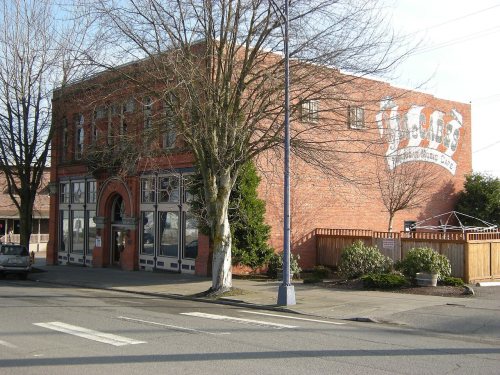
25 listings: 19 buildings, 3 historic districts, the Hewitt Avenue Historic District, the Swalwell Block and Adjoining Commercial Buildings and the Rucker Hill Historic District, with 103 contributing buildings, 1 site, and 1 structure. 125 historic buildings in all.
How old are the homes in Everett?
16% of Everett’s homes were built before 1940 (Census estimate, ±1.4 points), against a typical 4.3% for a Washington town; the median home was built in 1981.
Founding dates: Wikidata, Wikipedia, the U.S. post office records of Blevins & Helbock (CC0) and the Census. Homes by year built: Census ACS 2020–24. National Register of Historic Places: National Park Service (list of May 22, 2026). Old photos, postcards and papers: Wikimedia Commons, the Library of Congress and other public archives, credited on each item’s page. Maps: U.S. Geological Survey historical topographic maps (via Esri) and Sanborn fire-insurance maps (Library of Congress). History text and census tables: Wikipedia (CC BY-SA 4.0). Places that used to be: USGS Geographic Names Information System (2021).
From Wikimedia Commons (6), the National Register of Historic Places (24), Wikipedia, Wikidata and Wikipedia for famous people, U.S. Geological Survey historical maps, U.S. Census counts (via Wikipedia), the US Post Offices dataset (Blevins & Helbock), the USGS Geographic Names Information System, Sanborn fire insurance maps (Library of Congress) and old county and town histories (Internet Archive). Archive images are copied here with their credits and licenses, shown on each photo’s page. Refreshed monthly.




 1891
 1892
 1892
 1892
 1892


