Founding year: Wikipedia. First post office: 1836.
History grade
What drives Suffield’s History grade
On its age, its old homes and the National Register, Suffield is more historic than 42% of U.S. towns. Its age holds the grade up; its National Register listings pull it down.
C+
HistoryA character grade: shown, never part of Suffield’s overall grade.
Ohio towns list about as much on the Register as the country (a typical Ohio town has 2.9 per 10,000 residents, the U.S. 2.4), so Suffield’s 0.0 sits below most of its state (23% of Ohio towns have fewer) while its 0 listings outnumber those of 23% of U.S. towns.
NoteThe founding year comes from Wikipedia alone; no second source gives 1802.
How sure. Graded on any two of the three inputs instead, the letter would range from C− to B. The pre-1940 share is a Census survey estimate (±6.4 points).
Founding year: Wikipedia (other dates in Quick answers). Homes: Census ACS 2020–24. National Register: National Park Service, May 2026 list; each listing counted once (boundary changes and added documentation belong to their listing), and a historic district counts its contributing buildings. How TownRatings grades history →
What stands out about Suffield’s past
Read from the archive, the National Register and the record. The page puts what stands out first.
Wikipedia doesn’t have a history of Suffield yet. The photos, dates and memories neighbors add here are how it gets written.
Suffield Township is one of the eighteen townships of Portage County, Ohio, United States. The 2020 census found 5,973 people in the township. Suffield was founded in 1802 and formally organized in 1818. It is best known as being the home of the Wingfoot Lake Airship Hangar, which serves as the operations center for the Goodyear Blimps and the home base for the semi-rigid airship Wingfoot One.
Suffield was established in 1802.
Intro from Wikipedia. Population: U.S. Census Bureau.
From the old history books
What they wrote about Suffield in 1885
Passages that mention Suffield, cut from the printed page as they were published.
History of Portage County, Ohio1885 · page 565Read the page →
Read the text
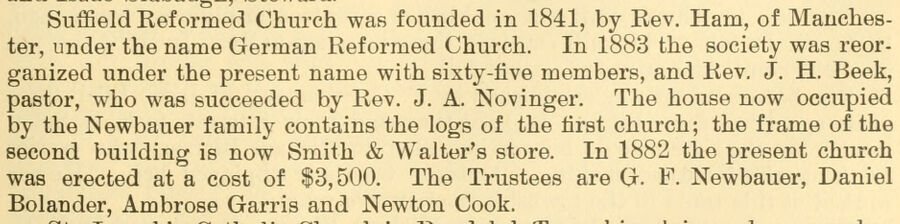
Suffield Reformed Church was founded in 1841, by Rev. Ham, of Manchester, under the name German Reformed Church. In 1883 the society was reorganized under the present name with sixty-five members, and Rev. J. H. Beek, pastor, who was succeeded by Rev. J. A. Novinger. The house now occupied by the Newbauer family contains the logs of the first church; the frame of the second building is now Smith & Walter's store. In 1882 the present church was erected at a cost of $3,500. The Trustees are G. F. Newbauer, Daniel Bolander, Ambrose Garris and Newton Cook.
Text read by machine from the scan; it may contain errors.
History of Portage County, Ohio1885 · page 237Read the page →
Read the text
"In the southwestern corner of the county a settlement was made in May, 1802, by Royal Pease, a native of Suffield, Conn., who owned a considerable portion of the land comprised in the township now known as Suffield. Pease settled on what is now known as the Kent Farm, and made a clearing, built a cabin and put out a crop of wheat. This old pioneer remained alone at his settlement for nearly a year, but the following spring after his arrival Benjamin Baldwin made his appearance, and soon after him David Way and family. In 1804 John Fritch, a Pennsylvania German, located at the little
Text read by machine from the scan; it may contain errors.
Scans and text from the Internet Archive. Books published in 1930 or earlier, which are in the public domain.
By decade
No old photos in the archives yet
Weddings on Main Street, storms, parades, school pictures, the old store. If it’s in your family album, it belongs here.
Be the first to add onePhotograph a print flat, in daylight, no flash.
In 1802, according to Wikipedia’s history of the town. Suffield’s post office opened in 1836.
How does Suffield rank for history?
Suffield is more historic than 42% of U.S. towns. The History grade combines the town’s founding era, the share of homes built before 1940 and its National Register listings. It’s a character grade, so it isn’t part of the overall grade. How it works.
How old are the homes in Suffield?
7% of Suffield’s homes were built before 1940 (Census estimate, ±6.4 points), against a typical 15% for an Ohio town; the median home was built in 1974.
Founding dates: Wikidata, Wikipedia, the U.S. post office records of Blevins & Helbock (CC0) and the Census. Homes by year built: Census ACS 2020–24. National Register of Historic Places: National Park Service (list of May 22, 2026). Old photos, postcards and papers: Wikimedia Commons, the Library of Congress and other public archives, credited on each item’s page. Maps: U.S. Geological Survey historical topographic maps (via Esri) and Sanborn fire-insurance maps (Library of Congress). History text and census tables: Wikipedia (CC BY-SA 4.0). Places that used to be: USGS Geographic Names Information System (2021).
From old county and town histories (Internet Archive). Archive images are copied here with their credits and licenses, shown on each photo’s page. Refreshed monthly.