1 place in town is on the National Register, among them a historic district with 175 buildings. Below: 6 old photos and papers, maps from 1898 on, and the census since 1810.
Founding year: Wikidata; Wikipedia’s history section gives the same year. First post office: 1813.The full story ↓
History grade
What drives Lisbon’s History grade
On its age, its old homes and the National Register, Lisbon is more historic than 98% of U.S. towns. All 3 inputs are above most U.S. towns; its share of homes from before 1940 ranks highest and its age lowest.
A+
HistoryA character grade: shown, never part of Lisbon’s overall grade.
Ohio towns list about as much on the Register as the country (a typical Ohio town has 2.9 per 10,000 residents, the U.S. 2.4), so Lisbon’s 618 sits above most of its state (99% of Ohio towns have fewer) while its 175 historic buildings outnumber those of 92% of U.S. towns.
How sure. Graded on any two of the three inputs instead, the letter would range from A to A+. The pre-1940 share is a Census survey estimate (±7.0 points). Two sources give 1803.
Founding year: Wikidata (other dates in Quick answers). Homes: Census ACS 2020–24. National Register: National Park Service, May 2026 list; each listing counted once (boundary changes and added documentation belong to their listing), and a historic district counts its contributing buildings. How TownRatings grades history →
What stands out about Lisbon’s past
Read from the archive, the National Register and the record. The page puts what stands out first.
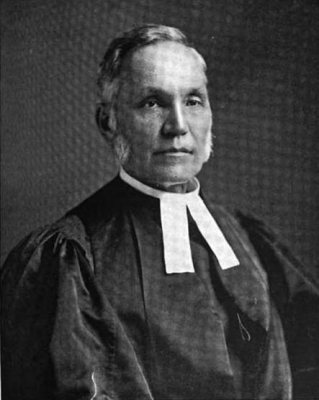
The village was platted on February 16, 1803, by Baptist minister Lewis Kinney and originally named New Lisbon after Lisbon, Portugal. It was incorporated under a special act of legislature on February 7, 1825, and was renamed to Lisbon in 1895.
Initially known for its iron and whiskey production, Lisbon grew into a diverse economic hub during the Industrial Revolution and became one of the largest towns along the Sandy and Beaver Canal. During this period, it was home to the county's first bank, the Columbiana Bank of New Lisbon; its first insurance company, and Ohio's first newspaper, The Ohio Patriot, founded by Alsatian immigrant William D. Lepper and printed from 1809 to 1833.
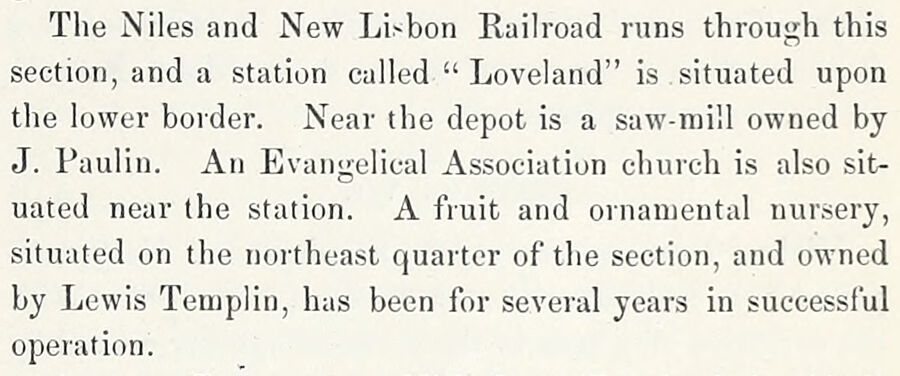
The Niles and New Lisbon Railroad runs through this section, and a station called “Loveland” is. situated upon the lower border. Near the depot is a saw-mill owned by J. Paulin. An Evangelical Association church is also situated near the station. A fruit and ornamental nursery, situated on the northeast quarter of the section, and owned by Lewis Templin, has been for several years in successful operation.
Text read by machine from the scan; it may contain errors.
a souvenir history of the old village of new lisbon, ohio and the old town of salem, ohio1903Read the page →
Read the text
1837 caused a suspension of the work and it was not completed until 1846, the first boat from the east, under command of Captain Dunn, reaching New Lisbon on October 26th of that year. The arrival was hailed with great rejoicing, a jubilee meeting was held at Hanna’s warehouse, at which New Lisbon’s most eloquent attorney made an appropriate speech on behalf of the citizens. to which
Text read by machine from the scan; it may contain errors.
a souvenir history of the old village of new lisbon, ohio and the old town of salem, ohio1903Read the page →
Read the text
the leader of the class. In 1821 Samuel Brockonier, of the Beaver circuit of the Methodist Episcopal church, preached at Salem. The circuit was afterwards changed to New Lisbon, then to Hanover, Lima and Salem respectively. In 1852, petition being made to the conference, Salem was made a separate station, with Rev.
Text read by machine from the scan; it may contain errors.
History of Salem and the immediate vicinity1898 · page 83Read the page →
Read the text
Schooley became a convert, and, for many years, preached the new faith. A few were gathered into a congregation and a church was organized and met in a log building on the Lisbon road about a mile and a-half out from Salem. Subsequently a new church was built on the site of the present Phillips church, on the Lisbon road."
Text read by machine from the scan; it may contain errors.
Scans and text from the Internet Archive. Books published in 1930 or earlier, which are in the public domain.
Timeline
Lisbon, 1803 to 1990
Woven from the archive, old maps, post office records, the National Register and the people born here.
Nothing in the archives for these yearsWeddings on Main Street, storms, parades, school pictures, the old store. If it’s in your family album, it belongs here.
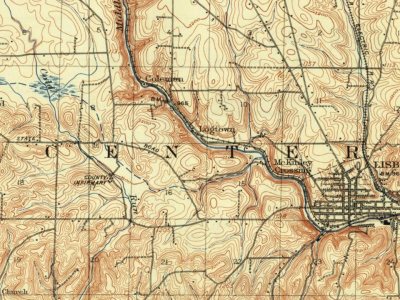
Every edition of the U.S. Geological Survey’s map of Lisbon. Tap a year, or press play to watch the town change.
1909Lisbon sheet · 1:62,500
U.S. Geological Survey historical topographic maps (public domain), via Esri’s collection of the scans. The red ring marks the center of Lisbon.
Every building
Lisbon, building by building, 1898–1915
Fire insurance maps drew every building, what it was made of and what it was used for, so insurers could price the risk of fire. Pick a year, then a sheet.
In 1803, according to Wikidata and Wikipedia’s history of the town. Lisbon’s post office opened in 1813, and the census of 1810 counted 303 people here.
How does Lisbon rank for history?
Lisbon is more historic than 98% of U.S. towns. The History grade combines the town’s founding era, the share of homes built before 1940 and its National Register listings. It’s a character grade, so it isn’t part of the overall grade. How it works.
What is on the National Register in Lisbon?
One place: the Lisbon Historic District (listed 1979).
How old are the homes in Lisbon?
49% of Lisbon’s homes were built before 1940 (Census estimate, ±7.0 points), against a typical 15% for an Ohio town; the median home was built in 1941.
Founding dates: Wikidata, Wikipedia, the U.S. post office records of Blevins & Helbock (CC0) and the Census. Homes by year built: Census ACS 2020–24. National Register of Historic Places: National Park Service (list of May 22, 2026). Old photos, postcards and papers: Wikimedia Commons, the Library of Congress and other public archives, credited on each item’s page. Maps: U.S. Geological Survey historical topographic maps (via Esri) and Sanborn fire-insurance maps (Library of Congress). History text and census tables: Wikipedia (CC BY-SA 4.0). Places that used to be: USGS Geographic Names Information System (2021).
From Wikimedia Commons (6), the National Register of Historic Places (1), Wikipedia, Wikidata and Wikipedia for famous people, U.S. Geological Survey historical maps, U.S. Census counts (via Wikipedia), the US Post Offices dataset (Blevins & Helbock), the USGS Geographic Names Information System, Sanborn fire insurance maps (Library of Congress) and old county and town histories (Internet Archive). Archive images are copied here with their credits and licenses, shown on each photo’s page. Refreshed monthly.







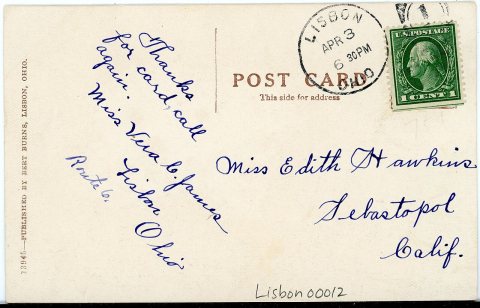 1914
 1915
 1915
 1915