Founding year: the first Galion post office (Blevins & Helbock, CC0).The full story ↓
History grade
What drives Galion’s History grade
On its age, its old homes and the National Register, Galion is more historic than 92% of U.S. towns, #126 of 993 in Ohio. All 3 inputs are above most U.S. towns; its share of homes from before 1940 ranks highest and its age lowest.
A
HistoryA character grade: shown, never part of Galion’s overall grade.
Ohio towns list about as much on the Register as the country (a typical Ohio town has 2.9 per 10,000 residents, the U.S. 2.4), so Galion’s 10.6 sits above most of its state (75% of Ohio towns have fewer) while its 11 historic buildings outnumber those of 76% of U.S. towns.
How sure. Graded on any two of the three inputs instead, the letter would range from A− to A. The pre-1940 share is a Census survey estimate (±5.2 points). The founding year is the first post office, not a stated founding date.
Founding year: the first post office (other dates in Quick answers). Homes: Census ACS 2020–24. National Register: National Park Service, May 2026 list; each listing counted once (boundary changes and added documentation belong to their listing), and a historic district counts its contributing buildings. How TownRatings grades history →
What stands out about Galion’s past
Read from the archive, the National Register and the record. The page puts what stands out first.
The region was first inhabited by Native American tribes up until the first settlers, Benjamin Leveridge and his two sons, arrived in 1817. In 1820, William Hosford and his two sons, Asa and Horace, settled on land outside of the area. It was not until Colonel James Kilbourne decided to "lay out a town half way between Columbus and the Lakes" that the crossroads of Portland and Main street were settled by the Hosford family. This crossing was known by various names including: Moccasin, Horseshoe, Hard Scrabble, Spang Town, Hosfords and Goshen. Galion was laid out in 1831. However, in 1824 the town petitioned for a post office using the name Goshen and later changed to Galion by the postmaster general, John McLean, due to a town already being named Goshen in Ohio. The etymology of the name Galion is uncertain. A post office called Galion has been in operation since 1825.
Passages that mention Galion, cut from the printed page as they were published.
History of Crawford County, Ohio1912 · page 416Read the page →
Read the text
name in Clermont county- So the postmaster general wrote them it would only add to the confusion existing by establishing another Goshen and suggested the name of Galion. And on June 24, 1825, the Galion post office was established with Horace Hosford as postmaster. Just as the settlement was known by several names, so was the post office given
Text read by machine from the scan; it may contain errors.
History of Crawford County, Ohio1912 · page 307Read the page →
Read the text
arrived in the year previous. It was located at the springs, not far from the home of the Levendges. Besides the Hibner grist-mill, north of Galion was a saw-mill, while Hosford's and Park's grist-mills and Sharrocks' grist and saw-mill were all located on the banks of the stream south of Galion and within a few miles of each other. Modern "im-
Text read by machine from the scan; it may contain errors.
History of Crawford County and Ohio1881 · page 454Read the page →
Read the text
The authority ujjon which this association is as follows: We, the undersigned residents and citizens of the incorporated village of Galion, Ohio, to wit, James H. Green, J. G. Meuser, S. G. Cummingg, Henry Nau and C. Ernst Klopp, desiring to organize a company for the purpose of raising moneys to be loaned among the members of such company for use in buying lots, or
Text read by machine from the scan; it may contain errors.
History of Crawford County and Ohio1881 · page 454Read the page →
Read the text
The authority upon which this association is founded is as follows: We, the undersigned residents and citizens of the incorporated village of Galion, Ohio, to wit, James H. Green, J. G. Meuser, S. G. Cummings, Henry Nau and C. Ernst Klopp, desiring to organize a company for the purpose of raising moneys to be loaned among the members of such company for use in buying lots, or
Text read by machine from the scan; it may contain errors.
Scans and text from the Internet Archive. Books published in 1930 or earlier, which are in the public domain.
By decade
Galion, decade by decade
3 decades in the archive, from the 1890s to the 1980s. Scroll each row; tap a photo for its story.
Nothing in the archives for these yearsWeddings on Main Street, storms, parades, school pictures, the old store. If it’s in your family album, it belongs here.
Nothing in the archives for these yearsWeddings on Main Street, storms, parades, school pictures, the old store. If it’s in your family album, it belongs here.
The Galion post office opened in 1825, the earliest record of the town by name (U.S. post office records).
How does Galion rank for history?
Galion is more historic than 92% of U.S. towns, #126 of 993 in Ohio. The History grade combines the town’s founding era, the share of homes built before 1940 and its National Register listings. It’s a character grade, so it isn’t part of the overall grade. How it works.
What is on the National Register in Galion?
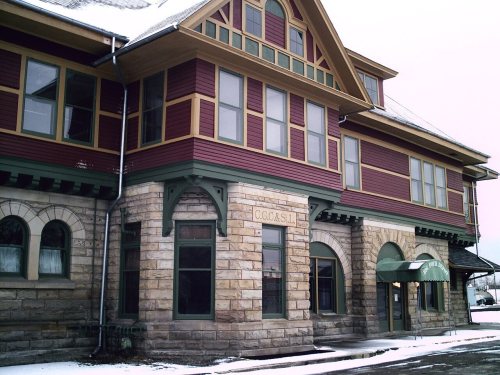
4 listings: 4 buildings, among them the Big Four Depot (listed 1975, the first). 11 historic buildings in all.
How old are the homes in Galion?
31% of Galion’s homes were built before 1940 (Census estimate, ±5.2 points), against a typical 15% for an Ohio town; the median home was built in 1956.
Founding dates: Wikidata, Wikipedia, the U.S. post office records of Blevins & Helbock (CC0) and the Census. Homes by year built: Census ACS 2020–24. National Register of Historic Places: National Park Service (list of May 22, 2026). Old photos, postcards and papers: Wikimedia Commons, the Library of Congress and other public archives, credited on each item’s page. Maps: U.S. Geological Survey historical topographic maps (via Esri) and Sanborn fire-insurance maps (Library of Congress). History text and census tables: Wikipedia (CC BY-SA 4.0). Places that used to be: USGS Geographic Names Information System (2021).
From Wikimedia Commons (5), the Library of Congress (1), the National Register of Historic Places (4), Wikipedia, Wikidata and Wikipedia for famous people, U.S. Geological Survey historical maps, U.S. Census counts (via Wikipedia), the US Post Offices dataset (Blevins & Helbock), the USGS Geographic Names Information System and old county and town histories (Internet Archive). Archive images are copied here with their credits and licenses, shown on each photo’s page. Refreshed monthly.


 2009
 2007
 2001